Endless Devotion
A first reaction to the deluxe new siddur or prayer book recently issued in a Hebrew-English edition by Koren Publishers is that, at 1,244 handsomely printed, imitation stamped-leather-bound pages, it is a bit hefty to be carried to synagogue on the Sabbath by the Orthodox users for whom it is primarily intended. To be sure, the ArtScroll Siddur, with which it is meant to compete, has only 200 fewer pages and, printed on thicker paper, is as bulky. But the ArtScroll, the standard siddur of most American Orthodox synagogues since its publication in 1989, is already on their shelves. The Koren Siddur must be brought by the congregant—at least until it gains a place on those shelves too, as its publishers clearly hope that it will.
The Koren is large because, like the ArtScroll, it has facing English text and English commentary at the bottom of its pages, both the work of its editor, Great Britain’s distinguished Chief Rabbi Sir Jonathan Sacks; a spatially generous layout less cluttered than the ArtScroll’s, and a comprehensiveness at least as great. Besides the regular weekday morning, afternoon, and evening services, and their Sabbath and holiday variations, which (with the exception of the long Rosh Hashanah and Yom Kippur liturgies) are found in any traditional siddur, the Koren includes numerous items that usually are not. Some of these are for holiday-related occasions like bi’ur chametz, the declaring of a house free of unleavened food before Passover, or ushpizin, the welcoming of the biblical patriarchs said by Jewish legend to visit on Sukkot; others belong to life-cycle rituals such as pidyon ha-ben, the redemption of a first-born son, or the confession before death. In addition, the Koren has a lengthy introduction by Sacks, the text of all Torah readings for weekday and holiday mornings, a prayer calendar of the Jewish year, a digest of rules and regulations pertaining to Jewish prayer, and a “Halakhic Guide To Prayer For Visitors To Israel,” where some customs differ from the Diaspora’s. It adds up.
Of course, Jewish liturgy itself has kept adding up over the centuries, continually growing from its earliest origins. These go back, if not as far as is claimed by rabbinic tradition, which ascribes them to Abraham, Isaac, and Jacob, considerably farther than they are held to by the common misconception that Jewish communal worship is largely a post-Second Temple institution, a response to the abrogation of the priestly sacrifices after the Temple’s destruction by the Romans in 70 C.E. There are passages in the siddur that would seem to support this view, such as this one from the morning service:
Now, because of our sins, the Temple is destroyed and the daily sacrifice discontinued, and we have no priest at his service, no Levite on his platform, no Israelite at his post …Therefore, may it be Your will, Lord our God and God of our ancestors, that the prayer of our lips be considered, accepted and favored before You as if we had offered the daily sacrifice at its appointed time and place, according to its laws.
(All translations are taken from the Koren Siddur)
Yet in actuality, the synagogue was central to Jewish life long before the Temple’s destruction and for centuries coexisted with the sacrifices from which it sprang. Its revolutionary significance was pointed out by the German-Jewish historian Ismar Elbogen in his magisterial 1923 study, The Jewish Liturgy and Its Historical Development:
…it was the first time in human history that regular assemblies for worship were held at sites that had no other sanctity than what was bestowed upon them by the community of the faithful. It was a liturgy that freed itself from the practices theretofore customary among all peoples, relinquishing all such accessories as sacrifices and other offerings and intermediation by priests, and placing man and his spiritual life at the center of the liturgy. It is the same kind of liturgy as came to prevail in the European religions, and thus became familiar to all of civilized humanity.
As Elbogen observes, Christianity and Islam took not just the “forms” of regular prayer from Judaism but the very idea of it. Paradoxically, however, it was the supreme importance to biblical Judaism of animal sacrifice in the Temple that led to this idea’s development. This was because, by the time the First Temple was razed by the Babylonians in the sixth century B.C.E., all sacrifice to the God of Israel on altars other than the Temple’s had been stamped out in the name of the Temple’s exclusivity. Worshipers living far from Jerusalem, whether in Palestine or in exile in Babylonia, were compelled to find alternate modes of religious behavior. The two they settled on were public readings from the Torah on Sabbaths, holidays, and the Jewish market days of Monday and Thursday, when rural residents flocked to towns, and prayer gatherings held at the hours at which Temple sacrifice took place, originally conceived of as vicarious participations in sacrifice rather than as substitutes for it.
These gatherings began in Second Temple times with members of the priestly caste in Palestine, which sent semi-annual delegations from outlying districts to Jerusalem to assist for a week in the sacrificial ministrations. Since not all priests could join these missions, those staying behind expressed their identification with those making the journey by sessions of daily worship synchronized with the morning and afternoon sacrifices and the evening locking of the Temple’s gates. When, eventually, these sessions were opened to the general public, made year-round and combined with readings from the Torah, Jewish prayer as we now know it emerged. By the time of the redaction of the Mishnah over a hundred years after the Second Temple’s destruction, the core of the three daily services of shacharit, mincha, and ma’ariv was nearly the same as it is today.
This core included basic prayers well-known even to many non-observant Jews, such as the shema yisrael, the “Hear O Israel,” and the amida or shemoneh esrei, the silent “standing prayer” or “Eighteen Benedictions” (so called because its weekday version had eighteen—later enlarged to nineteen—repetitions of the formula “Blessed are You, Lord”). Numerous other familiar prayers, however, only came later. Until the eighth or ninth century, when the siddur (the Hebrew word means “ordering,” that is, the ordering of the liturgy) was first committed to writing, the daily, weekly, and holiday services had to be brief enough to be memorized, if not by the congregation, at least by its leader, to whose recitations it answered “Amen.” Only once a written siddur existed was it possible to add new prayers freely, the sole limit on them being the congregation’s time and patience.
It was then that the siddur’s long period of expansion commenced. The hymn adon olam, “Lord of the Universe,” for example, which opens the daily shacharit and—heartily sung to a variety of melodies, the oldest originally a 17th-century German drinking song—concludes the Sabbath and holiday additional service or musaf, is attributed to the 11th-century Hispano-Hebrew poet Shlomo ibn Gabirol. The solemn aleinu le-shabe’ach, “It is Our Duty to Praise,” the coda of all three daily services, was restricted to the High Holidays until roughly 1300. This is also approximately when the mourner’s kaddish entered the liturgy (other forms of the kaddish are older), while the favorite Sabbath hymn lekha dodi was composed by the 16th-century Palestinian kabbalist Shlomo Alkabetz. Part of the prayer for the state of Israel recited by many congregations today derives from 19th-century prayers by European Jews for their governments. A siddur inherited by me from my father, printed in Vilna in 1909, asks God to “protect, assist, elevate, exalt, and raise high our lord Tsar Nikolai Alexandrovitsh, his wife the esteemed Tsarina Alexandra Fyedorovna, his mother the esteemed Tsarina Maria Fyederovna, and the crown prince Alexei Nikolayevitsh, along with all the royal family, long may it live in glory.”
The siddur is thus not a single text but a compilation of texts, differing (although generally only slightly) from one part of the Jewish world to the next. Until the first attempts to streamline it were made by the German Reform movement in the early nineteenth century, it never stopped absorbing new hymns, poems, biblical and rabbinic passages, doxologies, confessional formulas, and pleas for divine aid and intercession. Its original order became a disorder that still seemed orderly to Jewish worshipers because anything repeated day after day, year after year, and century after century, will be perceived by those who repeat it as the natural—indeed, the only conceivable—way of doing things.
Nevertheless, the original core of Jewish prayer is still intact and tightly structured. Located some two-thirds of the way through shacharit, it begins with the barkhu or “Bless ye,” a call to worship that once marked the morning service’s commencement, just as it still does that of the evening service:
Prayer leader: Bless the Lord, the blessed One!
Congregation: Bless the Lord the blessed One, for ever and all time!
Prayer leader: Bless the Lord the blessed One, for ever and all time!
Anyone familiar with the traditional synagogue service knows the feeling of snapping to attention that the barkhu produces. Until now the congregation has behaved like an undisciplined aggregate, some of its members barely moving their lips as they pray, others whispering, murmuring, or declaiming the words out loud; some keeping up with the prayer leader and some not; the latecomers striving to catch up with the earlier arrivals; no one paying much heed to anyone else. With the barkhu, the atmosphere changes. The prayer leader takes command; his chant grows louder and more emphatic; the congregation becomes a single body and responds in unison. The barkhu still functions as a call to prayer, even if those called by it have been praying for quite a while.
From the barkhu, the shacharit proceeds to the yotzer, a paean to God, the creator of light, who “great in knowledge, prepared and made the rays of the sun.” This section builds up to a description of the different orders of God’s angels chanting His praises in words taken from the epiphanies of the prophets Isaiah and Ezekiel:
All accept on themselves,
one from another,
the yoke of the kingdom of heaven,
granting permission to one another
to sanctify the One who formed them,
in serene spirit, pure speech and sweet melody.
All, as one,
proclaim His holiness
saying in awe:
Holy, holy, holy is the Lord of hosts:
the whole world is filled with His glory!
Then the Ophanim and the Holy Hayot,
with a roar of noise,
raise themselves toward the Seraphim and,
facing them, give praise, saying:
Blessed be the Lord’s glory from His place!
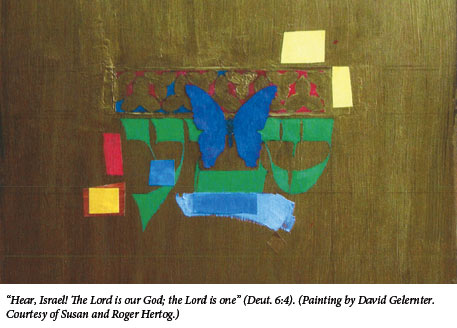
From here the service proceeds to the bocher be-amo yisrael be-ahava, a prayer thanking God for His love in choosing Israel; next, to the tripartite “Hear, O Israel,” Judaism’s great declaration of faith that adonai eloheinu, adonai echad, “the Lord is our God, the Lord is One”; then to the ga’al yisrael, the theme of God’s salvation as evinced by the parting of the Red Sea; and on to the silently recited Eighteen Benedictions—which, as explained by Sacks in emphasizing the numerical “fractals” of the liturgy, repeat the triads that have preceded them with “three blessings of praise at the beginning … three of acknowledgment at the end,” and in between, “six individual requests, followed by six collective ones, each divided into two groups of three.”
The climax of this progression comes in the prayer leader’s repetition of the Eighteen Benedictions, now recited aloud with the addition of the kedusha or “Holiness.” In it, the congregation rises and the prayer leader intones:
We will sanctify Your name on earth,
as they [the angels] sanctify it in the highest
heavens, as is written by Your prophet,
“And they call to one another saying:
Congregation: Holy, holy, holy is the Lord ofhosts, the whole world is filled with His glory!”
Those facing him say “Blessed –”
Prayer Leader: Holy, holy, holy is the Lord ofhosts, the whole world is filled with His glory!” Those facing them say “Blessed –”
Congregation: “Blessed is the Lord’s glory from His place.”
Kadosh, kadosh, kadosh: the prophet Isaiah’s three “holies” are customarily exclaimed while rising with each on the balls of one’s feet, as if the congregation were a throng of angels seeking to catch a glimpse of God’s throne over the heads of those in front of it. It is, as Jonathan Sacks writes in his thoughtful introduction, a moment of “astonishing drama.” Angels and men in rabbinic midrash are often portrayed as rivals, men striving for the angels’ closeness to God, angels jealous of God’s fascination with men, and there is an undercurrent of this competition in the morning prayer, which describes [His] ministering angels,
all of whom stand in the universe’s heights,
proclaiming together,
in awe, aloud,
the words of the living God, the eternal King.
They are all beloved, all pure, all mighty,
and all perform in awe and reverence the will of their Maker.
All open their mouths in holiness and purity,
With song and psalm,
And bless, praise, glorify,
revere, sanctify and declare the sovereignty of [God]
What mortal can vie with such creatures of perfection? Yet in the kedusha, men and angels join together, serenading God with the same words. As it is above, so it is below. For a brief moment every morning, the universe is unified as it was at the time of its creation, of which shacharit is a recurring commemoration.
It is wonderfully poetic—even more so in Hebrew, to which Sacks’ English does not always do full justice.
Often, it does. “Bless the Lord, the blessed One” for barkhu et adonai ha-mevorakh, with its response of “Bless the Lord, the blessed One, for ever and all time” for barukh adonai ha-mevorakh le-olam va-ed, strikes just the right note. How easy it is to strike a wrong one can be seen from the ArtScroll’s “Bless Hashem, the blessed One” / “Blessed is Hashem, the blessed One, for all eternity”; the United Synagogue of Conservative Judaism’s Siddur Sim Shalom’s “Praise the Lord, Source of Blessing” / “Praised be the Lord, Source of blessing, throughout all time”; and the Reform movement’s Mishkan T’filah’s “Praise Adonai to whom praise is due!” / “Praised be Adonai to whom praise is due, now and forever!”
All three of these are ill-conceived, each in a way that is characteristic of its denomination of Judaism. “Hashem”—literally, “the Name”—is a Hebrew circumlocution commonly used by Orthodox Jews in obedience to the biblical prohibition on taking God’s name in vain; as a rendition of adonai, “Lord,” in the barkhu, it suggests that a translated Hebrew prayer is a vain thing itself. Sim Shalom’s “Praise” instead of “Bless,” coupled with “Source of Blessing” (an epithet for God borrowed from the 13th-century kabbalist Bahya ben Asher) in place of “the blessed One,” are meant to sidestep the question of how God can be blessed by man; yet a good translation transmits questions (this one already embedded in the language of the Bible), it does not conceal them. Mishkan T’filah, which also bowdlerizes blessing to praising, seeks a bold immediacy by going to the opposite extreme from the ArtScroll and incorrectly treating adonai as if it were the name of God rather than a translatable Hebrew word for God. The Koren alone is faithful to the barkhu’s gravity and simplicity.
In other places, however, the Koren seems wrong, too. “With a roar of noise” for Ezekiel’s be-kol ra’ash gadol—literally, “with a great sound of noise”—is clunky. It evokes a revved car engine more than the clamor of angels. Although the King James Bible’s “with a noise of a great rushing” may also leave something to be desired, it at least calls to mind waterfalls, not exhaust pipes.
On the whole, Sacks makes little attempt to reproduce the siddur’s poetry. Take the lines in the yotzer beginning with “[His] ministering angels.” In Hebrew they are:
Va-asher meshartav kulam omdim be-rum olam
u-mashmi’im be-yir’ah yachad be-kol
divrei elohim chayim u-melekh olam.
Kulam ahuvim, kulam b’rurim, kulam giborim,
Ve-khulam osim be-eimah u-veyir’ah retzon konam.
Ve-khulam potchim et pihem bi-kedusha
u-vetahara
be-shirah u-vezimrah, u-mevarkhim
u-meshabchim u-mefa’arim
u-ma’aritzim u-makdishim u-mamlikhim
Like all good poetry, this passage depends on its fusion of sense and sound—that is, of its chorus of singing angels and its humming Hebrew mem. This consonant already dominates the first line, whose last four words end with it. Lines 1, 3, and 5 rhyme in am—twice in olam, “world” or “universe,” and once in konam, “their Maker”—while the same syllable occurs three more times in kulam, “all.” Even more insistent is –im, the masculine plural ending of Hebrew nouns and present-tense verbs, which is repeated 15 times, reaching a crescendo in the concluding “bless, praise, glorify, revere, sanctify, and declare the sovereignty of [God],” all double-memed verbs that, culminating in the triple mem of mamlikhim, swell like a grand musical chord.
The translation in the Koren Siddur conveys none of this. Yet Sacks was wise, I think, not to attempt it—and not only because the task might well have been beyond him, or anyone. Even Orthodox Jews who do not completely understand the siddur’s Hebrew are not, after all, going to recite the shacharit in English. Their God expects them to worship Him in Hebrew alone. It is, as it were, His native tongue in which He converses with His angels, and He appreciates the effort to speak to Him in it, however lamely. Sacks’ translation is not meant to be prayed in, nor is it aimed at creating a literary equivalent that would vie with the Hebrew and draw attention away from it. It is there solely as an aid to understanding the Hebrew, a kind of interlinear (though not printed that way) gloss. This is also the logic behind its counter-intuitive printing of the right-to-left-written Hebrew on each left-hand page and the left-to-right-written English on each right-hand page, thus arranging the two languages back-to-back rather than face-to-face. As explained on the Koren Siddur website, this placement is meant to allow the Hebrew and English texts “to align at the center of the Siddur,” so that, as both “flow to the margins,” they are symmetrical and more easily compared.
But are even Orthodox worshipers who fully understand the shacharit’s Hebrew moved by its poetry or drama? An outside observer might be permitted to doubt it. Although these worshipers may show a bit of emotion in the shema (drawing out the last syllable of echad as did the martyred Rabbi Akiva who, exclaiming it as he was tortured to death by the Romans, “lingered on ‘One’ and surrendered his soul with it”), and may raise their voices for the “holy, holy, holy” of the kedusha, they then take their seats again and help the prayer leader hasten through the rest of the service with a half-swallowed “Blessed is He, blessed is His name” after each “Blessed are you, O Lord” and a quick “Amen” at its end.
They have reason to hurry. Most are men with jobs to get to and have already been praying for close to half an hour, having managed to recite before the barkhu—to give a partial list—the blessings for donning their tallitot and tefillin; a lengthy passage from the Book of Exodus; the adon olam; the yigdal, a versification of the thirteen dogmatic beliefs declared by Maimonides to be incumbent on every Jew; the fourteen “Blessings of the Dawn”; a passage from the Book of Genesis; long descriptions of the daily sacrifices from the Pentateuch; a section of the Mishnah detailing the ingredients and preparation of the k’toret, the incense burned in the Temple; more long descriptions of sacrifices; the thirteen logical principles by which the Mishnaic sage Rabbi Yishma’el taught that the Torah should be expounded; a non-mourner’s kaddish; for those in mourning, a mourner’s kaddish; a dozen different Psalms and compilations of verses from the Book of Psalms; excerpts from the Books of Chronicles and Nehemiah; the prophetess Miriam’s song about crossing the Red Sea in the Book of Exodus, and another non-mourner’s kaddish.
Nor are the Eighteen Benedictions the end. Still to come are the tachanun or plea for God’s forgiveness, of which an even longer version is said on days the Torah is read; another non-mourner’s kaddish; the ceremony of removing the Torah scroll from the Ark if it is a Monday or a Thursday; the reading from it; the ceremony of returning it to the Ark; more Psalms and biblical passages; another non-mourner’s kaddish; aleinu; a mourner’s kaddish; a special Psalm for the day of the week; and a final non-mourner’s kaddish, after which the worshiper strips off his tefillin, quickly removes and folds his tallit, and departs with few words—unless, that is, he has chosen, like many Orthodox Jews (the non-Orthodox rarely bother with daily prayer), to say shacharit at home and keep his synagogue-going for Sabbaths and holidays. This saves not only travel time but also the prayer leader’s repetition of the Eighteen Benedictions with the kedusha, the reading of the Torah and the many kaddishes, all of which are performable only in a minyan or prayer quorum of ten.
And indeed, Sabbath and holiday prayer in a typical Orthodox congregation is less rushed. There is more singing on the congregation’s part and a slower, more melodic delivery on the prayer leader’s. Yet the overall impression remains one of casualness. Worshipers pray silently or out loud as they wish, sometimes joining the prayer leader for a phrase or two, sometimes calling out words on their own. Some hold themselves upright; others “shockle,” to use the Yiddish word for rocking back and forth or swaying from side to side with a motion that can be contemplatively slow or almost sexually frenetic. Men may converse in the middle of the prayer; at the end of the silent shemoneh esrei, which is recited at different speeds, those who are done stand chatting while waiting for the others to finish. Small children run unhindered in the aisles. As the Torah is read, the sexton strolls around the synagogue assigning ritual tasks: being called to the Torah; lifting it when the reading is over; rolling it tight, restoring its drapery and silver crown, and putting it back in the Ark. On returning to their seats, the recipients of these honors stop to shake the hands held out to them. If a congregant is reading rather than praying, no one minds. He may be immersed in a page of Talmud or The Ethics of The Fathers, a Mishnaic tractate of rabbinic epigrams that is included in the siddur because it is studied in some congregations on the Sabbath but that also serves as an intellectual refuge for those bored with the prayer itself.
In any congregation, there are also likely to be worshipers praying with genuine fervor. On the whole, however, if prayer is, as Sacks says, “the most intimate gesture of the religious life and the most transformative,” there is more intimacy than transformation in most Orthodox services. Although the synagogue may be the house of God, one doesn’t expect to have a fresh or deep experience each time when one drops in on God so often. Nor, perhaps, can one expect God to. There is a joke about the Jew who complains, “O Lord, my next-door neighbor is a Conservative Jew; he prays once a week and he’s a millionaire. Down the street lives a Reform Jew; he prays once a year and he’s a billionaire. And I pray three times a day, every day, and have nothing but debts.”
“That’s just it,” God replies. “I hate nudniks.”
The Ba’al Shem Tov, the founder of Hasidism, might have said that the Jew’s prayers never reached God at all. Once, it is told, the Ba’al Shem came to a synagogue and balked at entering it. To his entourage he explained that it was crammed with perfunctory prayers whose failure to rise to the heavens left no room for him to set foot inside.
The struggle to keep prayer—“the language of the soul in conversation with God,” to quote Sacks again —from becoming a routine activity is intrinsic to every religion that makes praying a regular duty. In The Ethics of the Fathers is the saying, attributed to the 1st-century sage Shimon ben Netanel, “Be punctilious in reciting the ‘Hear O Israel’ and the other prayers, and when you pray, make your prayers not rote but mercy cries to God”; yet a punctilious cry for mercy is not easily achieved. The 4th-century church abbot Agatho, when asked what the hardest part of the religious life was, replied that it was prayer, since the demons who hated God put more effort into thwarting it than into anything else.
Whoever has ever prayed regularly and not just at rare moments of personal crisis knows what these demons are: they range from difficulty in concentrating and the disturbance of distracting thoughts to religious doubts and the inability to identify with the words one is saying. The observant Jew is tempting prey for them. A devout Catholic attends a once-a-week mass that has a great deal of pageantry to hold his attention and in which his role is limited to brief responses to the longer utterances of the priest. In most Protestant services, congregational participation consists largely of hymn singing, an expansively enjoyable activity. Though Muslims pray five times a day, each prayer is brief, a few pithy formulas declaring God’s greatness accompanied by frequent changes of physical position. Only Jews must recite every morning, “The incense contained eleven kinds of spices: balsam, onycha, galbanum and frankincense … myrhh, cassia, spikenard and saffron …twelve manehs of costus, three of aromatic bark; nine of cinnamon,” or, every evening:
Blessed are You, Lord our God, King of the Universe,
who by His word brings on evenings,
by His wisdom opens the gates of heaven,
with understanding makes time change and the seasons rotate,
and by His will
orders the stars in their constellations in the sky.
He creates day and night,
rolling away the light before the darkness,
and darkness before the light.
This is a beautiful prayer—there are many like it in the siddur—but the demons are not awed by beauty. Jews have developed ways of dealing with them. They learn the daily services by heart so that they can shut their eyes while saying them and keep the outside world at bay; a few may even wrap their prayer shawls around their heads to be alone with God. They shockle, letting the steady rhythm of their bodies concentrate them as breathing does in meditation. They enter the prayers imaginatively: a list of the ingredients in the Temple incense is different if you picture yourself as the incense maker. (The early 19th-century Hasidic master Avraham Yehoshua Heschel of Apt is said to have recited the Yom Kippur service’s description of the High Priest in the Holy of Holies entirely in the first person because he believed he had performed the task in a former life.) They seek out the prayers that speak most to them. Someone who is ill or has illness in his family will, in the Eighteen Benedictions, put all his feeling into “Heal us, Lord, and we shall be healed … Blessed are You, Lord, Healer of the sick of His people Israel.” A person conscious of having done wrong will dwell on “Forgive us, our Father, for we have sinned … Blessed are You, Lord, the gracious One who repeatedly forgives.”
Concentrating on the liturgy by endowing its words with maximal meaning, personal significance, or special intensity is known in Jewish tradition as kavanah, a Hebrew word meaning “intention.” But the word also has a more technical significance, designating in kabbalistic practice a specific mystical meditation designed to heighten prayer’s effect on the Upper Spheres. Although in some Orthodox circles they may be making a comeback, such kavanot, of which the Koren Siddur has several, have on the whole fallen into disuse, perhaps because they make a long service even longer. While as capable of degenerating into mere words as anything else, the cosmic significance with which they endow the act of prayer can be a powerfully focusing force.
Nothing, however, can keep one focused on one’s prayers when one loses faith in the God to whom one has been praying. This happened to me midway through adolescence. Although since then I have attended many synagogues services, I have never really been able to pray. A part of me still yearns for the days when I could. It misses the thrill of the leather straps biting into my arm each morning as I said, “I will betroth you to me for ever; I will betroth you to me in righteousness and justice, loving-kindness and compassion; I will betroth you to me in faithfulness; and you shall know the Lord.” It misses the soul-throb of God’s bringing on the evening while the last light goes out in the west, the spheres rolling out darkness over the face of the earth. It misses the devotion of bowing low like a servant leaving the room of his master, “the King of all kings, the Holy One blessed be He,” in the concluding aleinu.
There were times when I prayed mechanically then, too. There were times when I didn’t pray at all. But there were times when I felt like a priest in the Temple, binding my soul to the altar and offering the daily sacrifice at its appointed time and place. It was the intensity of that experience that makes me feel like an imposter when I take part in a synagogue service today. Like anyone skilled at playing a role, I alone know I am playing it. I go through the motions of prayer as proficiently as do the men around me. You don’t forget such things any more than you forget how to swim or ride a bicycle.
And yet I sometimes wonder how many of these men are having an experience more intense than my own. Not a large number, to judge by outward appearances. Most seem to be engaged in what they are doing without overly troubling themselves about it. They take pleasure in being together, as people take pleasure in any group activity—folk dancing, say, or a sing-along. I do not say they have no feeling of uplift. Clearly they do. But it is an uplift that could also be mine if I allowed it to be, which may be why I place no great value on it.
I acknowledge my snobbery. There is, as Emile Durkheim was perhaps the first to observe in his Elementary Forms of Religious Life, a social dimension to worship that may be mistaken for something else. Praying in a minyan is different from praying alone, less because of the additional prayers said by the worshipers than because of the human solidarity established among them. Precisely this, though, is its spiritual danger. Judaism, to be sure, is about community. The God of Israel made His covenant not with individuals but with a people, of which a congregation of worshipers is a microcosm. But a congregation can lift its voices more to itself than to God. Communal worship then becomes reflexive, a form of self-celebration. Of all prayer’s demons, this may be the subtlest.
A sociologist like Durkheim might remark that it is altogether too subtle to be concerned with, since group prayer is by nature an act in which the social and spiritual are indistinguishable. A woman I know would agree. She has a religious history similar to my own except for the fact that she has continued to attend regular Orthodox services all her life. “It’s my way of connecting with what is beyond myself,” she has said to me. “Whether that’s human or divine, I can’t say. I only know that nothing else brings me into the same contact with it.”
My father, who prayed with great kavanah yet was adamant about having no religious beliefs whatsoever, had a different answer. “It’s what a Jew does,” he would say. He once told me a story about a man standing in the street outside a shtibl, a little synagogue, looking for a tseynter, a tenth Jew to add to the nine waiting inside to say the afternoon prayer. Spotting a likely-looking candidate, he asks: “Excuse me, mister. Are you Jewish?” “Yes, I am,” says the Jew. “What can I do for you?” “You can join a minyan for mincha,” the man says.“I’m afraid that’s impossible,” answers the Jew. “Why?” asks the man. “Because I’m an atheist,” says the Jew. The man gives the Jew a withering look. “And where,” he inquires, “is it written that an atheist doesn’t have to say mincha?”
In fact, it’s written nowhere. As far as Jewish law is concerned, an atheist has to pray like anyone else.
Maybe my snobbery, then, has less to recommend it than I think. I have always considered it a form of respect for the God I once believed in to refuse to dishonor either of us by mouthing empty words to Him. But the God of Judaism would rather have empty words than none. Mitokh she-lo lishma ba lishma, the rabbis said: the deed not initially performed for its own sake will come to be for its own sake if persisted at.
Is it only a foolish pride, then, that makes me insist on my impostership? The Hasidic rabbi Yisroel of Koznitz is said to have let out a cry of illumination upon hearing the verse “And thy carcasses shall be meat unto all the birds of the air” read in the tokhecha, the chapter in Deuteronomy describing the curses God will bring on the people of Israel if disobeyed by them. Afterwards, he related his insight to his disciples:
Prayers said without fear or love, are like carcasses. But He who hears every prayer has mercy on His creatures. From above He awakens men’s hearts, so that at long last they can pray with their souls as they should, and then their prayers grow great and devour the carcasses and fly like birds to the gates of Heaven.
On Sabbaths, holidays, and days of the new moon, an extra sacrifice was offered in the Temple, which led to the institution of the musaf, a fourth, additional synagogue service after the Torah reading. It centers on the silent prayer, whose weekday benedictions are now replaced by a passage about this sacrifice. On Sabbaths, for instance, one says:
May it be Your will
Lord our God and God of our ancestors, to lead
us back in joy
to our land and to plant us within our
borders…
And the additional offering of this Sabbath day
we will prepare and offer before You in love,
in accord with Your will’s commandment,
as You wrote for us in your Torah…
“On the Sabbath day,
make an offering of two lambs a year old,
without blemish,
together with two-tenths of an ephah of fine
flour mixed with oil as a meal-offering, and its
appropriate libation.”
Among the earliest changes in the traditional liturgy made by the Reform movement in Germany, one found in its first prayer book, printed by the Neuen israelitischen Tempelverein of Hamburg in 1818, was the elimination of this passage. The motives for deleting it were obvious. Apart from wishing to disassociate themselves from the dream of returning to Zion, the new synagogue’s founders regarded even lip service to the reinstitution of animal sacrifice as an embarrassment, the expression of an atavistic desire to revert to a more primitive stage of Judaism that had been happily outgrown.
Contemporary Reform synagogues in America have gone further by eliminating the musaf service entirely. In the Mishkan T’filah, as in its predecessor, the Central Conference of American Rabbis’ Union Prayer Book, the Sabbath morning service ends with the Torah reading. There is not so much as an editorial note to indicate the musaf’s absence.
The Conservative movement, though it too renounces the hope for sacrifice’s renewal, has been less radical. Its 1947 Sabbath and Festival Prayer Book contains the traditional amida of the musaf, with the passage on sacrifice emended to:
May it be Thy will, O Lord our God and God of our fathers, to lead us joyfully back to our land, and to establish us within its borders where our forefathers prepared the daily offerings and the additional Sabbath offerings, as is written in Thy Torah, through Moses, Thine inspired servant.
The 1989 Siddur Sim Shalom has two musaf services, the emended traditional one and an “alternative” one. The traditional one modernizes the language of “May it be Thy will” and adds, “And there [in our land] may we worship You with love and reverence as in days of old and ancient times.” The alternative one gives the worshiper a choice of four different amidas, all ignoring the subject of sacrifice entirely.
One could easily make sport of these two musafs, the first for the tougher-minded who don’t shrink from the fact that their forefathers slit the throats of bullocks, rams, lambs, goats, and doves in the Temple, the second for the squeamish who would rather not think about it. Yet when it comes to animal sacrifice, we are all squeamish today. It is a practice so foreign to us that we scarcely have any notion of what its sacredness was about or of why, for most of human history, religious ceremonies all over the world revolved around it.
Historically, if communal prayer took the place of animal sacrifice, animal sacrifice, as the Bible reminds us in the story of the binding of Isaac, took the place of human sacrifice. Early humanity worshiped its gods with the taking of human life because human life was the most precious thing it could give them. Animal life came next. And because, as the Book of Deuteronomy tells us, ha-dam hu ha-nefesh, the blood is an animal’s life, it commands us: “Only be sure that you eat not the blood … thou shalt pour it upon the earth as water.” The meat of the sacrifice is to be eaten and enjoyed. The blood is for God alone.
The flow of blood always shocks. It mesmerizes. Even cutting a finger sends a shiver of horror and excitement through us that no pain or ache can duplicate. The few drops that are quickly staunched by a band-aid are the life beginning to leave us. The blood gushing from an animal’s throat at an altar needs no words. It is wordless prayer, just as prayer is bloodless sacrifice.
There is a logic in the absence of the musaf in Mishkan T’filah. We are beyond all that now, so why mention it?
There is a logic in the emended musaf of Siddur Sim Shalom, too. Our forefathers did what they did and we are not ashamed of it, but it would be absurd to want to do it ourselves. Let us therefore mention it—in the past tense.
There is only tradition in the musaf of the Koren Siddur. All but the more hallucinatory Orthodox Jews know that the Temple will not be rebuilt in historical time and that animals will not again be slaughtered in it. And the great majority of them, if honest, would admit to being thankful that this is so.
But the traditional musaf expresses a passionate wish. And the additional offering of this Sabbath day we will prepare and offer before You in love: it is the wish to be able to offer to God what is most precious—and what is most precious is not the words that we say day in and day out. Words are what the siddur has accumulated, more and more of them, as though in the fear that there can never be enough. Some move us more and some move us less, but none grabs us and shakes us until we feel faint. We yearn for the prayer that cuts to the quick like a knife.
Suggested Reading
Life in Learning
The special relationship between Jews and learning has been endlessly documented. Yet these investigations have largely overlooked the textual communion that transubstantiates books and learning into the body and blood of Jewish experience.
Rachel and Her Children
blurb.
Waiting for Moshe Right
The web series Soon by You is part Seinfeld, part Srugim.
Singing Gentile Songs: A Ladino Memoir by Sa’adi Besalel a-Levi
Sa'adi Besalel a-Levi's memoir of life in 19th-century Salonica provides a rare and intimate glimpse into a lost Ottoman Jewish world. Sa'adi was an accomplished singer and composer and a printer who helped to found modern Ladino print culture. He was also a rebel who accused the leaders of the Jewish community of being corrupt, abusive, and fanatical. In response, they excommunicated him—frequently, capriciously, and, in the end, definitively—though with imperfect success.
Comments
You must log in to comment Log In