Holy Sinner
I grew up singing Carlebach’s music at camp, school, and synagogue, but unlike most people my age, I don’t remember some kind of “big reveal” moment when I learned about his sexual misdeeds. My father, Jonathan D. Sarna, wrote American Judaism: A History when I was in elementary school, and I remember dinner table conversations about his inclusion of Carlebach’s misconduct in the book. My grandfather told stories about co-officiating a wedding with Carlebach: He showed up late and hugged and kissed everyone in the room including the women. Proper and extremely punctual, my scholarly British grandfather did not approve.
I knew all of this, but I loved the music. More than that, I loved the type of group singing environments where his music was most often experienced. As Rabbi Angela Buchdahl says in Simon Mendes’s new documentary, The Darkest Light:
Most of the Jewish world, they don’t even know how many songs that they think of as just basically traditional, they don’t even know it’s Carlebach. There is no place you can go in the Jewish world and not hear the music of Shlomo Carlebach. . . . it’s just become like the music of our people.
The film reinforces this claim by panning through religious spaces of all denominations, from Buchdahl’s Reform temple Central Synagogue, through neo-Hasidic alternative minyanim, to summer camps of all kinds, Conservative congregations, and various Orthodox spaces, including the Upper West Side shul over which Carlebach sometimes presided—all of them singing and dancing to tunes like “Od yeshama” (his first composition) “Esso enai” (hissecond), “Ata takum,” and others. Not to speak of “Am Yisrael chai.”
As an undergraduate, I met a Carlebach victim for the first time. I was trying to bring Shlomo’s daughter and musical heir Neshama Carlebach to campus for a performance, and a member of the Hillel staff spoke up: Shlomo had abused her. Suddenly, Carlebach’s abuses, which Neshama still vociferously denied at the time, were not historical. He had harmed a person I knew and cared for. We did not issue an invitation, but every Friday night the building still rang out with Carlebach tunes.
At the time, I made some rules for myself—and a few years later I even published them on my WordPress blog (the Substack of yore). I would not teach Shlomo’s Torah even though his hasidic nuggets about human brokenness and the world’s need for tikkun (repair) were sometimes psychologically acute and moving. I would avoid using his name as a brand, so for example: I would push for “Musical Kabbalat Shabbat” instead of “Carlebach Minyan.” And if someone asked me, “who wrote that tune?” I’d just shrug it off. If we can sing “Maoz tzur” to an old German folk song beloved by Martin Luther (“Dear Christians one and all, rejoice with exultation springing!”), and “Torah tziva lanu Moshe” to an old Czech folk song, then I figured that we could sing tunes written by Carlebach.
Shlomo Carlebach was born in Berlin in 1925. Alongside his parents and siblings, he escaped Berlin and took a ship to New York in 1938—according to the family’s legend, within hours of their departure Hitler announced that there would be no more boats. In 1943 he was admitted to the advanced yeshiva in Lakewood, as an early student of Rav Aharon Kotler who is said to have viewed Shlomo as a potential successor. Instead, he left to study with the Lubavitcher Rebbe, because “at Lubavitch, I’ll learn to how to expand the souls of thousands.” In 1949, alongside Zalman Schachter, he became one of Lubavitch’s first emissaries to college campuses.
Ultimately, Carlebach split with Chabad over gender separation. He felt he couldn’t do the work of bringing in souls if he couldn’t sing and dance with women too. In the movie we hear Carlebach argue for his methodology: “Let’s assume I’m coming to a college and I have a hundred kids. Yeah. So I say ‘boys on one side, girls on the other side’ I lost ninety. Then I say ‘girls don’t sing.’ Out of ten, I lost nine.” Carlebach recalls the Lubavitcher Rebbe saying to him about this, “if you want to do it, do it on your own.”
In the late 1950s, he set out, both spiritually and halakhically, into the world on his own. In a Greenwich Village club, he saw a musician performing who could only play two chords on a guitar. “So I thought, listen, I’m not that stupid. Two chords I can learn.” In 1959 he released his first record, an instant hit.
In 1966, Carlebach performed at the Berkeley Folk Festival, and encountered the “thousands of Jewish hippies wandering the streets of San Francisco in search of nirvana.” Shortly thereafter, he opened the House of Love and Prayer in San Francisco to serve these “holy hippalach.” These were the years in which Carlebach managed to be a key figure in both the Orthodox ba’al teshuva movement and the non-Orthodox neo-hasidic Renewal Movement. The film interviews the prominent Israeli writer Yossi Klein Halevi, who Carlebach called “Holy Brother Joe.” Klein Halevi describes what he sees as the source of Carlebach’s success. Carlebach, he says, could see something in you that you couldn’t see in yourself— that you were holy. Klein Halevi, the son of a survivor, describes postwar Jews as people who felt that they didn’t “deserve to be joyful.” “Shlomo,” he says, “was trying to revive the Jewish soul.”
In 1972, forty-seven years old and at the height of his fame, Carlebach married Neila. As Neila (then Elaine Glick) tells the story, she was visiting the Kotel that August, when Shlomo appeared, singing and playing the guitar, surrounded by ecstatic followers. Looking back on the moment, she describes him as having a “halo.” He approached, asked for her number, and then “did not stop calling.” By December, they were married, “I didn’t have a chance,” she says.
In 1977 Carlebach closed the House of Love and Prayer in San Francisco and founded Moshav Modi’in (often known as the Carlebach Moshav) in Israel. The Carlebachs had two daughters, Neshama and Nedara (Dari), both of whom appear in the film, along with their mother. The couple divorced in 1980 (oddly, the film doesn’t mention the divorce at all). Over the next fourteen years, Carlebach toured virtually nonstop. He had just returned from a concert tour and was on a plane bound for Canada when he died of a massive heart attack in 1994. He left behind no will, music rights, life insurance or savings.

The Darkest Light is bookended by Rabbi Buchdahl and her Central Synagogue congregants grappling with Carlebach’s legacy. They stopped using his music for an entire year. But at the end of that year, despite learning new songs, Central brought the Carlebach tunes back. Buchdahl says, “We did not feel like erasing Carlebach or cancelling his music was the right tack, nor the Jewish response, honestly. . . . Part of what we need to do is truthtelling and not erasing.”
The Darkest Light is unsparing in its truthtelling. The film begins with a middle-aged Shlomo walking onto a set before an audience of religious families. He tunes his guitar and begins strumming and talk-singing:
Let me tell share something with you, my dearest friends. I’m sure you remember the Bible, and if not, pretend you do. Anyway, the Medrash says, “’It was the evening’—these are the deeds of the wicked. ‘It was morning’—these are the deeds of the good people.” One day. What does it mean? The difference between a good person and a wicked person is only one day. Because even the most rotten person would like to be good tomorrow. . . .
Here it all is: Shlomo’s ability to instantly establish an intimate connection with an audience, in part through his frank acknowledgement of human frailty. Anyone can become holy, to use his favorite adjective, but wickedness is only a day away. Later in the documentary, we see archival film of him working the crowd and hugging all his “holy brothers and sisters,” but especially the young sisters:
I love you. Yeah. You are so sweet. Thank you so much darling. Yeah. Can I have—You’re beautiful! Thank you so much. I love you. Love you. Can I give you my card now? I want you to give me your number . . . Write it down. Hey you’re the cutest girl in the world. What’s your name . . .
What was taken at the time to be just part of his charismatic exuberance, the friendly spiritual light he brought into every room, suddenly looks much darker.
Shlomo’s victims are at the heart of the film. Their memories of finding themselves alone as impressionable teenagers or young women with a suddenly aggressive rabbi-popstar grabbing, groping, aggressively kissing and grinding against them, are difficult to hear—and impossible for any fair-minded person to discount. One grandmother describes finding herself alone with him for just a few minutes in a room before a concert at her Conservative synagogue when he suddenly attacked her.
On the occasions when he was confronted, which doesn’t seem to have happened much, Carlebach denied it. “This isn’t true, this isn’t true,” he said to Sara Shendelman, who confronted him on behalf of a group of Berkeley women, before (sort of) acknowledging it: “Oy, this needs such a fixing.”
As far as one can tell, the rest of his victims didn’t get even this much. One of them, Donna Zerner, who met him as a staffer at the Whole Life Expo spirituality event, says:
For me, what was hard was not what he did. What was hard was years later, after he died, I watched as person after person deified Rav Shlomo, now he was like . . . capable of no wrong. That was really hurtful. I felt sick in my stomach from hearing this.
I have read testimonies like these before, including those in the bombshell 1998 Lilith article by Sarah Blustain that kicked off the public reckoning, but watching the victims discuss their experiences and the repercussions on film is completely different.
The starkest image is delivered in the testimony of Sheva Kuvet Hart, “holy sister Sheva,” who began following Carlebach around the Bay Area like a Deadhead following the Grateful Dead when she was a teenager. She describes being invited to Carlebach’s house in Moshav Modi’in to study Torah. When she arrived, all the men who were sitting with him got up and left. He asked her to sit down next to him, spread a large book over their laps and then reached under the book and grabbed her thigh. Abuse, covered up by Torah. It got worse:
I got up, but he pushed me, and he pressed himself into me like I could not leave. And he was saying “Holy sister Sheva. Please, please, just please . . .” He unzipped his pants. That’s when I shoved him, and I ran out of there. I was overwhelmed with grief . . . He knew that the only thing I had ever been looking for was family, to belong somewhere, to be in community, to not feel alone in this world.
The film also includes Carlebach devotees who say that such women need to, “go to his kever and ask forgiveness.” As one of them says, “he was a king,” and one doesn’t speak that way about kings. If you listen carefully, Shlomo’s ex-wife Neila Carlebach defends him but sounds more ambivalent. “Women threw themselves at him,” she says, and that’s why “she left several times” before their divorce. “He wasn’t a predator,” she says, and “90 percent of the times women threw themselves at him,” which leaves open the question about what she thinks about the other 10 percent.
But the documentary has no doubts, nor, on the evidence presented, should it. The title itself, The Darkest Light, comes from a teaching by Carlebach, told at another concert:
You know, my dearest friends, there is a certain light which is darker than all the darkness in the world. Because dark never said “I’m light.” Darkness was never lying to you. But imagine if light comes to you and says “I’m light” but it’s not light. That’s the most awful darkness there is, right?
Such moments when Carlebach seems to be saying the quiet part out loud are almost as harrowing as his victims’ testimony.
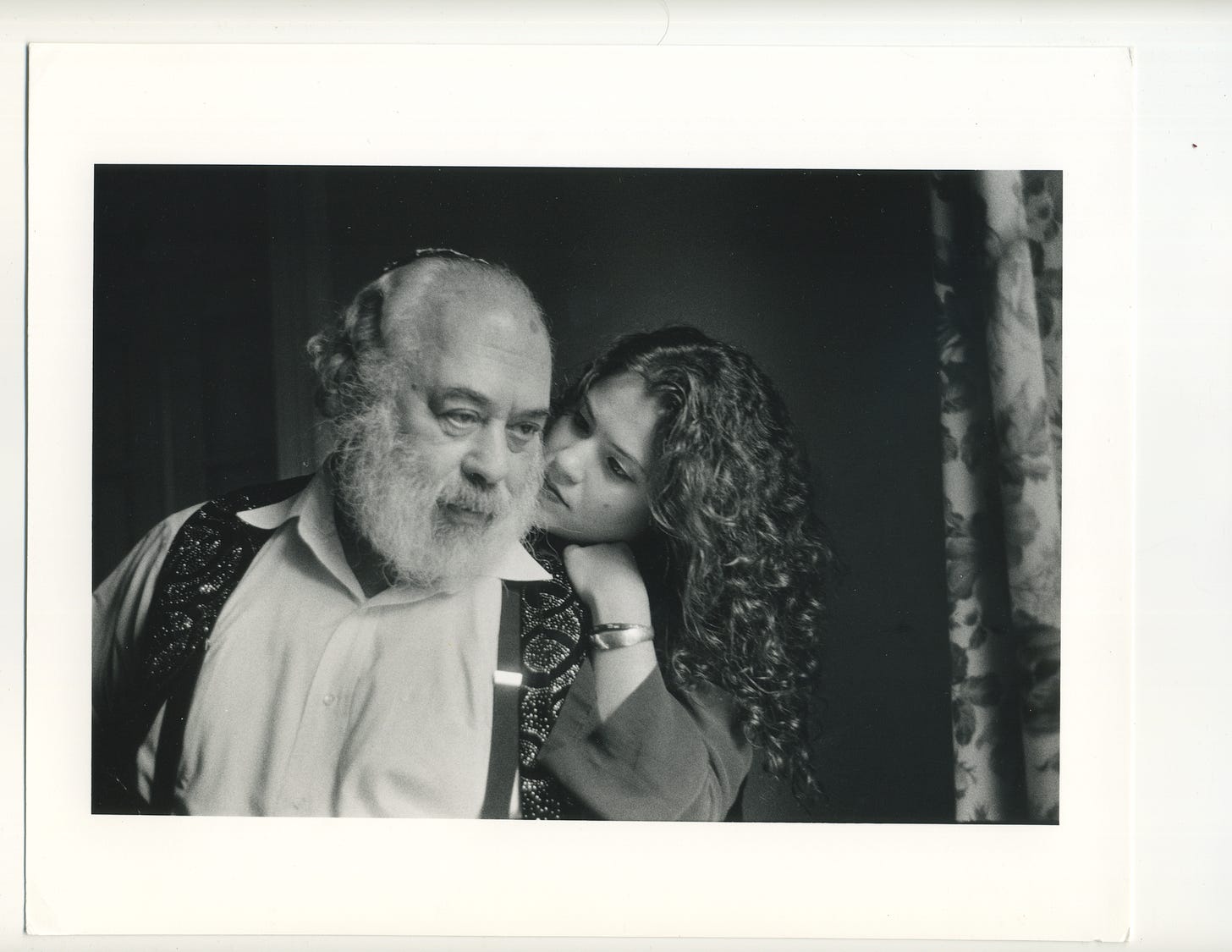
The Darkest Light also tells the story of Neshama Carlebach belatedly coming to grips with her father’s complex legacy. We hear about her loving childhood, and the professional risks Carlebach took for her and other women. Neshama says, “I did not see him ever stop fighting for women to have a voice.” This is true. I was a second-hand beneficiary of Carlebach’s feminism. He inspired many of the rabbis who would go on to champion high-level Torah education and ordination for Orthodox women in the United States, including my teachers Rabbi David Silber and Rabbi Avi Weiss.
After her father’s sudden death, Neshama took over all his gigs. Although only twenty, she had been performing with him for years and the family needed the money. But she also idolized him. Not only did she want to carry on his work, she “wanted to be him.” A charismatic, witty performer, she says of her younger self, “I would have grown a beard if I could.” When the Lilith article appeared three years after Carlebach’s death, she denied allegations against him as “garbage,” and continued to do so for some twenty years.
In 2017, discussions about Carlebach’s abuses reemerged with the MeToo movement. Neshama connected the allegations to an assault she herself experienced on the Moshav as a child by one of her father’s friends. The night of the assault, she told her father what had happened, and he refused to believe her: “What would he want from you, you’re just a little girl?”
“What did it feel like to not be believed?” the filmmaker asks her. “He sliced me, just down the center of my being,” she says, and then describes the crushing realization that all the allegations against her father were real. In January 2018, she wrote a career-defining Times of Israel blogpost: “My sisters, I hear you.”
There is a large bookshelf, maybe a bookcase, of hagiographies of Shlomo Carlebach, several of which I perused before and after I watched The Darkest Light. In one of the most popular ones, Holy Brother,Yitta Halberstam Mandelbaum says that there were “many thousands of [personal] transformations” that took place due to his work, bringing Jews closer to Judaism through the “palpable love that pulsated from Shlomo.” He possessed “infinite moral courage” and “unwavering determination to fulfill what he saw as his personal tafkid (mission).” Shorn of the hyperbole, this is almost true, but The Darkest Light makes an entirely necessary correction, “a fixing.” Carlebach was a great man who wrote beautiful music and brought many people into Jewish practice—but he wasn’t courageous when he weaponized his charisma and apparent spiritual wisdom to maneuver teenage girls into dark, defenseless places.
As I watched the film, it became clear that Simon Mendes, the director and producer, must have watched hundreds of hours of Carlebach tape. Others have spent that much time with Carlebach’s legacy and come to different conclusions. Shlomo Katz, a singer, composer and the rabbi of Congregation Shirat David in Efrat, Israel, writes about spending twenty-five years immersed in Carlebach’s videos and cassettes. In them, he found “the whole Torah” revealed through Carlebach’s “warmth, brilliance and depth.”
Katz is the editor of Even Shlomo: The Torah Commentary of Rabbi Shlomo Carlebach and a co-founder of the Shlomo Carlebach Legacy Trust. Opening the volume on Genesis the other day while I was working on this essay, I came upon this teaching, entitled “Shhhhh….”
The Torah says that Noach was a holy man. By Avraham, the Torah does not say that he was a holy man. Do you know why?
Can you imagine how sad Avraham would have been if the Torah would have said something good about him. All he was praying to God was, “Please, let me be hidden, I’m begging you that no one should know.”
Let’s say I got married last week and this morning I was interviewed by the Israeli television and I told them all the secrets and privacy which are now between me and my wife. Disgusting . . . the first relationship between people has to be hidden, it has to be on the level of secrets.
You know why the Torah begins with a beis and not with an aleph? Because the beginning of all beginnings is that letter which you can’t even see.
Setting aside the fact that the Torah has plenty of good things to say about Avraham, one might, perhaps, understand why Katz only heard “deeply soulful music” in such a drasha about the intimacy between Avraham and God. But, after watching Mendes’s film, one wonders about a person who believes that the “beginning of all beginnings” is secrets. Perhaps Carlebach too was “begging that no one should know.” Katz might see only “Torah from the Tree of Life,” but, after seeing this film, our eyes are opened—and now we watch and listen to that very same tape, and see new things: a hand lingering, grasping where it does not belong.
TheDarkest Light gives the last word to Donna Zerner, one of Carlebach’s victims. She says:
It’s time, it’s past time, that we stopped glorifying charismatic abusers. How we deal with the Shlomo legacy is only important for moving forward. It’s really important, if we’re going to talk about him, to talk about all of him. Not just the “Holy Brother,” the loving, selfless man, but also the predator. By recognizing that, I think it gives permission for more victims to speak the truth. Because now is what’s important.
In contrast to another victim, now a grandmother whose grandson sings “Am Yisrael chai,” who wishes the Jewish people would just find new tunes, Zerner says, “I have no problem with it. I love Shlomo’s music. When I hear it, I usually don’t even associate it with him, I just go ‘oh, I like that song.’” It would be presumptuous to tell either of them to feel or think otherwise.
Meanwhile, Central Synagogue is back to singing Carlebach melodies, which makes sense to me. To cancel Carlebach’s music is to play into the simplistic Manichean ideology of his strongest defenders: people are either all good or all bad. The defenders say, I listened to twenty-five years of cassette tape and it was extraordinary, therefore Carlebach was a tzaddik. Cancel culturists say unknown numbers of women were abused, so he must be all bad. But neither approach prepares us for the future, when the next charismatic abuser comes along.
In that moment, we will be confronted again with the powerful mix of good and evil, redemption and violation working in concert. Then, too, the healing will be real and so will the injury. Next time, I hope we will be quicker to see it.
Suggested Reading
Like a Surgeon with a Scalpel, an Archaeologist with a Spade
David Weiss Halivni once rescued a scrap from a page of the Shulchan Arukh from the sandwich paper of a Nazi guard. His whole life turned out to be about rescuing texts.
Oh Homeland, Don’t You Wonder (Tzion Ha-lo Tishali)
Dan Alter translates Judah Halevi's poem of yearning for Zion from nearly a thousand years ago.

A Tragic Epilogue
Matti Friedman reflects on the life and sacrifice of a fallen soldier.

The Wizard of Words and the Baggy Monster: Rereading Amos Oz’s A Tale of Love and Darkness
Israelis made Amos Oz a cultural symbol—almost a fetish—of who they thought they were or fancied themselves to be. But their adoration wasn't unconditional. Oz's editor, literary scholar Yigal Schwartz, called Israel’s unbalanced relationship with Oz a “bipolar reading disorder."
Comments
You must log in to comment Log In