Letters, Summer 2025
No Afikoman, No Problem
The catastrophe of the afikoman lost in the fabric of space-time in Dara Horn’s graphic novel (“Escape Goat,” Spring 2025) could have been avoided if the “wise child” had known a little halakha. Rabbi Moses Isserles clearly states (Shulchan Arukh, Orach Chayim 477) that if the afikoman is lost, another matza may be substituted.
This halakha is also useful as a counterargument if the afikoman thief continues to make outrageous demands.
Michael Stiefel
via email
Demon Bowls
Shai Secunda’s lively review of Avigail Manekin-Bamberger’s critical study on the Babylonian Jewish incantation bowls of late antiquity (“Bewitched and Between,” Spring 2025) resonated for me in a perhaps unexpected way. By coincidence, the bowls and their demon-controlling magic were already on my mind because I was reading Harashta, an Israeli young adult fantasy novel. This recent debut by Israeli writer Yehudit Kagan has been a breakout success in Israel. JRB readers may want to know a little about Kagan’s modern take on the bowls—and her book’s significance for Jewish fantasy today.
Though an often-humorous adventure tale, the book is full of Aramaic-speaking demons (the book’s title is an Aramaic term for “witch”), all taken from the scholarly literature on the bowl inscriptions. In fact, Kagan thanks Manekin-Bamberger in the acknowledgments. Kagan’s protagonist is Ophir, a religious girl doing her national service (a common alternative to Israeli military service for Orthodox girls) who gets into trouble with demons after she steals a Solomonic scroll from the National Library of Israel. Borrows, not steals, Ophir would insist, because she only wants to use the scroll’s magic to cure the dementia of the elderly Miriam, the last of the incantation bowl scribes who resides in an assisted living facility in Haifa. But while Ophir is pulling her library heist, the demon world is rallying around a new king-elect, Hormiz, who wants to take the scroll for himself and use it to take over the human world.
Kagan updates the Babylonian Jewish magic a bit. For instance, Ophir develops her own talent for the creation of incantation bowls, at one point dumping out a plastic container of schnitzel and using a magic marker to inscribe a make-do version when cornered by demons. When a particularly powerful demon needs to be trapped, Ophir tries to scale up by using a satellite dish.
Indeed, though Kagan’s fantasy draws on the magic of antiquity and takes us into the court life of demons, its highlights are its vivid portrayals of present-day Israel, its various religious and ethnic sectors, the mundane but entrancing details of Jerusalem, Haifa, Safed. Beginning with her very straitlaced religious heroine who has to join forces (but for modesty’s sake not come into physical contact) with a secular demon-hunter named Daniel, Kagan handles the sociological tensions of the Jewish state today with good-natured satire and keen insight. I loved the moments in the book in which Ophir interrupts her adventures to text her rabbi and ask about a point of halakha.
Kagan herself is Orthodox (one of her bios says that she is “the mother of three little demons”). Her novel, which began as a series of humorous Facebook posts, reflects the activity in recent years on the part of Orthodox Jews in Israel who, along with their secular friends, are exploring the relationship between Judaism and fantasy through organizations and conferences such as Shaatnez (shaatnez.org), of which Kagan is a founder, and Mythopia (mythopia.org). In Harashta, one sees the influence of young adult fantasy in English (especially Jonathan Stroud’s Bartimaeus Sequence) and of Israeli author Hagar Yanai’s pioneering young adult fantasy trilogy Ha-livyatan mi-bavel (The Leviathan of Babylon, 2006–2017) but also a coming-of-age of Israeli fantasy reflected in the book’s popularity.
Kagan gets asked a lot about whether her book has a political message or is an allegory for Israel today. Do the demons represent the Palestinians, or the ultra-Orthodox, or perhaps even secular Jews? The fact is, Kagan’s demons are just that—supernatural creatures in a work of imaginative fantasy, which is why different readers have come away with different views of the book as a take on Israel and its challenges.
Still, Hormiz mounts a surprise invasion of Israel after paralyzing the country, until recently so reliant on technology for its defense, by shutting down its computers and electronics. The various Israeli magicians must overcome their long-standing resentments and schisms if they are to unite to defeat the enemy. A sympathetic demon (there are quite a few) wishes them well but prefers to avoid conscription so that he can stay at home and study Talmud. In other words, a certain amount of reality seeps into the book, though even Kagan’s cruelest demons are nowhere as debased and monstrous as Israel’s real-life enemies.
Michael Weingrad
Hillsdale, Michigan
Fearless
Earlier this year I listened uncomfortably to an episode of Bari Weiss’s podcast, Honestly. On the podcast, multimillionaire entrepreneur Bryan Johnson described his obsession with overcoming death. Johnson described how he invests his seemingly endless wealth and resources into his own body, believing we are at the precipice of a new, eternal reality.
Johnson’s regimen and lifestyle struck me as vain, self-indulgent, and egotistical. At the same time, I could not escape a lingering anxiety that it was eerily similar to the philosophy espoused by my teacher and rebbe, Rabbi Irving “Yitz” Greenberg. Somehow their approaches seemed at once similar and completely irreconcilable. I spent months pondering this complex relationship and wondering why I found one compelling and the other completely off-putting.
As I read the latest issue of JRB, and in particular Rabbi Greenberg’s article (“Resurrection: The Triumph of Life in Judaism,” Spring 2025), I gained much-needed clarity. While reading the article, I was transported back over a decade to a seminar when I was a smicha student at Yeshivat Chovevei Torah in Rabbi Greenberg’s evening class. A group of us would stay late into the evening and sit around a table with Rabbi Greenberg to hear his wisdom and theology.
Rabbi Greenberg shared that one of his core theological principles emerged from the final verse of Psalm 48: “For this is our eternal God, who will allow us to triumph over death.” God, he shared, was a God of life. Judaism is a religion focused on choosing life over death. Life, in a very literal form, would ultimately be restored.
So, what distinguishes Rabbi Greenberg’s belief in Judaism as a path toward eternal life from Johnson’s similar, somewhat homeopathic path? Johnson’s obsession with death stems from a fear of mortality. He does not want to see what comes next. Rabbi Greenberg’s obsession comes from an embrace of mortality. Johnson does not want to approach finality. Greenberg denies the existence of finality altogether.
Rabbi Greenberg’s reasoned acceptance of a literal resurrection is characteristically countercultural, particularly in the modern world. But for him, it is the inevitable extension of a religion focused on creating and sustaining life. That choice ought not to be made, as Johnson suggests, through a fear of death but by a love of life.
Rabbi Jordan D. Soffer
Head of School
Striar Hebrew Academy
Extraterrestrial Exodus
I always look for forward to your whimsical covers, but the “one little goat” being beamed up to a flying saucer as his alarmed flock looks on might be my favorite (Spring 2025). Kudos to Mark Anderson!
Talya Kohn
Toronto, Canada
Suggested Reading

Escape Goat
Dara Horn's new graphic novel about a neverending Passover seder and a talking, time-travelling goat is great fun. It's also a deep meditation on Jewish history and memory.

Bewitched and Between
In the talmudic era, many Jewish legal documents were standardized. Even magic bowls inscribed with methods to divorce a demon.

Resurrection: The Triumph of Life in Judaism
I grew up blessing the God who "resurrects the dead" but I never heard it discussed.
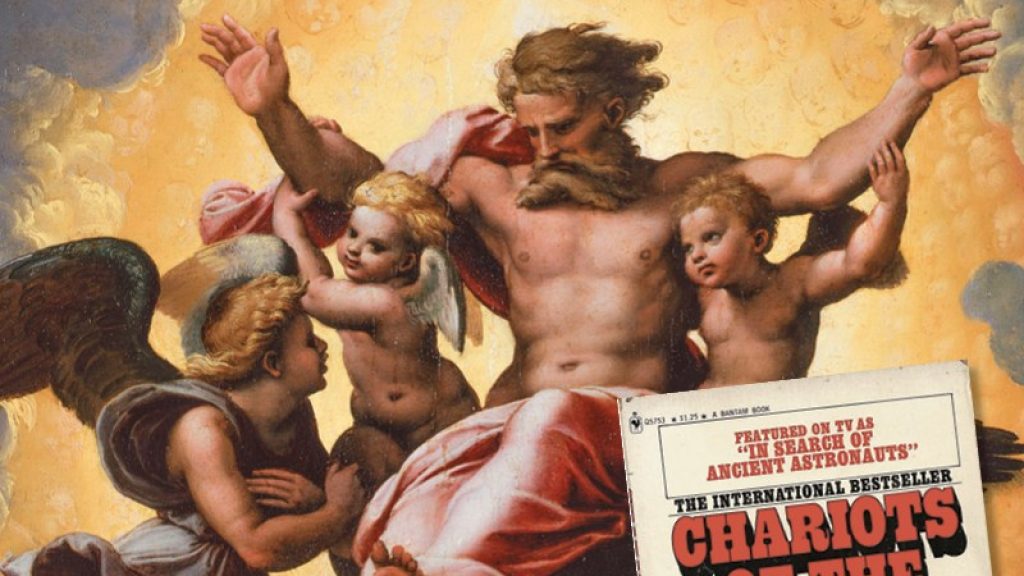
Chariot and Saucer
David Halperin spent an academic lifetime studying mystical visionaries from Ezekiel to the Sabbatians. But first came the UFO truthers.




Comments
You must log in to comment Log In