Bewitched and Between
Somewhere in late antique Iraq, where a large rabbinic community once flourished, the following lines, in Babylonian Jewish Aramaic, were written out in a semicursive hand:
This is the deed of divorce (gita) of Lilith.
A day of the days from all days and years and generations of the world.
I, Giyonay daughter of Lalay, servant of heaven, I release (patarna) and I divorce (metarakhna) you from my whole body.
The release (mifatar) of the ice in Tammuz.
The dismissal (mishavaq) of an unclean raven [from] its temple.
The text calls itself a “gita”—an Aramaic cognate of the Hebrew word “get”—and it uses the language of Jewish divorce with its technical vocabulary, date stamp, and first-person perspective to dissolve an undesired relationship. Clearly, though, this is not a typical divorce document. The prose is peculiar, almost poetic, in marking a single day in a cosmic time span and allusive in summoning the unfastening of winter ice in the summer season. Remarkably, the parties to the proceedings are not an unhappily married couple—elsewhere in the text, we hear of Giyonay’s husband, Hormiz—but rather a couple who want to rid themselves of Lilith, the demoness. This text is spirally inscribed on the inside of a simple clay bowl, which is the main surviving form of Babylonian Jewish amulets. As it turns out, Lilith’s gita is not a conventional divorce deed nor simply an incantation; it’s a hybrid magical get, bewitched and between.
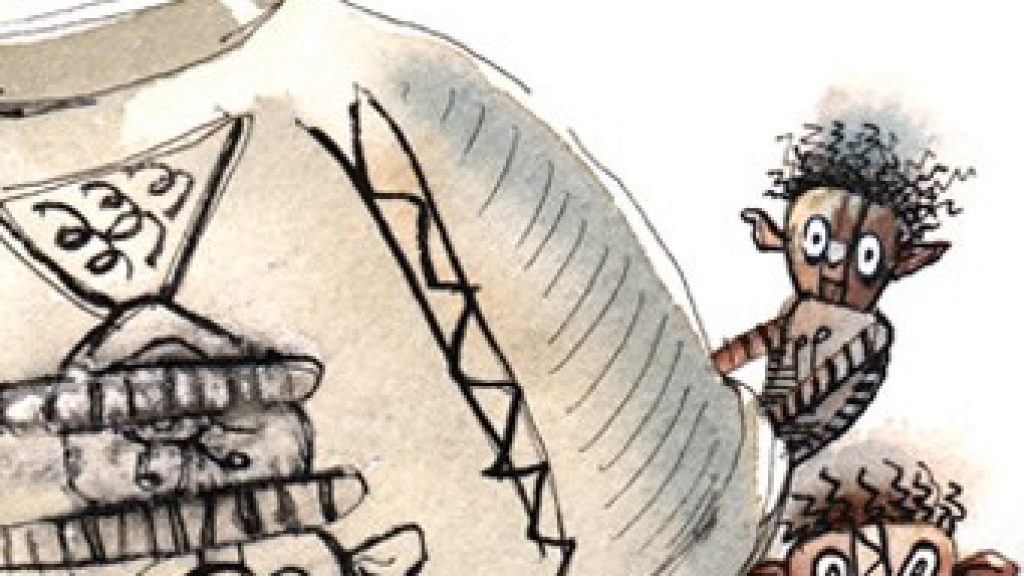
These magic bowls have been known to modern scholars since the middle of the nineteenth century when they were first dug up in archaeological expeditions to Mesopotamia. Ordinary earthenware buried in the corners of homes, many of the magic bowls are adorned at their center with wide-eyed and wild-haired demons whose legs, hands, and sometimes necks are bound in chains. The incantation bowls seem to have functioned like metaphysical mousetraps—“demon traps,” really—as they used text, image, and the upside-down dome of the bowl’s bottom to ensnare diabolical threats. Of course, the aim of the magic bowls was less to trap the demons than to exorcise them, hence the talk of divorce.
Over the years, scholars have contemplated the relationship between this peculiar Babylonian habit and the rabbinic community that gave us the Talmud. Hundreds of the incantation bowls are composed in a square, Jewish Aramaic script in an Eastern dialect of the language that is quite close to talmudic Aramaic (other unearthed bowls were written in Syriac and Mandaic, Aramaic dialects spoken by the Rabbis’ Christian and Mandaean neighbors). Many of the bowls cite biblical verses, like Zechariah 3:2, “But [the angel of] the LORD said to the Accuser, ‘The LORD rebukes you, O Accuser; may the LORD who has chosen Jerusalem rebuke you!’”
And some of the bowl spells invoke characters known to us from rabbinic literature, such as Rabbi Yehoshua, son of Perahia, remembered in the Talmud as the teacher of Jesus who forcefully pushed his problematic student away from Judaism. In the magic bowls, Rabbi Yehoshua banishes demons rather than wayward students. He also presides over demonic divorce proceedings.
Nevertheless, magic bowls have seemed, at first and even second glance, thoroughly unrabbinic. Alongside incantations invoking the God of Israel and His heavenly hosts, the bowls also name pagan gods and goddesses, including the Greek goddess of love, Aphrodite. One Babylonian Jewish Aramaic text even incants, “By the name of Jesus, who conquered the height and the depth by his cross, and by the name of his exalted Father!” Moreover, the magicbowls are engaged in what looks, sounds, and seems like sorcery, which is strictly condemned by the Torah and the Rabbis. For this reason, historians of Babylonian Judaism have typically hypothesized that the bowls were used only by Jews who were not part of the rabbinic community.
The last few decades have seen the appearance of scores of magic bowls in scholarly articles and books. Now about six hundred of them have been transcribed, translated, and discussed, while some fourteen hundred, held in private and public collections and by antiquity dealers, await future publication. This development has been accompanied by a reassessment of the bowls’ significance for understanding Babylonian Jewry, including the rabbis and their Talmud.

The late Hebrew University scholar of religion Shaul Shaked called attention to a small set of bowls commissioned by people bearing good Jewish names and rabbinic titles—for instance, Rav Dimi, son of Sarah, and Rav Ashi, son of Mahlafta. Other researchers, including Gideon Bohak and Yuval Harari (the Ben-Gurion University folklorist, not the Hebrew University author of Sapiens), have set out to explain how the rabbis could maintain a strict stance against sorcery while recommending amulets, incantations, and other occult practices. Their answer is simple: Most people consider themselves pious and their practices—even seemingly bizarre ones—respectable. The dangerous, damnable wizards and witches have always been the other guys, their religious competitors.
These arguments have set the stage for Seder maziqin, a handsomely illustrated Hebrew-language book by Avigail Manekin-Bamberger. The work, whose title “Order of Demons” is a deliberate play on the mishnaic “Order of Damages” (Seder neziqin), is an erudite, frontal assault on the presumed distance between “magic and [rabbinic] law, the high and the low.” Manekin-Bamberger poses a set of thought-provoking questions:
Did ancient Jews fundamentally distinguish between an oath taken in God’s name in a court of law and an oath taken in God’s name to exorcise the demons? Is there a difference between the beliefs of a man who divorces his wife with a get and that of someone who divorces a demon with a get?
Seder maziqin is a work of sustained philological research, driven by the remarkable preponderance of rabbinic ideas and halakhic terminology in the magic bowls.
Manekin-Bamberger compares magical divorce deeds to rabbinic ones, noting many similarities, including a fastidiousness for documenting nicknames. She also considers other halakhic features of the bowl spells, such as personal vows and rabbinic decrees. Not a few bowls deploy rabbinic vow language—think of the technical terminology used in the Kol Nidre service—in which people can issue bans on themselves and others and subsequently remove such bans through cathartic techniques that sound a lot like exorcism.
Manekin-Bamberger also looks at the development of the rabbinic gezeira, conventionally rendered as “(legal) decree,” which, she argues, comes to refer to elaborate rabbinic rituals of excommunication that echo the exorcism of malevolent beings in the magic bowls. In one of the most technically impressive sections of the book, Manekin-Bamberger studies judicial procedure in the Talmud and the bowls, including the motav, or “session.” In talmudic discourse this is a court session for the verification of documents; in the magic bowls, it involves Rabbi Yehoshua ben Perahia’s attempts to verify the proper names and nicknames of demonesses.
These intriguing parallels encourage Manekin-Bamberger to pursue two lines of inquiry. The first concerns the identity of the people who composed the Jewish Aramaic bowls. The second contemplates the hidden gears operating both Jewish magic and Jewish law.
Given the sorry state of the evidence, Manekin-Bamberger cannot conclusively prove who wrote the bowl spells. But she can dispense with some of the less compelling hypotheses. Against the pet theory of some scholars hoping to hear the faint echo of the voices of ancient women in the bowls, she conclusively demonstrates that there is no evidence that the bowl spells were written by women. Even those incantation bowls that use spells conjugated in the first-person feminine singular were not composed by women but apparently by men, professional scribes who ventriloquized the voice of their female clients.
Since a substantial number of the magic bowls presume a high level of halakhic expertise, it is also unreasonable to presuppose that they were made by a secret coven of nonrabbinic incantors. More likely, they were written by expert Jewish scribes who produced a variety of legal texts, including conventional Jewish deeds of divorce and incantations of exorcism in their workshops. Indeed, while Manekin-Bamberger does not focus on them in Seder maziqin, a few bowls show evidence of niche rabbinic scribal practices, such as elongating the letter waw in two technical rabbinic terms of divorce, terukhin and shivuqin, divorced and separated.
Manekin-Bamberger also explores the legal fiction behind the magical gittin, at one point wondering whether it reflects the disconcerting conception that demons are just like us, cohabiting and separating, even legally divorcing. Consider the following incantation from a bowl written for a certain Mahdukh daughter of Newandukh that draws a close correspondence between a magical get and a demonic divorce:
I write you . . . Lilith . . . a deed of divorce, just as demons write deeds of divorce and give them to their wives and they do not come back again unto them.
Here, demons and humans seem to dwell in the same halakhic universe. If demons divorce each other by drafting halakhic deeds of divorce, then humans might banish them by using the same terms and techniques. One cannot help but wonder whether demons, who were thought to take up residence in peoples’ homes and bodies, were also seen as somehow legally married to the poor and unfortunate souls now banishing them with incantation bowls.
Manekin-Bamberger insists that the magical gittin were regarded as real, not metaphorical. Thus, they attest to an intriguing intersection of halakhic and magical thinking:
If the rabbis thought of law as operating also on a metaphysical plane, then oaths, documents, and rabbinic rulings achieve new meaning. Laws become not merely pragmatic instruments of human interrelations, but metaphysical, religious rulings that entail, at every moment, the involvement of higher powers.
Both exorcism and divorce were detailed ritual procedures effecting real if unseen change in the world.
This is an intriguing thesis that promises to freshly illuminate the mechanics of ancient Jewish magic and the metaphysics of halakha. Yet, it strikes me as undeveloped and possibly flawed. To begin with, what precisely is meant by calling magic and law “real” as opposed to “metaphorical”? Do legal systems, even “pragmatic” ones, function differently if they involve divine powers rather than, say, royal or state authority? Unfortunately, Manekin-Bamberger doesn’t really engage with legal theory, so she does not reflect on the mysterious workings of all forms of law, not only halakha. After all, even in secular society, we assume that a few words uttered and a wedding band proffered bind two people together forever, in sickness and in health—that is, until they scratch some more legalese on a piece of paper and unmake an otherwise enduring relationship. It can almost seem like, well, magic.
Still, Manekin-Bamberger is clearly onto something in arguing that Babylonian Jewish magic and rabbinic halakha bear a striking connection. The rabbis were, after all, relentless readers who found extraordinary power in language’s infinite possibilities. Like Genesis, in which God merely states, “Let there be light: and there was light,” the Rabbis insisted that language, even unadorned, could make and break worlds. Famously, halakhic discourse is obsessed with getting its formulations just right, whether in a piece of liturgy or in a rabbinic teaching.
The Rabbis were also intrigued by the invisible transformations wrought by thinking, speaking, and writing, whether in the sacrificial cult, where a thought can nullify a sacrifice; in the laws of ritual purity, where it might render a vessel susceptible to impurity; or in divorce law, where a grammatical error can have catastrophic results. In the final analysis, Manekin-Bamberger may be right that halakha’s closest kin can be found not in, say, the mundane workings of late antique jurisprudence but in the enchanted lines of the Aramaic incantation bowls.
Suggested Reading
Common Clay
Virtually nothing of Babylonian Jewry of the talmudic period, from the 3rd to the 6th century C.E., has survived beyond the Babylonian Talmud itself to help contextualize or confirm the many things the text tells its readers.

Imperial Rabbis
What, exactly, was Babylonian about the Babylonian Talmud and its sages?A new book by Simcha Gross suggests a radically new understanding.
Lilith and the Knight
Demons, dragons, and a “Tel Aviv hipster in King Arthur’s Court.”

Insiders and Outsiders
The Jewish sect that rejected cholent.


Comments
You must log in to comment Log In