Letters, Spring 2026
Canonizing the Rav
I am a fan of Seth Winberg’s writing and his organizational activity; his Hillel work is of the highest order. However, I believe that in his review of Daniel Ross Goodman’s Soloveitchik’s Children (“Wayward Children?,” Winter 2026), he missed the mark in several ways.
Winberg identifies Soloveitchik the theologian as a “neo-Kantian who thought of halakha as a pure discipline like math or theoretical physics.” Soloveitchik saw halakha as “independent of external factors and of human responses to them.” This is a fair description of Soloveitchik putting a theological paradigm stamp on his Brisker talmudic shiurim. The students who took over his role as rosh yeshiva at Yeshiva University identified with this approach. But this is Soloveitchik at his least theological.
Goodman’s book is focused on Soloveitchik’s theological articulations and his influence on theologians such as myself, David Hartman, and Jonathan Sacks. Goodman does not deal with the RIETS roshei yeshiva or Aharon Lichtenstein, Soloveitchik’s son-in-law and closest student, because they are focused on Soloveitchik’s learning, not his theological teachings.
Soloveitchik’s paradigm of halakha as math or theoretical physics (a model which Soloveitchik articulates in the opening section of his greatest essay, Halakhic Man) differs from Soloveitchik the theologian in the rest of Halakhic Man. There, Soloveitchik identifies holiness with living and life affirmation and describes Judaism as the religion that abhors and fights death. He insists that holiness is of this world and that halakha’s goal is to bring the divine presence to rest in this world, and “the halakha will find its fulfillment, its total realization in this world.” He is the theologian of the centrality of covenant who writes that halakhic man received the Torah at Sinai not as a passive recipient but “as a partner with the Almighty in the act of Creation”—for example, that humans are cocreators of halakha. He writes that halakhic man’s calling as a rabbi is social justice “to save the oppressed from the hands of his oppressors,” and that man’s task is tikkun olam. Soloveitchik calls it “repair[ing] the defects in the cosmos.” Soloveitchik writes that repentance is about more than undoing sins; it is about “self-creation,” and he later writes that the goal of self-creation is that a halakhic man be an exemplar of “individuality, autonomy, uniqueness and freedom.” He writes that hiddush (innovation or creating) is essential to the religious life and that the highest state of halakhic man is prophecy, and the prophet is a creator and a free person. This is before we get to Soloveitchik the theologian who wrote The Lonely Man of Faith. While Soloveitchik’s inheritors stress Adam 2 in that essay—the human who is obedient and focused on relationship to God—I would call attention to Soloveitchik’s celebration of Adam 1, who has a divine mandate to create, to repair the world, and to conquer the universe.
All these are themes in Soloveitchik that are articulated by his theological disciples and that Goodman spells out brilliantly and systematically, including comparing and contrasting the disciples to each other and to their master, the Rav. No one else has done as thorough and accurate a study of these themes in Soloveitchik and in the disciples.
One of Goodman’s greatest contributions lies in his pointing out that even when the disciples conflict with Soloveitchik, they are, often, applying Soloveitchik’s ideas and paradigms—although they are going beyond Soloveitchik’s own application. Thus they show his influence even where they diverge. For example, I apply Soloveitchik’s concept of tzelem elokim to greater egalitarianism for women. I take Soloveitchik’s teaching of the telos of halakha (the creation of worlds and the Jewish people’s eschatological vision) and apply it to legitimate halakhic change. David Hartman draws on Soloveitchik’s view of the development of prayer as a model for an activist, bold halakhic approach rather than on Soloveitchik’s other theme of prayer as the expression of human submission and insignificance in the face of an all-powerful God.
Winberg misreads Goodman’s affirmation of Soloveitchik’s influence on his disciples’ departures as a claim that Soloveitchik approves of our departures or that we disciples feel we have Soloveitchik’s tacit blessing even when we depart from his stands. Winberg counters that Soloveitchik tolerated his theological disciples’ departures, but he was on a different theological wavelength from them. He again misses the difference between influence and approval.
Winberg disputes Goodman’s assertion that interfaith dialogue is now accepted among Modern Orthodox. Goodman’s statement reflects that Hartman, Sacks, and I (and such Soloveitchik-influenced YU graduates as Michael Wyschogrod) all play active roles in the Jewish-Christian dialogue. Winberg echoes official YU/Rabbinical Council of America positions that Soloveitchik prohibits interfaith theological dialogue. He ignores (1) that Soloveitchik does affirm Jewish-Christian dialogue on social justice and civic matters, (2) that Soloveitchik elsewhere teaches that halakha deals with all civic and social affairs as theological matters (it follows that all the dialogue on secular and civil matters that Soloveitchik approves is intrinsically theological), and (3) that Soloveitchik gave his Lonely Man of Faith essay originally in an address to a Catholic clergy training seminary in Boston.
My argument with Winberg is more than theological hairsplitting. The issues facing Modern Orthodoxy (such as feminism, LGBTQ, halakhic change, etc.) have radicalized, and the denial of a hearing to the independent disciples means that the community cannot deal effectively with these issues—except by yielding to the haredi position. As a result, Modern Orthodoxy of the Soloveitchik kind has been in retreat.
The circle of thinkers in the YU/RIETS school have set up a cautious Soloveitchik theological canon that never goes beyond what he directly affirmed. Yet a theologian’s importance is substantially shaped by the application and the expansion of his ideas by others—including when they apply it in new or even opposing ways. Winberg’s review strengthens the small circle’s self-perception as keepers of the pure flame but reduces Soloveitchik’s present and future status as a seminal Jewish religious thinker in the twentieth century, not just a spokesman for Modern Orthodoxy.
Yitz Greenberg
President of the J. J. Greenberg Institute
at the Hadar Institute
Seth Winberg Responds:
I am grateful for Rabbi Greenberg’s thoughtful reading of my review of Soloveitchik’s Children. I have fond memories of cataloging his recorded lectures when I was a rabbinical student, and he has been a generous and gracious mentor ever since. Greenberg’s willingness to engage in detailed, substantive debate exemplifies the intellectual openness he has always modeled.
My review of Goodman’s book was rooted in questions of historical method and evidence, not in a desire to police Soloveitchik’s legacy. Greenberg describes Goodman’s book as merely arguing for Soloveitchik’s “influence” rather than his “approval” of his disciples’ theological departures. But as I argue in my review, Goodman’s specific claims are considerably stronger than that. After all, that Soloveitchik influenced later Modern Orthodox thinkers is a given.
I’m Walkin’ Here!
Jenna Weissman Joselit’s observation about walking tours that “clog the neighborhood’s narrow streets” (“Strolling the Lost Yiddish City,” Substack) captures something profound about urban preservation and tourism. These tours create connection and congestion—opening pathways to lost worlds while simultaneously creating bottlenecks in the living present. It’s a fitting metaphor for how we engage with history: Sometimes our eagerness to access the past can clog our ability to move freely through it. Sapoznik’s guide seems to navigate this tension beautifully, offering immersion without obstruction.
Anonymous
via jewishreviewofbooks.substack.com
Suggested Reading

From Smyrna to Worcester
Coming to America with a shipload of onions.
Shouts and Roars for the Finalists
Five finalists for the Sami Rohr Prize for Jewish Literature have been announced. Read our reviews now.
War & Peace & Judaism
Robert Eisen was walking to campus on 9/11 when he saw a dark cloud above the Pentagon. Alick Isaacs fought for the IDF in Lebanon. Their experiences prompted them to rethink peace and Judaism.
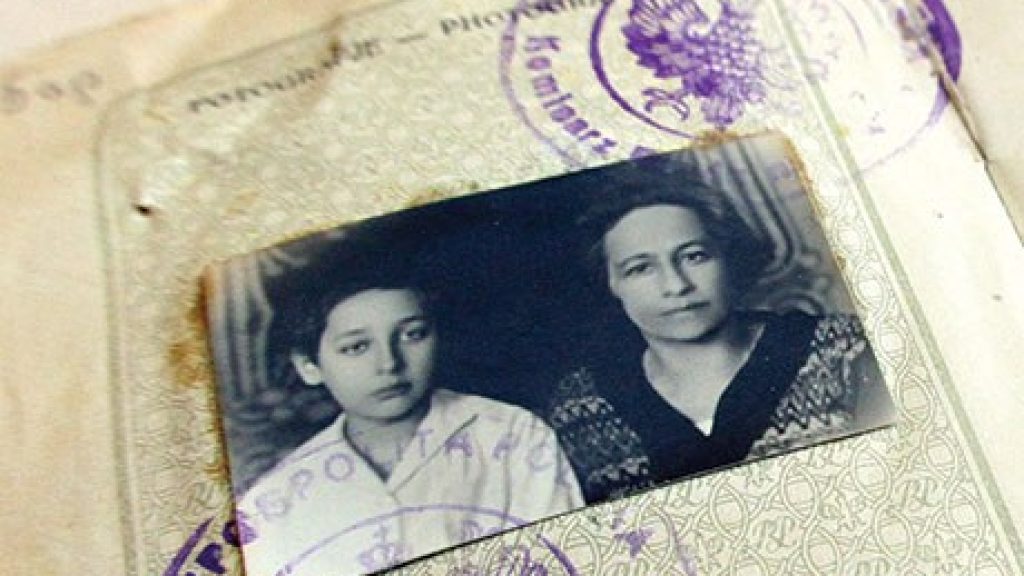
The Many Dybbuks of Romain Gary
Romain Gary—a Lithuanian Jew who regarded himself a Frenchman par excellence—emerges in a recent memoir as a master of self-invention and (just as immoderate) verbal invention, a chameleon of pseudonyms, a man of irreconcilable contradictions, divided against himself.

Comments
You must log in to comment Log In