Lost and Found and Random
Amos Oz wrote that when he was a child, he wanted to grow up to be a book. After all:
People can be killed like ants. Writers are not hard to kill either. But not books: however systematically you try to destroy them, there is always a chance that a copy will survive and continue to enjoy a shelf life in some corner of an out-of-the-way library somewhere, in Reykjavik, Valladolid, or Vancouver.
I was reminded of this passage from A Tale of Love and Darkness as I leafed through the Posen Library’s latest massive sourcebook, which focuses on the Hellenistic and Roman periods. Loss of texts is, in historical fact, the rule; Oz’s childhood daydreams notwithstanding, survival is the exception. The farther back we go in history, the more we need to reckon with the fact that the overwhelming majority of what was written has been lost. Ancient writing materials—papyrus, parchment, wax, wood—usually survived only a few decades or a couple of centuries at most.
The texts that survived long enough to be included in this volume made it to the present day in one of two ways. A small number were kept in uniquely dry storage conditions or written on stone or clay and somehow remained legible (or semilegible) over the centuries. The most well-known example of such lucky survival is the Qumran scrolls, which were kept in jugs and remained hidden in caves until they were discovered near the Dead Sea in 1947. But the vast majority of ancient texts survived only because someone painstakingly copied them by hand, someone took care to preserve that copy, and then someone else copied from the previous copy, and so on until the printing press arrived on the scene in the fifteenth century. Books that were regarded as holy or foundational were copied many times by many people, but most texts were saved from oblivion by coincidence.

Consider the first text that appears in Emerging Judaism: Hecataeus of Abdera’s account of the origin of the Jews in his work on the history and geography of Egypt. Hecataeus, who was born in Abdera in Thrace, settled in Alexandria toward the end of the fourth century BCE and worked for King Ptolemy I. In the following passage he tells the story of the exodus from Egypt from the Egyptian perspective:
When in ancient times a pestilence arose in Egypt, the common people ascribed their troubles to the workings of a divine agency; for indeed with many strangers of all sorts dwelling in their midst and practicing different rites of religion and sacrifice, their own traditional observances in honour of the gods had fallen into disuse. Hence the natives of the land surmised that unless they removed the foreigners their troubles would never be resolved. At once, therefore, the aliens were driven from the country. . . . The greater number were driven into what is now called Judea, which is not far distant from Egypt and was at that time utterly uninhabited. The colony was headed by a man called Moses, outstanding both for his wisdom and for his courage.
Hecataeus’s work is the first Greek text that says anything substantial about Jews, but it didn’t survive. Fortunately, Diodorus Siculus, a Greek historian of the first century BCE, copied parts of it and included them in his Library of History. It just so happens, however, that this part of Diodorus’s Library of History also didn’t survive. We only know these passages because a Byzantine priest from the ninth century quoted those lost parts of Diodorus’s text in his book. What was lost entirely and what, if anything, was changed in Hecataeus’s account of the Jews over fourteen hundred years, we’ll never know.
Similarly, the magnificent frescoes of the synagogue in Dura-Europos, depicting biblical scenes from floor to ceiling, would have probably been effaced long ago if that border city hadn’t been buried under thick layers of dust for seventeen centuries. These wall paintings were not just ornamental; they were creative interpretations of biblical episodes. For example, one of them shows Moses drawing water from a well, an image probably inspired by all the water miracles that Moses performed but especially from ancient legends about a magic well that traveled with the Israelites wherever they went during their desert journey.
Both the Romans and the Sasanians, who fought over Dura-Europos, seem to have eventually forgotten about it, leaving the city vacant and undisturbed, which is precisely what allowed for the unlikely survival of its synagogue with its glorious art. We can only wonder about all of the other Jewish wall paintings that must have been destroyed or eroded over the centuries, leading to the false impression that Jews have always been averse to figurative art.
The philanthropist Felix Posen, who put forth the vision and the (tremendous) resources for a comprehensive collection of written and visual materials from over three thousand years of Jewish history, was driven by the idea that Judaism has always been a culture, not just a religion. Such a capacious vision can make every piece of evidence seem indispensable—even the tattered pieces of a woman’s hairnet are exciting when that is all that remains of what Jewish women wore in this period.
But what was Jewish culture in antiquity? It’s not impossible that Jews who lived during the Hellenistic and Roman periods wrote adventure novels or satirical poetry or love letters—the people among whom they lived certainly did—but no Jewish writings of this sort made it into our hands. Most of the extant written materials are concerned with religious beliefs and practices, centering on the Jerusalem Temple, synagogues, and the Bible. This doesn’t mean that these were the only things Jews cared about, only that they are what later generations thought was important enough to transmit.
When the scholar Mordechai Margulies discovered the fourth-century Sefer ha-razim (The Book of Mysteries) in 1963, he was sick to his stomach, precisely because it did not fit his notion of Jewish books worth saving. “It is only thanks to the rabbis,” Margulies wrote, “that this apostasy of the commoners, who were impoverished in spirit and were immersed in magic and spells, did not take over the Jewish people in their entirety.” Among the contents he found so appalling was this gory spell:

(Rev Zadoban’s Bible Land Pictures.)
If you wish to turn the king’s opinion to your favor, or (that of) the chief of the army, or a rich man, or a ruler, or a judge of a city, or all the citizens of the state, or (if you wish to change) the heart of a great or wealthy woman, or the heart of a beautiful woman, (do this). Take a lion cub and slaughter it with a bronze knife and catch its blood and tear out its heart and put its blood in the midst (of the heart) and write the names of these (above mentioned) angels in blood upon the skin between its eyes.
Thankfully, editor Carol Bakhos and the editorial team that worked on Emerging Judaism do not worry about what counts as apostasy or the low culture of the commoners. They charmingly describe their approach in the introduction as a “kind of random (but very large) sampling of a society as a whole that may, if successfully presented, provide the reader with a fuller view of Jewish society in antiquity because of its many vantage points.” Thus, the spell above appears in Emerging Judaism alongside highbrow philosophical debates on the soul and the afterlife, and scraps of barely known texts appear alongside pages-long passages from the Talmud and midrash. Moreover, texts that one would generally think of as religious are mined for information about other facets of everyday life. For example, the Mishnah’s famous list of thirty-nine kinds of labor that are prohibited on Shabbat is used for learning which crafts and trades were common in ancient Jewish society.
As is clear from this anthology, Jews produced a substantial number of texts between the fourth century BCE and the second century CE. But here’s a fact that never ceases to amaze me: If we were to assemble a volume that contained only the texts from this period that later generations of Jews actually took care to copy and preserve, it would be astoundingly thin. All but two books written during this period (Daniel and Ecclesiastes) were excluded from the Jewish Bible and labeled as “external books.” Although there were probably many who did not agree with Rabbi Akiva’s statement that “one who reads ‘external books’ has no share in the world to come,” most of these books went largely unread and uncopied in Jewish communities.
Who preserved these external books? For the most part, Christians. Some books, like Ben Sira, Judith, and Maccabees, were included in the Greek version of the Bible and were therefore included in the Christian Bible as part of the Apocrypha. Other books, especially those featuring apocalypses and heavenly revelations, were preserved by particular churches in languages such as Ethiopian, Syriac, and Slavonic. The writings of the prolific Jewish philosopher Philo of Alexandria were preserved because later Christian theologians liked Philo’s allegorical explanations of Jewish law and his ideas about a mediating divine entity that emanates from God but operates separately. The works of the Jerusalem-born historian Flavius Josephus were kept because a few passages in them (some of which may not even be authentic) mention Jesus. For many Jews, the fact that those and other texts were preserved by Christians was enough to make them heretical. The Posen team, however, rightly chose to include them.
And then there is one set of texts that even some of this volume’s most ecumenical readers may balk at: the New Testament. Although the Gospels feature the life of a Jew who acted and preached within a Jewish social and religious environment, although the letters of Paul were written by a self-proclaimed Pharisee who is said to have been a disciple of Rabban Gamaliel, and although the Hebrew Bible is quoted on almost every other page, putting the New Testament on the Jewish bookshelf is somewhat daring even for a volume funded by a secularist foundation aiming at “a fuller view of Jewish society in antiquity.”
In truth, however, the distinction between Christianity and Judaism was far from clear at least until the end of the first century CE, and even after that, it may have been more important to Jewish and Christian theologians than to church and synagogue goers. Emerging Judaism includes some compelling examples of the coexistence, not to say intermixing, of Judaism and Christianity in late antiquity.
For example, it presents a lengthy prayer (originally in Greek) from the fourth century CE modeled on the rabbinic prayer of eighteen benedictions (shemoneh esrei), which nonetheless frequently refers to Christ as savior. The first segment of this prayer concerns Abraham, Isaac, and Jacob but brings Jesus into the lives of the fathers as well:
For from the beginning of our forefather
Abraham’s laying claim to the way of truth,
You led him by a vision . . .
But truly, having also given Isaac to him,
And having known him to be like that one in character,
You were also called his God, having said,
I will be your God, and of your seed after you (Genesis 17:7).
After having placed our father Jacob in
Mesopotamia, having shown [him] the Christ,
through him you spoke, saying;
Look! I am with you (Genesis 28:15)
And I will increase you, and multiply you exceedingly (Genesis 48:4).
Whoever created this prayer, and whoever recited it, probably did not think of it (or of themselves) as either Jewish or Christian but as both or perhaps as something in between. The same can probably be said for the writer, and possibly also the client, of another text included in the volume—a magical incantation from Babylonia, written in Jewish Aramaic, that invokes the Hebrew biblical names of God together with the name of Jesus.
What does it mean, then, to classify a text or an artifact from this period as Jewish? That it was created by Jews? That it was used by Jews? That its ideas and themes cohere with some established notion of what Jewishness is? Each of these criteria is problematic in a different way. Perhaps because of this, Emerging Judaism does not concern itself with identifying cultural products as Jewish. Instead, it identifies certain historical and social contexts as Jewish. The result is a vastly diverse collection of materials that can feel a bit scattered at times but nonetheless allows us to imagine Jewish life in the past in something approaching its rich variety.
Emerging Judaism is not a book that you can read from cover to cover. It’s encyclopedic, encompassing an enormous range of topics, and despite the editors’ best efforts to make the texts as accessible and comprehensible as possible, many are remarkably dense, technical, even impenetrably arcane. It is best suited for readers who already have a good sense of what they’re looking for. If you want to learn about the Jewish revolts against Rome, or about translations of the Torah, or about Passover celebrations in the Jerusalem Temple, the elaborate tables of contents and indices will guide you to their destination quite efficiently. If efficiency is a priority, however, one can search the digital version of this volume, available for free (with registration) on the Posen Library website. Considering the sheer size of the volume and its price (which is not unreasonable given its quality and heft), this is certainly the more economic choice.

Yet there is something to be said for opening this volume—or really, any volume of the Posen Library—flipping to a random page, and seeing what you find. Here’s something that jumped out at me the last time I paged through Emerging Judaism in search of something else altogether:
Veturia Paula, placed in her eternal home, who lived 86 years 6 months, a proselyte for 16 years under the name of Sarah, mother of the synagogues of Campus and Voluminus. In peace her sleep.
This is a translation of a Latin inscription on a sarcophagus from the third or fourth century CE, found in Rome. What made this Roman woman convert to Judaism when she was seventy years old? What does it mean that she was “mother of the synagogues”? Was she a generous donor, or did she hold a leadership position in the Jewish community in Rome? Who prepared this sarcophagus for her and chose to commemorate her this way?
All those questions are unanswerable, but the experience of this almost random encounter was somehow meaningful, not only because the survival of Veturia Paula/Sarah’s sarcophagus was a matter of chance in itself but also because it is often random encounters like this that give the past a new life.
Such experiences are rarer when searching a database, but the Posen Foundation is certainly right to have created a robust digital platform to accompany its majestic printed volumes.
Comments
You must log in to comment Log In
Suggested Reading

The Future Is Old
Rabbi Tarfon let his mother literally step on him. It wasn't enough, his colleagues said.
The Lamp of Zion
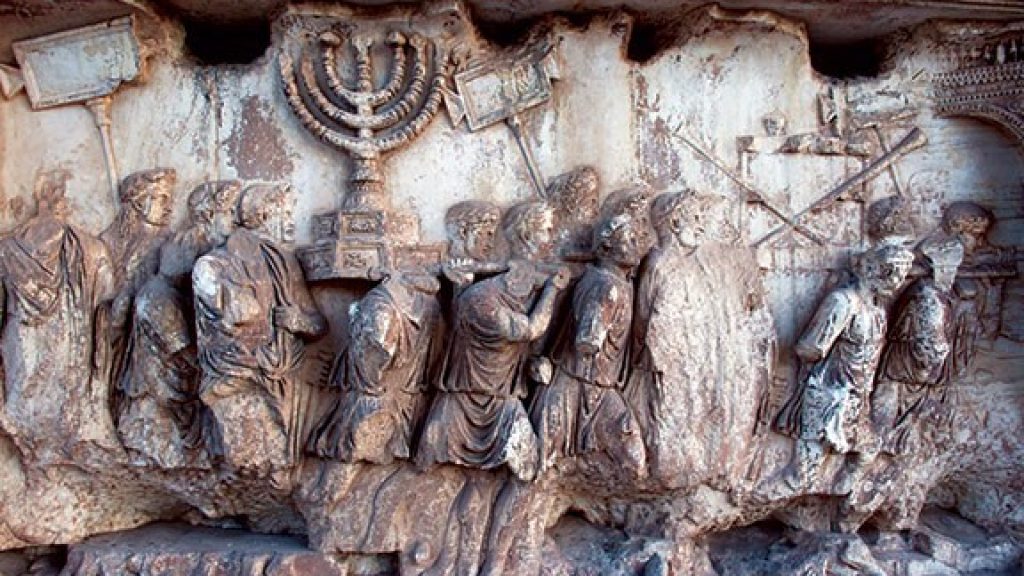
Over time, the menorah has morphed from a nostalgia-evoking relic of the past to a nation-inspiring symbol pointing forward.

Now a Museum, the Synagogue was Meticulously Restored . . .
The synagogue is a mikdash me’at, a little sanctuary or temple. But what really makes a shul holy and how should they be remembered?

How Jews Were Modern
What’s a nice Jewish boy doing making bronze statues of tsars? And does it count as Jewish culture? Ahad Ha’am wanted to know and the Posen Foundation’s ambitious new survey raises the question afresh.


Warren Wacholder
A good book review is of course one that inspires you to immediately order a copy of the book. And naturally making a statement like “Emerging Judaism is not a book that you can read from cover to cover” would inspire the response “challenge accepted.” I will have to let you know in a year or two (assuming no other literary interruptions) when I hopefully complete the task.
Warren Wacholder