Balancing Acts: A Response to Shai Secunda
I have always found responses to book reviews unseemly, particularly when they resort to a kind of point-counterpoint exchange. There is always room for different perspectives and opinions, and a reader can expect that one review will be balanced by another. But, given the prominence of the Jewish Review of Books, I feel an obligation to respond to what I believe to be Shai Secunda’s misrepresentative and distorting review of my book, Embracing Exile: The Case for Jewish Diaspora (“The Unbearable Lightness of Exile,” Spring 2026).
The central problem is that Secunda evaluates the book not on its own terms but in terms of the book he would write and which he demands that I should have written. The tip-off of this misdirection appears early in his review, where Secunda writes, “Despite its 2025 publication date, the Gaza war and the recent rise in antisemitism go unmentioned. And unlike other diasporist manifestos, seldom is heard a discouraging word about the State of Israel.”
Despite its 2025 publication date, this is not a post–October 7 book. My book was substantially finished before October 7, 2023, and it might well have been published before that time if not for a variety of glitches in the editorial process. Of course, after October 7, 2023, as I was working on revisions (called for by detailed scholarly readers’ reports, which identified errors, recommended additions, and pointed to arguments that needed to be strengthened, for all of which I am grateful), I had the opportunity to consider revising in light of the recent events. But I chose not to, precisely because the book was intended not as a contribution to the abundant “anti-this” or “anti-that” polemics of the moment but as a rebalancing of a long-told narrative that is partial and, therefore, in light of its gaps, “wrong.” The absence of “a discouraging word about the State of Israel” is a product of the intent just described. If this is what Secunda wants, he should look elsewhere. There is nothing in my book—representing my own view, at least—that is intended as a critique of the state. As an early review in the Jerusalem Post correctly understood, this book “calls for unity—not around one place but around shared identity. . . . [It argues that] Jewish life doesn’t need one home to flourish—it already has many.”
Now, Secunda tips his hat to the cautions I express in my introduction, writing that I frame my book “as a collection of ‘affirmations of diaspora,’ not ‘a complete, balanced representation of Jewish traditions of exile and redemption through the ages.’” But he fails to point to my more substantive observation, where I suggest, in answer to the question of why the lament-filled version of Jewish history has dominated Jewish consciousness, that “the first and most obvious answer to this question is that there has been much in Jewish history to lament.” One would have to be malicious or a fool to deny this. But this story of the fate of the Jews has often been told. I had no need to tell it again. What I did seek to do was to tell the story rarely told, though it may be well known to the scholarly world (where, being scholarly, it will inevitably be debated).
To begin my alternative telling (again, intended to rebalance the common view), I offer a brief account of Jewish history with a different emphasis, an emphasis on the more peaceful, sometimes flourishing, and often less traumatic events and experiences (Secunda describes this account as “quick and dirty,” though his complaint is that it is too clean). Early in this account, I write that “there was no new exile as a product of the Jewish war with Rome . . . [because] Rome did not have a policy of exile for its defeated peoples.” The notion that there was a new exile in 70 CE is widespread—nearly universal—in the popular Jewish imagination, and it is often repeated even by serious students of Jewish history. But what I write here (which Secunda blithely describes as a “blithe half-truth”) is simply a fact. Secunda wants me to add, as he does, that the Romans “did enslave tens of thousands and expropriate their land” (I already write about Jewish prisoners of war and the refugees from the “ravages of the war”), but this is well documented in modern writing. My purpose is to correct the common misconception (which functions as an instrumental Jewish myth), not repeat what is already well known.
(I would add that this myth is so powerful that it is the source of an error I commit in this very discussion, when I write about “those prisoners of the Jewish war famously depicted on the Arch of Titus”—an image that every Jewish student seems to “know.” In fact, as I learned from Doron Lopez in his Rome and the Jews after the Destruction of the Temple [Hebrew; Jerusalem: the Zalman Shazar Center, 2021], no captive Jews are depicted on the arch. The image is of Roman soldiers triumphantly carrying the spoils of the Jerusalem Temple.)
In the same context, Secunda complains about my representation of the experience of rabbinic sages and other Jews during the Second Crusade, adding reference to the report of the torture of Mina of Spier in Sefer Zekhirah. Secunda is correct that my description is overly sanitized. But, again, I am writing in response to common, popular Jewish views, and it is not an exaggeration to say that the canonical list of Jewish historical tragedies includes the Crusades, understood to be an undifferentiated sequence of murderous gatherings directed overwhelmingly against the Jews. This was hardly the case. As Robert Chazan, among others, makes clear, “the very areas devastated [during the First Crusade] were quickly resettled” (European Jewry and the First Crusade), and “the Church leadership . . . beginning with the Second Crusade, exerted strenuous efforts aimed at obviating Jewish assaults, efforts that were fully appreciated by the Jews.” In fact, though one would hardly know it from Secunda’s comment, Sefer Zekhirah exhibits a “strikingly positive attitude toward Christians” and includes descriptions of Christian neighbors as a Jew’s “gentile lover/friend” (Chaviva Levin, Journal of Jewish Studies 65, no. 1). All of this Levin explains as the product, in part, of “the effective protection afforded Rhineland Jewry by their Christian neighbours during the Second Crusade” (emphasis mine).
It is not an accident that these examples come from my quick history in the introductory chapter, a history intended to offer a different perspective (different from the canonical history, quickly described earlier in my book) on the balance of Jewish experience and history. In light of the narrative that almost exclusively highlights the sufferings of the Jews, the counternarrative must emphasize the periods and experiences that are not dominated by suffering, of which there are many. This alternative narrative will inevitably give greater attention to what is lesser known, but it is never meant to deny the suffering that Jews experienced all too often. It seems to me that all this should be obvious to the reader.
Several of Secunda’s other critiques also reflect his notion of what I should have written—generally: adding documentation of the sufferings of the Jews—rather than what I wrote.
For example, Secunda objects when, in my brief recounting of Jewish history, I make quick reference to a quote from Sahl ben Masliah, a Karaite “who led a controversial group of Jerusalem-based asceticsknown as the Mourners of Zion.” Masliah writes, “How can you enjoy yourselves, O exiles, and find pleasure in taverns and good food?!” My point here is to highlight what Masliah is seeing, not what he is feeling, and certainly not to discuss the Mourners of Zion or their struggles with the destruction, exile, and the like (which are part of the other historical narrative). Besides, the sort of discussion he is calling for here, whether in the body of the text or in a note, is not appropriate for the book and its intended audience.
This point requires some elaboration. Secunda observes that “this book is aimed at a wider audience,” but his critique then fails to recognize the consequences of this fact. Such an audience would find itself alienated by the conventions of scholarly monographs. Lengthy discussions of recent scholarship and its relative merits, accompanied by mountains of ponderous footnotes, would communicate “this is not for you.” In recognition of the intended audience, Oxford’s editors wisely limited the book to what they judged to be a reasonable number of words. Central to the editorial process was eliminating many endnotes and reducing what remained to a streamlined minimum. A book that retained these would have spoken more completely to the scholarly reader, but it would have defeated its purpose. The scholar already knows much of what the book covers. It is the educated general reader for whom this will be new.
A final example of Secunda’s “what I would have written” approach—and a good illustration of his failure to respect my agenda—is his critique of my choice to discuss Agnon’s story cycle A City in Its Fullness, which he describes as “simply odd.” In his mind, “the novel Until Yesterday would have been more apt.” As I make clear, my choice was inspired by the work of Agnon scholar Alan Mintz, of blessed memory, who describes Agnon’s project in this work as “a kind of inverted Diaspora Zionism.” My analysis of Agnon’s story cycle serves as a perfect introduction to the narrative I am writing here, one focusing on holy lands (such as Agnon’s Buczacz) in the diaspora and sacred diaspora lands transported to the Land of Israel. Only Yesterday (the actual English title of Tmol Shilshom, which is what I assume Secunda intends) takes place overwhelmingly in Palestine, and it would, at best, have provided only for a discussion of the relative merits of the land and the diaspora, which is not my agenda.
The temptation to declare “what I would have written” is particularly challenging in speaking of the twentieth century and beyond. There is so much to choose from that consideration of the idea of diaspora in this period might consume numerous books, as indeed it has. It fell to me, therefore, to choose which stories I wanted to tell, in full recognition that any story would be incomplete. Here, any critic might declare the alternate paths they might have taken. Indeed, at a public presentation in a university setting not long ago, this is precisely what my interlocutor did—suggesting people or topics I might consider next time, suggestions for which I was grateful. But a dismissive listing of what the critic considers the better choices is quite another thing, as it reflects his conception of the topic in which he is interested, not an attempt to understand mine.
Indeed, beyond being a statement of what he would have written, Secunda’s review is composed of a series of declarative dismissals (concerning the targets of these swipes, I trust readers to make their own judgments) and considerable blind spots. From what he has written, one would have no idea of the topics or readings that comprise the vast bulk of my work. Further, it is essential to observe that Secunda’s review proceeds, from beginning to end, with nary a positive word. In this connection, I am reminded of the unexpected rule that applies to courts in rabbinic tradition (Bavli Sanhedrin 17a): If a group of judges unanimously condemns, without a single dissenter, then their judgment is nullified. There is much wisdom in this teaching.
Suggested Reading

A Tale of Two Exiles
What did a seditious Sicilian duchess and the heretical son of a chief rabbi have to do with the beginnings of French antisemitism?
A Good Golus
“Well,” he said, “this is a good little golus you’ve got here.”
A Party in Boisk
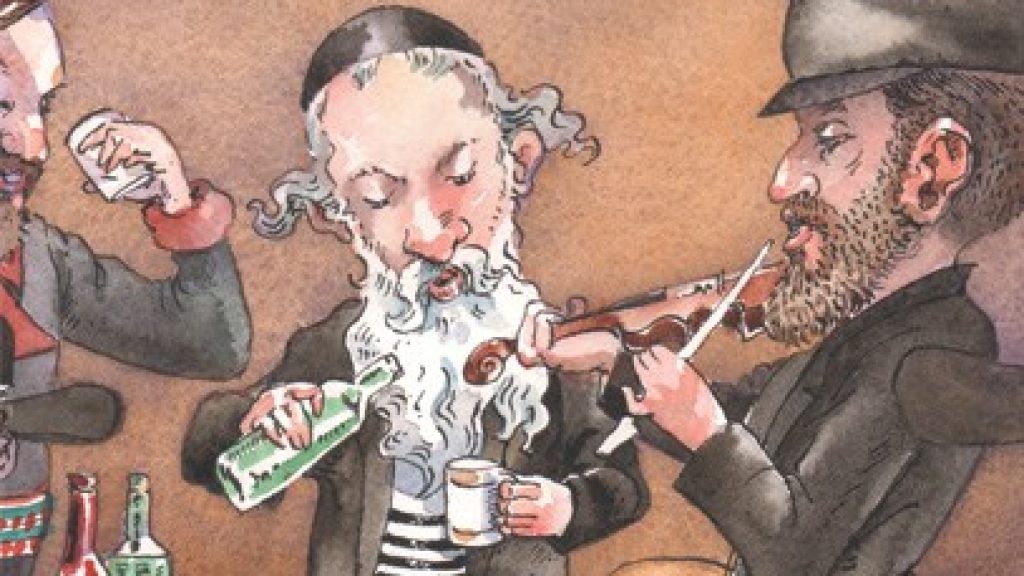
The bodily joy a group of Boiskers took in fulfilling the commandment to study Torah is still surprising, and that may have something to do with the Torah they chose to study.

The Unbearable Lightness of Exile
A new book asks if exile is really that bad.



Comments
You must log in to comment Log In