Awe and Shmutz
The greatest challenge for a Philip Roth biographer is that Roth was there first, inventing himself as he went. “Making fake biography, false history, concocting a half-imaginary existence out of the actual drama of life is my life,” Roth once said to an interviewer, and he spent that life substituting fictional Roths—Portnoy, Kepesh, above all, Zuckerman—for the real one, confounding readers and researchers alike. “There has to be some pleasure in the job, and that’s it,” he said.
If Roth was his own biographer, how can anyone else compete? Roth’s authorized biography, by Blake Bailey, was published in 2021, three years after his death. It is a massive, richly encyclopedic volume, which is indispensable but sometimes credulous in taking Roth’s side (especially against ex-wives and lovers) and a bit tone-deaf about his Jewishness. Shortly after it was published, Bailey was accused of grooming teenage girls as a middle school teacher, and of sexual assault. W. W. Norton canceled its second printing (the book was republished by Skyhorse), and the largely celebratory discussion of the biography and Roth’s literary genius turned into a discussion of his own issues with women.

In his new biography, Philip Roth: Stung by Life, Steven J. Zipperstein is fully aware of what it takes to measure Roth against the tales of himself he told in his novels. His book, slim and eloquent, is more consistently insightful than Bailey’s. Although it does not aim to be another massively researched doorstop, Zipperstein nevertheless dishes head-turning revelations from archives and informants, at times in a gossipy tone. He also has a loving eye for Roth’s Jewish environment.
A wide-ranging scholar of Russian and American Jewish history, Zipperstein has savored Roth from the moment he encountered him in the Spring 1967 issue of Partisan Review, which published an excerpt from the forthcoming Portnoy’s Complaint (“Whacking Off”). “I was an Orthodox Jewish teenager,” Zipperstein writes, “eager not to abandon the only way of life I knew but wrecked by reading the likes of Roth, whose confessional voice, explosive intelligence, and impatience with dishonesty to oneself all had the feel of a barrage of urgent letters addressed just to me.” Zipperstein reprises Roth’s lesson as he absorbed it: “Nowhere, Roth announced, was there a true and full escape from life’s onslaught. The most essential challenge to the prospect of everlasting peace was carried right there in one’s own body,” in the shape of sex, along with physical frailty.
Ever the not-nice Jewish boy, Roth prided himself on the taste for disruption that colored his life as well as his writing. He was a literary anti-pastoralist, allergic to the peace promised by those who want to reconcile us with the universe. He sided with our explosive frustration over the taming of desire that the pastoralists, among them rabbis with their moralizing sermons, imagine is possible.
From the beginning, Roth struck out against the suffocations of American Jewish identity. But he also clung to family, neighborhood, and Jewishness. Zipperstein paints an incisive, affectionate portrait of Roth’s hometown—Newark’s Weequahic neighborhood, a little Jewish utopia with no taverns or factories, whose high school produced more future PhDs than any other in the country. The neighborhood was 95 percent Jewish, a refuge from the Gentile insults Jews had to endure in downtown Newark. Roth’s father, Herman, was opinionated and headstrong, a hocker, as he called himself, always ready to put his two cents in (at one point, he wanted the teenage Philip to enter the then-burgeoning banana trade). “Why do I continue hocking? I realize it’s a pain in the ass,” Herman wrote in a letter to his son, “but if it’s people I care for I will try to cure, even if they won’t . . . themselves.” Roth’s mother, Bess, was a fanatical homemaker and worrier who, his brother Sandy admitted, once brandished a knife at the dinner table while begging her sons to finish their meal, an incident recalled in Portnoy’s Complaint. Perhaps unsurprisingly, Philip became a demon of domestic order—in the army his bed was always perfectly made. At the same time, he was cultivating his skills as a tummler par excellence, with a talent for stand-up routines that would animate many of his novels.

He taunted Jewish suburban mores in the stories collected in his first book, Goodbye, Columbus, which won him the National Book Award when he was twenty-six. In “Defender of the Faith,” a manipulative army private uses his Judaism to evade responsibilities on the base. This provoked Emanuel Rackman, a prominent pulpit rabbi and former military chaplain, to ask, “What is being done to silence this man? Medieval Jews would have known what to do with him.” The answer was not much, though Roth always made a great deal about his attempted muzzling by the forces of respectability.
A deeper wound came from Irving Howe, a critic Roth had long admired. In a piece for Commentary in 1972, Howe accused Roth of relying on the “literary hand-me-downs of American Jewish fiction,” adding, “I doubt, in any case, that Roth is really interested in a close and scrupulous observance of social life.” A decade later, Roth took revenge in The Anatomy Lesson, his third novel about his alter ego Nathan Zuckerman. The Howe figure is Milton Appel, a critic who has never “taken a mental position that isn’t a moral judgment.” Appel’s “virtue racket” is the opposite of Zuckerman’s unrepentant rebelliousness. Howe’s criticism may also have spurred a more serious response than Roth would ever have admitted. His later works feature careful, tenaciously researched studies of social life, Jewish and otherwise.
Roth was obsessed with Jews and Jewishness but turned off by Judaism. His attack on decorum was, he thought, an act of loyalty to those “unaccommodating Jews, full of anger, insult, argument, and impudence.” He was able to convey his people’s “fanatical security, fanatical insecurity,” he said, more than rabbinic respectability ever could.
If Roth’s identity was formed by headstrong Jews, his writing was shaped by Henry James. Zipperstein sees Roth as a disciple of James, another antipastoralist, though a more discreet one than Roth. James, like Roth, is all about the way humans are messier and more contradictory than expected, a fact that makes trouble for the author. For James, imagining people’s lives is what a writer does, and when he gets them wrong, he goes back to the drawing board. Roth does the same, most of all for the Roth stand-ins that populate his books. In American Pastoral Roth declared, “Getting people right is not what living is all about anyway. It’s getting them wrong that is living, getting them wrong and . . . getting them wrong again. That’s how we know we’re alive: we’re wrong.”
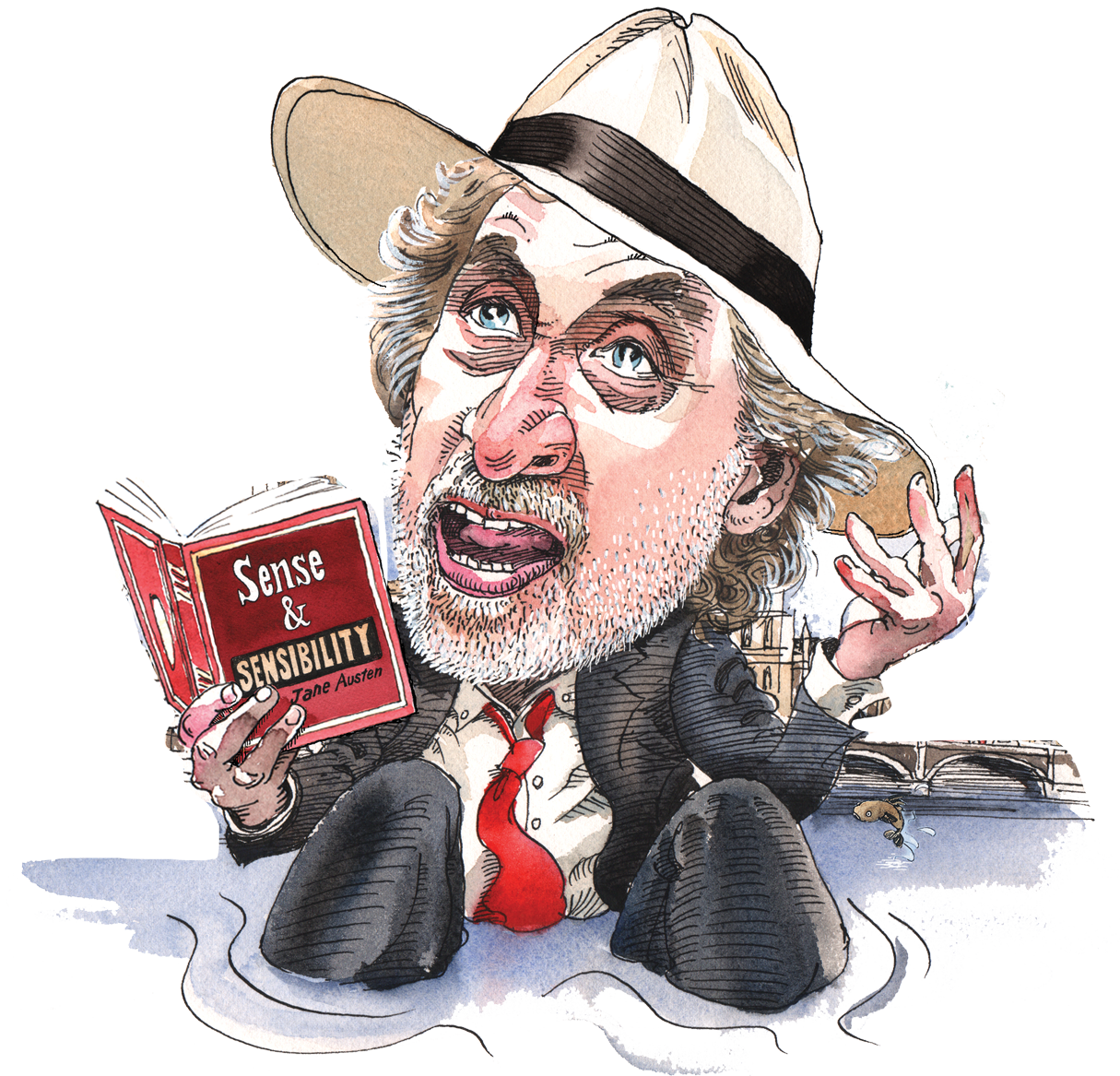
In his best novels, Roth reshapes his characters as he learns new things about them. He wants to get them right, but they keep surprising him. Like Lambert Strether in James’s The Ambassadors trying to grasp Chad Newsome’s life in Paris, Roth’s Nathan Zuckerman in The Counterlife mulls over his brother Henry’s metamorphosis from a suburban dentist to a ba’al teshuvah in the Judean hills. Suddenly Zuckerman thinks, “Can it be a conscious ploy? What if it isn’t still more of that passionate, driving naïveté for which he has always shown such talent but a calculated and devilishly cynical act? What if Henry has signed on with the Jewish cause without believing a word? Could he have become that interesting?” The notion of having a talent for naïveté is wryly Jamesian, as is the prospect that naïveté might just be a cover for cynicism, all of which adds up to a more interesting quarry for an author.
Roth is Zipperstein’s quarry, and his biography has its share of fascinating disclosures. In 1962, for instance, Yeshiva University hosted a panel on “The Crisis of Conscience in Minority Writers of Fiction.” Roth (fresh off the success of Goodbye, Columbus) and Ralph Ellison were the stars, alongside a forgotten Italian American novelist named Pietro di Donato. Roth always described it afterward as an ambush, a coordinated assault on him with questions from the audience like “Mr. Roth, would you write the same stories you’ve written if you were living in Nazi Germany?” Thirty years later, he still felt wronged: “I was . . . being grilled. . . . I was not just opposed but hated,” he wrote in his memoir The Facts. But in fact, Zipperstein writes, “Roth’s recollections are contradicted by a tape recording—long buried in Yeshiva’s archives because Roth had threatened a lawsuit if it was aired or published.” The tape showed the audience laughing at his jokes, applauding him repeatedly. At one point, Zipperstein writes, he “brought down the house” with appreciative laughter.

During the event, Roth mentioned a letter from a disgruntled reader in Detroit who asked, concerning his short story “Epstein,” about a Jewish adulterer, “Why so much shmutz?” This was a question, Roth said, “to which I have no answer. . . . It is a question that literature is always asking with wonder and awe.” He added that “to have to deny the actuality of shmutz, is to make Jews less than human.”
The search for the shmutz turns over many a new stone. Zipperstein draws on diaries by several of Roth’s close friends, his first wife, Margaret (Maggie) Martinson, and the never-before-seen diary of his longtime mistress Maletta Pfeiffer. Zipperstein significantly revises the portrait of Martinson left to us by both Roth and Bailey:
For the remainder of his life, even after his retirement from writing, he would describe at length in memos to his biographers how Maggie had nearly destroyed him at just the moment he was first taking off as a writer. Roth acknowledged the rank ethnocentrism of this portrait while still insisting it was entirely accurate.
For Roth she was, as Zipperstein puts it, “the same seductively dangerous gentile his father had long warned him about.” But this was as one-sided and self-serving—fictional—as his account of the Yeshiva University event. Martinson was indeed a combative, highly manipulative woman and an alcoholic. She really did trick Roth into marriage by buying urine from a woman in New York’s Tompkins Square Park and using it for her pregnancy test, a deed that Roth recounted in book after book. But she was also his best early reader and editor. She left an account of their relationship in her diary that, Zipperstein persuades us, is in some respects more acute than Roth’s fictional portraits, including his second novel, When She Was Good. In 1968, a few years after their divorce, Martinson was killed in a car wreck, a fate eerily predicted in When She Was Good. Roth was struck with guilt, Zipperstein writes.
Maletta Pfeiffer, with whom Roth conducted an exuberant affair throughout his marriage to the actress Claire Bloom and beyond, was the model for Drenka, the sexual daredevil and nurturing earth mother in Sabbath’s Theater. They finally broke up when she told him she was going to tell her children that she planned to go to Sweden with Roth when he won the Nobel Prize—an event he was sure would happen, though it never did. For Roth this meant publicity, and, worse, perhaps another marriage. Soon, Pfeiffer learned, Roth had a new girlfriend, Julia Grolier, “whom he would come to declare brought him more happiness than anyone ever before.”
Unlike his master, the decorous Henry James, Roth let his sexual thirst, and sexual grossness, enter directly into his work. He subscribed to Freud’s claim that art and culture are substitutes for the primal energy of sex. Zipperstein, drawing on Roth’s loyal friend and perceptive critic Claudia Roth Pierpont, describes Roth’s credo in Sabbath’s Theater:
No matter what, we all face extinction, probably preceded by excruciating pain and other dreadful humiliations. Sex can momentarily soften, even momentarily obscure the onslaught, but it can do no more than that—which, to be sure, is more than anything else can do.
That “to be sure” is something of a dare: Is it really true that only the sexual urge, with its oblivious intensity, provides a momentary stay against death? Roth, who divided his life between an ascetic devotion to the demands of his art and an unruly sexual acting-out, clearly trusted in sublimation, at least during his long and diligent working days.
Many Roth heroes are ascetics who get their comeuppance, ambushed by life’s unruliness. But the rebels like Portnoy, who reject all discipline, fare little better. Often in Roth, the apparent freedom afforded by rebellion turns out to be a straitjacket. The revolt against piety may deform the soul into a raging thing, as is the case with the fire-breathing Judean settler Mordecai Lippman in The Counterlife or the Vietnam-era terrorist Merry Lvov, the Swede’s daughter in American Pastoral. Even in Sabbath’s Theater, Roth’s paean to joyous, reckless liberty, Sabbath’s satirical denunciations of his wife are bitter and narrow, and he is sometimes just an embarrassing old man rather than, as he thinks, a bold, unfettered erotic maestro.

Perhaps Roth’s subtlest and most permanent exploration of these themes is in The Human Stain, where Coleman Silk crafts a new self as a white man at the greatest cost, losing his family and forcing himself to live with an intolerable secret. His motive is freedom, but since his whole adult life is built on a lie, he ends up cornered, unjustly accused of racism. His torment is only assuaged, typically for Roth, by a rapturous affair with a much younger woman.
Sensitive to any hint of betrayal, Roth was himself a betrayer, and could be sadistic in his need for independence. After a lover, Ann Mudge, attempted suicide, he told her, “Don’t think this is going to get me to marry you.” There were many other bad moments, most stemming from Roth’s utter unwillingness to resist sexual temptation. Drawing on Pfeiffer’s memoir, Zipperstein reveals that Roth seduced a friend of Claire Bloom’s teenage daughter Anna. In his biography, Bailey repeated Roth’s version, in which Anna’s standoffish dislike of Roth, rather than his obsession with her friend, drove a wedge between him and Bloom.
Claire Bloom accused Roth of harboring “a deep and irrepressible rage . . . and a profound distrust of the sexual power of women,” words that Roth never got over. He wrote a hundred-plus-page denunciation of Bloom’s memoir about their marriage, which thankfully remains unpublished. Is Bloom’s Roth the right one, or is Pierpont’s in Roth Unbound, where the novelist is remembered as a devoted, sweet-tempered friend to many women? Roth criticized his own vindictive and self-righteous impulses in his books, showing how they entrap the self though they seem to promise freedom. Yet he was still a vengeful spirit.
The urge to blame, Roth’s deepest stain, was an aspect of his need for control, which was just as strong as his crazy libido. “To allow for the chaos, to let it in,” is the goal, someone tells Zuckerman in I Married a Communist. But Zipperstein convincingly argues that Roth is at his best when he is least Dionysian. Despite his boast that “Céline is my Proust,” he didn’t do well with literary improvisation. His freewheeling satires, The Great American Novel and Our Gang, are sloppy, nearly unreadable. Instead, Roth needed the fine structures he deployed in his later works. Operation Shylock contains its lively chaos in nested Chinese boxes, achieving a virtuosic balance between mishegas and adroitness.
In Everyman, one of his last books and one of his grimmest, Roth praises the aging protagonist’s sudden erection after flirting with a woman, “feeling . . . as though he were fifteen. And feeling, too, that sharp sense of individualization, of sublime singularity, that marks a fresh sexual encounter or love affair.” When he wrote these sentences, the seventy-two-year-old Roth was in love with twenty-nine-year-old Catherine Steindler, who would soon leave him, like all the other women in their twenties and thirties Roth fell for in the last two decades of his life. He got them wrong, and wrong again. He used the erotic thrill and crushing disappointment in his fictions, which will outlive, the way all superior art does, the body’s pleasures and betrayals.
Zipperstein quotes Roth’s close friend Judith Thurman, who was with him in his final days. “Because we were so real to him, we were realer to ourselves,” Thurman said of the dozen-plus “remarkable women” clustered around his deathbed, “ranging in age from twenty-six to eighty-seven, half of them former lovers.” His last words, before thanking his nurses, were about his ex-lover Julia Grolier’s twins: “I loved your kiddos. They were the joy of my life.”
Roth showed his sympathetic, forgiving side, too, when, a few years earlier, he gratefully accepted an honorary degree from JTS. It was “the first time I’ve been applauded by Jews since my bar mitzvah,” he said in his acceptance speech. However, when it came to his final instructions, he asked that no Kaddish be said over his grave.
Comments
You must log in to comment Log In
Suggested Reading

Tangled Truly
Letters of ink. Letters of the heart.
At Home in America
Just beneath the surface of this Holocaust memoir is, in fact, an altogether different tale: a paean to the good life in America.

Getting Out from Under: The Philip Roth Story
“I don’t want you to rehabilitate me. Just make me interesting,” Philip Roth told his biographer. Has he?

“Love Between Writers”: Saul Bellow and Bette Howland
“I thought you knew that I belonged to the Truth Party too,” Bette Howland wrote her fellow novelist, mentor, and sometime lover, Saul Bellow. Her son recently found a new cache of letters between them that illuminates two brilliant artists at work.
Shimshon Leshinsky
Very well written intelligent entertaning review. You discarded some of his novels such as American Pastoral too quickly.I met Stephen and heard his lecture yesterday at the Jerusalem Book Festival 26 May 2026. We got very little about his feelings and thoughts about Israel although some of his books took place here.