The Weitzman Museum’s Thirteen-Gun Salute
Barely a speck in the ocean of material on the American Revolution, the Jews are usually considered small fry. But not if the Weitzman National Museum of American Jewish History’s ambitiously conceived new exhibition, The First Salute, has anything to say about it. The first of several planned reimaginings of the Philadelphia museum, this 4,500-square-foot display of more than one hundred items carves out a considerably enhanced role for the Jews. In what might be seen as a shot across the bow both for the museum and the community whose patrimony it preserves and celebrates, the show makes much of a little-known incident in 1776, transforming a footnote into a major historical moment.
When, in November of that year, the Andrew Doria, a ship of the fledgling American navy, sailed into the busy harbor of St. Eustatius, a tiny Caribbean island under Dutch dominion, it issued a thirteen-gun salute (one for each new state), which was cordially answered with eleven blasts by the Dutch authorities at Fort Oranje, in accordance with naval protocol. Said to be the first time the American flag—in this case, the Grand Union Flag—was saluted in a foreign port, the incident made waves in diplomatic circles. Since then, it’s been painted and published, the subject of several scholarly articles over the years as well as a popular book by Barbara W. Tuchman.

Enlarging the frame of the story, the Weitzman looks more closely at St. Eustatius, arguing that local Jewish merchants smuggled much-needed supplies of gunpowder and provisions to desperate revolutionaries and helped save the day. As cannons fire salutes, soldiers wield muskets, and the enslaved load and unload barrels of cargo in the sonically and visually arresting film that launches the exhibition, the Jews’ acts of derring-do “would change the course of history” and “help forge a new nation,” its narrator intones.
Through the artful use of cinematic and digital film as well as color photography, portraiture, and an archipelago of objects and documents culled from a network of institutions (among them Philadelphia’s Museum of the American Revolution, the United Kingdom’s National Archives, and the Cultural Heritage Institute of the Public Entity of St. Eustatius), the Weitzman works hard to make its case. Enlisting drama, speculation, heartbreak, artificial intelligence, and the intellectual firepower of its curator Josh Perelman and a trio of distinguished academic advisers (Laura Arnold Leibman, Pamela Nadell, and Jonathan Sarna), The First Salute treats its visitors to a succession of geography and history lessons.

No sooner do we enter the exhibition than we land on the island of St. Eustatius, where one of its late-seventeenth- or early-eighteenth-century cannons and a corresponding set of cannonballs await. A color palette of ocean blues and greens envelops us. Light levels do double duty, deliberately kept low to protect the historic documents on view while also calling to mind the murky depths of the sea. Swaths of undulating dark-blue fabric meant to evoke waves suspend from the ceiling. Lest visitors miss these visual cues, large-scale contemporary photographs of the harbor and its guardian fort make the maritime environment explicit.
So, too, do a series of standing text panels that succinctly inform while keeping museological wordiness to a minimum. Carefully excerpted selections from eyewitness accounts rather than curatorial observations keep things moving. Here, a visitor to St. Eustatius named Evangeline Walker Andrews describes the island as a “continued mart” of buying and selling, even as an official of the Dutch West India Company instructs its local commander to grant “freedom of religion and trade” to the Jews who call it home.
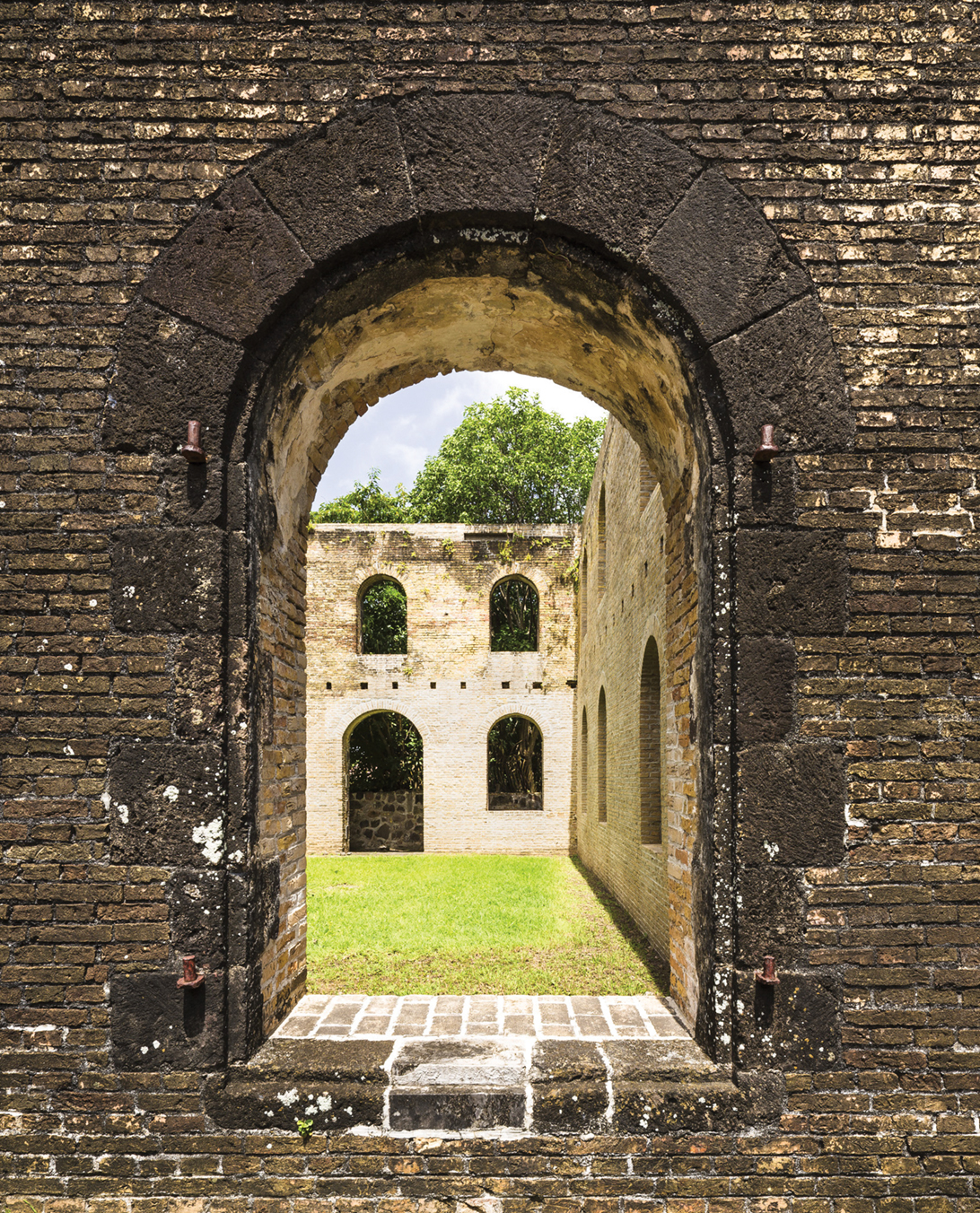
Numbering several hundred mostly Sephardi souls, this outpost of Jewish life was buoyed by the support of its mother Jewish community in Amsterdam, which sent overseas an earnest brass Hanukkah lamp as well as pallets of hardy yellow bricks with which to build its two-story synagogue Honen Dalim. One of the taller and sturdier structures on the eighteenth-century island, this house of worship withstood a devastating hurricane in 1772; hundreds of years later, its perimeter walls remain upright.
The Jewish community of Amsterdam also sent people, such as Rachel Mendes Balborda, to St. Eustatius. An impoverished widow, Balborda and other poor Jews were given a one-way ticket to its shores and other Caribbean islands such as St. Thomas, Barbados, and Suriname. A historic document, the Registro dos Despachos, records the bare bones of this global transaction.

What follows next underscores the island’s regenerative qualities. The first of four remarkable talking portraits is of Balborda. Dressed in a vivid blue dress and encased in an old-fashioned wooden picture frame, one hand resting on her lap, she comes to life and speaks to us for a minute or two before reverting to her stationary self. Drawing on a script composed of primary sources, the Dutch widow talks in accented English of how her new home “felt exotic, beautiful, and entirely new” and made her realize that “widowhood is not an ending. It’s the moment you gather yourself, lean on the women around you, and carry your family’s stories forward.” Meanwhile, a few feet away, Hannah de Leon Benjamin, a skilled midwife and healer dressed in a white blouse and a colorfully striped skirt with a white turban atop her head, describes her fulfilling work “calming” a fever, “guiding” a birth, and comforting the bereaved on the island.
Through the canny, sparing, and, yes, revelatory use of artificial intelligence, or what Dan Tadmor, the museum’s CEO, calls “curatorial technology,” plot points become people. History is given a face, a voice, gestures. A bugaboo of the historical profession, the cause for hand-wringing everywhere, artificial intelligence, we now see, can also enlarge the frame of interpretive possibility when in service to history rather than an end in itself.
We soon take our leave of St. Eustatius. A series of circles and dotted lines on the floor subtly guides our way, linking the Jews of one Caribbean community to another. With more Jews than the American colonies, a mix of voluntary immigrants and refugees as well as mixed-race descendants of the enslaved, those who called Suriname, St. Thomas, and Barbados home made the islands the center of eighteenth-century Jewish life in the New World.
At this point in the gallery, the economic and personal involvement of the Jews in slavery graphically unfolds, a pair of wrist shackles in full view. Its telling is unsettling, as it should be. Elsewhere, we’re on more familiar ground. The items on display—a Torah scroll from Suriname, a letter attesting to the kashrut of fourteen barrels of kosher meat sent from Newport—ring a more comforting bell.
And then we’re whisked off to the colonies and the early years of the Republic, where visitors experience in compelling, human detail what it meant to be American Jews in the making. A 1780 decorative sampler of the Ten Commandments embroidered on linen by a New York teenager named Rebecca Hendricks points to the covenant’s visible presence in these parts, its dainty crown read as either an homage to King George or as a traditional Keter Torah. A small, handwritten calendar of Jewish holidays in 1778, called the “Patriot’s Lu-ah,” suggests the possibilities of living a full Jewish life, while the beseeching tone of a 1784 petition from Philadelphia’s Congregation Mikveh Israel to the local authorities requesting permission to construct a mikvah hints at public resistance.
As the exhibition nears its close, visitors are returned to St. Eustatius and its Jews for whom, alas, there’s no happy ending: a tumultuous film with a bombastic soundtrack shows us why. The island was invaded in 1781 by British Admiral George Rodney, who regarded it as enemy territory or, worse still, as a “nest of vipers” who “deserve scourging, and they shall be scourged.” Treating the Jews among them with particular cruelty, he imprisoned the men, seizing their property and goods before banishing the entire community from their homes.

St. Eustatius’s Jews protested that “if nothing can be alleged against us but the religion of our forefathers, we hope that will not be considered a crime,” but to no avail. Two more talking portraits, those of the successful merchants Benjamin Lindo and Moses Myers, whose handsome figures are encased in sumptuously colored waistcoats of pink silk and burgundy velvet, respectively, tell the story of their ruin. Despoiled of everything, they and their fellow Jews were forced to flee and start anew. Again.
Rather than end on that note, The First Salute concludes with the blessings of freedom. A large and richly detailed sampler from 1822, the handiwork of another Jewish teenager, this one named Julia Abrahams, makes the point. Featuring a sturdy brick house at its center, it happily acknowledges the passage of time since the Declaration of Independence. By then, the Jews of St. Eustatius had already receded into the shadows of history.
The First Salute is at its best when the incident that gives the show its name is a jumping off point rather than a literal conceit. When objects do the talking rather than, say, the words of Admiral Rodney, the encounter is at its most resonant. Featuring a constellation of artifacts, of armaments and ritual objects that don’t usually consort with one another, it bears witness to interconnectedness: between Jewish history and world history, between a Jewish community in one part of the world and a Jewish community in another.
The narrative is also most compelling when understood as a case study of the process by which history is constructed. Composed of fragments—the flotsam and jetsam of the past—it thrillingly demonstrates what happens when imagination keeps company with interpretation.

Consider the cautiously optimistic letter—written in Yiddish on July 28, 1776, from Philadelphia merchant Jonas Phillips to his cousin in Amsterdam about business, politics, and the recent Declaration of Independence—which Phillips mailed by way of St. Eustatius because, he wrote, “It is not always possible” to send a letter to Europe from America via England:
The Americans have already made themselves like the States of Holland. . . . The enclosed is a declaration of the whole country. How it will end, the blessed God knows.
Along with the letter, he included a folded copy of the declaration’s text from its first printing known as the “Dunlap broadside.” As the missive slowly made its way over the high seas, it and other bags of mail were intercepted by the British. Unfamiliar with handwritten Hebrew script, much less Yiddish, they suspected it of being written in code and confiscated it.
For more than a century, the letter languished, unread by its addressee or anybody else, in a British archive. But here are Phillips’s words in Philadelphia in 2026 on the second floor of the Weitzman National Museum of American Jewish History—visible, present, and accounted for. Espionage was never its intent. All the same, Phillips’s letter reminds us that the past, too, has to be decoded.
Suggested Reading
Haunted Heritage
We know what makes a house a mansion. What makes it Jewish?

When Freedom Began to Ring
How the land of opportunity became the opportune land for Jews to thrive.

The Court Jew Who Hated Kings
In July 1492, three months after Spain published its edict of expulsion, Abravanel sailed with tens of thousands of other refugee Jews to Italy, where the history of Sephardi Jewry and its most illustrious leader resumed on somewhat friendlier grounds.

Sundowning
In Morningstar Heights, Joshua Henkin tells his story simply and directly, with a narrative economy that conceals much close observation and human understanding. These have always been the strengths of his work, though they are not the qualities best rewarded in contemporary American fiction.


Comments
You must log in to comment Log In