A Terrible Price
The Hamas massacre on October 7, 2023, pulled Asaf Hazani away from his civilian pursuits as an anthropologist into the parallel life he shares with many Israelis—that of a soldier in the IDF reserves. He’d spend the next months as a colonel at a divisional headquarters outside Gaza as the country struggled to comprehend the scale of the murder, kidnapping, and rape inflicted by Palestinians in southern Israel and as the army fought to reverse its own disastrous collapse in the war’s first days and move to the offensive.
Hazani has now published the first book-length look at the Gaza war from inside the army, presented as the field notes of an anthropologist who found himself in uniform and recorded his experiences in the war’s first stage, from October 2023 to January 2024. But it’s a stranger and more personal work than suggested by that description. The pages of Anthropology at War are filled with impressions, thoughts, associations with mythology and modern academic theory, even a poem the author wrote: “In a city’s navel / at the edge of a mosque / stands the saddest, saddest, saddest soldier in Gaza. . . .” This is the raw material of someone coming out of a powerful and disturbing experience and trying to understand it. A reader gets the impression that if Hazani were a painter, this would be a series of paintings, and if he worked with metal, we’d be looking at a sculpture of some kind.
The book’s Hebrew title is a quote from 2 Samuel, from an exchange between King David and his field commander Yoav: Khazo ve-khazeh tokhal he-charev (2 Sam. 11:25), sometimes translated as “The sword always takes its toll.” It’s an old soldier’s statement of fatalism—there’s a bullet with your name on it. Hazani, who grew up in an observant home in Jerusalem, struggles with the seemingly biblical quality of these events: the way the war began with mass slaughter and the taking of captives, as if this were the Book of Joshua, and the desire on our side for a kind of retribution that suits the crime. He registers the irony of a modern state that fights with unmanned drones and algorithms while soldiers entering combat blow shofars and call upon el nekamot, the God of vengeance. A reader is reminded of the popular hip-hop revenge song Harbu Darbu, released in the aftermath of October 7, which refers to our enemies as “sons of Amalek,” the archetypal foe of the Israelites in the Bible. The same term has also been used by the prime minister. The name the army chose for the war when it began was Iron Swords, which also has the ring of antiquity.

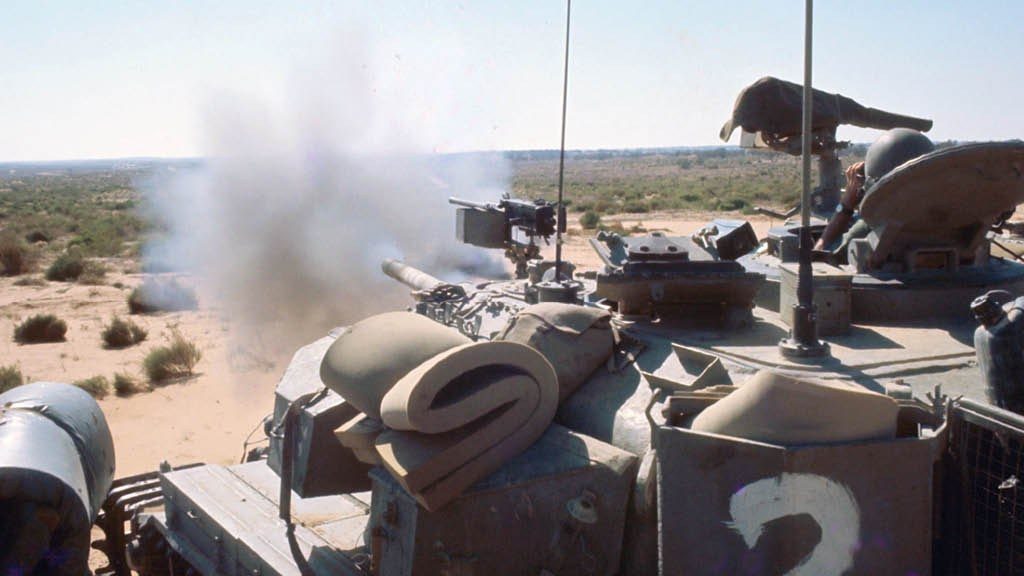
and in the war that followed. (Courtesy of Alexi J. Rosenfeld/Getty Images.)
The operative word and sentiment at play, Hazani believes, is “vengeance.” He observes, with discomfort, a verse from Psalms that he finds on signs hanging in army outposts: “I have pursued mine enemies and overtaken them, neither did I turn back until they were consumed” (Ps. 18:38). Vengeance is an impulse, not a military order. What of open-fire regulations and the laws of war? The Israelite warriors of the Bible often didn’t distinguish combatants from civilians. Neither do the Palestinian Muslim killers, many of them civilians, who began this war with a massacre of Jewish civilians and then ran to hide behind their own civilians. “The start-up nation, at the beginning of the twenty-first century,” Hazani writes, “is fighting an epic war with swords of iron.”
One way to describe the war’s first month is to say that Israelis, horrified by the massacre of our people, rallied, volunteered, and sacrificed their lives for the safety of the fragile Jewish state whose borders and foundations seemed to be cracking.
The story of October 7, and of the months that followed, is a story of heroism both military and civilian. Forced to conduct a war above ground, below ground, among civilians, and eventually on a half-dozen fronts, the citizen army was strained to its very limit but survived and has persevered. Many of us take this for granted, but we shouldn’t. As anyone who has been in Israel recently knows, our streets and train stations are plastered with stickers showing the smiling faces of hundreds of fellow citizens, mainly young men, who went off to battle and won’t come back. The civilian carnage resulting from Hamas’s cynical tactics in Gaza is horrific, our moral quandaries tortuous, the international hostility to Israel disturbing. But the result has been, at the time of this writing, that Israel’s position in the Middle East has been transformed and our enemies stricken.
The word “heroism,” as far as I can tell, appears once in Hazani’s book—and then only in a text from the military rabbinate that he doesn’t like. “Vengeance” appears twenty-seven times. He has little to say about any real battles, and indeed the staff officer Hazani, the one involved in the day-to-day conduct of the war, seldom appears. The demands of field security and army censorship, and perhaps the author’s own inclinations, dictate that anyone hoping for military details in these field notes will be disappointed. He’s aware of the complexity of the war, of course, and watched—mainly from his post at a staff base outside Gaza, occasionally on visits to the urban battlefield—as tens of thousands of Israeli soldiers went about the impossible task of hunting down the terrorist army that concealed itself in tunnels and dressed its fighters like civilians, while 250 Israeli hostages were caged underground or secreted in the homes of Palestinian families.
I’ve heard descriptions of the war from soldiers coming back from Gaza, including one whose elbow was shattered by a sniper round. The long package in the hands of the man in the street may be just his meager belongings—or it may conceal a rocket-propelled grenade launcher that’s about to kill you. The kid in the alley may be getting food or running messages for Hamas fighters who may be under your feet. Maybe that veiled shape is a woman—or maybe it’s a man with a magnetic mine coming for the side of your tank. Maybe that’s a sniper in the window, maybe a little girl. Maybe you’ll get home, maybe not.
“The challenge facing the IDF,” writes Hazani, “is maneuvering in a heavily populated territory scattered with explosive devices, with many enemy positions underground and in multistory buildings.” But his book isn’t animated by the unique military problems of fighting Hamas in Gaza, and he seems to think the anthropology of the war is comprehensible without them. He also has little to say about common combat soldiers. Indiscipline and extremism are worthy of thought—grit and sacrifice, less so. His tone is one of melancholy introspection. At its best the book is authentic and revealing, but anyone hoping for a portrait of this war will find less a tour of the battlefield than of the author’s mind.
The military that summoned Asaf Hazani to service on October 7 was shattered by the worst failure of defense and intelligence in Israel’s history. A reserve officer I interviewed remembered joining his unit that first day and discovering an uncertainty among fellow commanders that they even had the moral authority to issue orders. Clear warnings of an impending attack were missed and the border barely defended. After a failure like this, why should their soldiers trust them? And why should they trust their own superiors?
Hazani describes a conversation with a civilian mechanic at a garage in the war’s first months. The mechanic saw his uniform and rank and promised him special treatment but added bitterly that he didn’t trust anyone from the army. The exchange, the author realized, captured the baffling spirit of the moment:
On one hand—a colossal failure after which every kind of trust was lost, evaporated, vanished. On the other—the understanding that we have no other army. And that with this army, in this country, we must move forward.
The most striking chapter of the book is titled “A Professional Army of Militias,” in which Hazani describes the army as he encountered it in this war—chaotic and undisciplined at worst, creative and improvisational at best, and usually everything all at once. These qualities would only become more pronounced after the early stage covered by this book, when units became increasingly strained by exhaustion and brutalized by combat far longer than any scenario ever envisioned by planners of Israel’s reserve army. But the indiscipline was present, according to Hazani, in the war’s first months and is in fact endemic in the IDF.
Sometimes, Hazani writes, soldiers destroyed houses in Gaza when there was no operational need to do so. Sometimes soldiers didn’t use explosives but just set the houses on fire, which he sees, in at least some cases, as a primal enactment of revenge. He describes the ubiquitous smartphones, forbidden by army rules in theory but present in practice, even in the hands of senior officers—a failing he sees as symptomatic of an army that says one thing and does another.
In one scene, Hazani describes a visit to a battered mosque in the combat zone, where Palestinian detainees were being questioned, hands tied behind their backs. Beyond the mosque’s destroyed wall was an Israeli tank, and then the moonscape of the urban Gaza battlefield, in which entire neighborhoods looked as if they’d come under the wheel of a steamroller. Booms were audible in the distance. Dusk fell. The battered mosque reminded him of a beit midrash, a Jewish study hall, but here the holy texts were in Arabic. What these soldiers have been through before this moment isn’t clear to the reader and might not have been clear to the author.
An officer questioned captives before releasing them back to the street, and a soldier gave each a bottle of water and a wafer. In front of the group of detainees waiting for questioning, Hazani writes, a soldier stood with a holy book and “ripped the Qur’an in front of the eyes of the bound Gazans.”
Because darkness was falling, after a while no one could see what the soldier was doing except the soldier himself. The book in his hands had already been badly damaged by the fighting that tore through the building. But he kept going, as if in a trance. Hazani walked over and asked what he was doing. “He answered with a sad look, truly the saddest look I can imagine,” Hazani writes. “‘Me? I’m taking revenge on them.’” The soldier’s commanders didn’t intervene. Hazani isn’t sure that the soldier’s explanation, revenge, is the real one—the soldier just believes it’s the most logical one, “more legitimate than depression, shock, or exhaustion.”
This incident and others are linked, in Hazani’s account, to the spirit of religious vengeance present in this war—our God against theirs. It’s certainly true that the Israeli army isn’t the army of 1967 or even the army in which I served in the late 1990s, when religion was still on the margins and the ethos of the kibbutz still reigned. Israeli society has changed, and the Labor Zionist ideology of the sword and olive branch has faded, replaced to a large extent by traditional Judaism. On the enemy side, of course, is not Arab nationalism but extremist Islam. If your relatives are murdered by killers who justify themselves with the Qur’an, you may succumb to the dark urge to tear one up.
Some of the religious spirit Hazani describes is visible in video from the staging grounds before the big push into Gaza in October 2023. When soldiers were preparing themselves for battle, many reached for ancient texts and blessings, and some, like Joshua at the walls of Jericho, for the shofar. There were often rabbis present, military and civilian, to bless and inspire them. When the soldiers of this moment needed to arm themselves with a story, it was less likely to be that of the Zionist pioneers or the one-armed hero Joseph Trumpeldor than that of Israel and Amalek.
Religious Zionist kids are disproportionately likely to serve in combat units and continue on to officer school, which is a credit to them. But this, too, has dictated a new military ethos. It also, Hazani thinks, encourages a spirit that he encapsulates with a phrase commonly heard among soldiers: lo ro’eh ba-eyna’im, literally, “doesn’t see with his eyes.” This is roughly equivalent to the word “berserk,” meaning soldiers who are acting instinctively and will do anything to win. This may be the only way to win in ground combat, which demands a kind of mental fuel beyond the imagination of anyone off the battlefield. But there’s an inevitable tension between this and an awareness of rules of war and of the need to distinguish combatants from civilians.
Whether all of this has something to do with what Hazani sees as widespread indiscipline in the ranks, or with his description of the army as a “professional militia,” is a more complicated question. Anyone watching this war or talking to soldiers, or anyone who has served in the army—or in any army, in any war—understands that there are constant lapses of discipline both light and severe. These days, some violations are caught on smartphone cameras by people not only immoral enough to commit them but stupid enough to film them: soldiers amusing themselves by wearing women’s clothing in homes they’ve commandeered on the urban battlefield of Gaza, for example, or stealing things from the apartments where they take cover. Property is vandalized and walls sprayed with graffiti. There have also been outright war crimes, only a fraction of which, presumably, are known—like the violent abuse of detainees in the military prison at Sde Teiman, where military prosecutors recently charged five soldiers with severely beating a Hamas prisoner, leaving the man with broken ribs and bleeding from a wound in his rectum.

The army’s ability to investigate itself is flawed but does exist, our civilian judiciary is embattled but present, and Israeli citizens and soldiers deserve to have crimes prosecuted and the truth known. Violence can never be fully regulated, and this is an inevitable part of war. The American massacre of more than eighty German prisoners at Chenogne in 1945, for example, doesn’t mean the Allies were wrong in World War II.
The challenge faced by anyone trying to write critically about the Israeli army, however, or about Israel, is that any critique will be seized on by the country’s legions of virulent opponents from the ideological world that produces calumnies like the “genocide” in Gaza, a fiction designed to tie Israel’s hands and enable its enemies. This world includes not just organizations like Amnesty International and arms of the United Nations but also much of the formerly mainstream Western press, which now mostly serves a progressive left that has a near-theological obsession with the villainy of the Jewish state.
Making things even harder is the fact that some of this hostility has seeped into the Israeli left. When the daily Ha’aretz, for example, whose owner recently called Palestinian terrorists “freedom fighters,” reviewed Hazani’s new work, the headline was, “Reservist’s Explosive Book on Gaza Exposes Israel’s War Machine from Within.” This kind of ideological sensationalism was certainly not what Hazani hoped to provoke with his field notes, and it cripples any honest discussion we Israelis need to have about how to fight implacable and ruthless foes without losing our soul.
I have a friend who serves as a major in my old reserve brigade, the Fifth, who left his wife and five children at home on October 7 and spent most of the next year fighting in Gaza. For the first few weeks he picked up bodies along the border near Kibbutz Nahal Oz. Then the unit moved into the strip to begin clearing the border village from which the terrorists attacked Kibbutz Nir Oz and murdered or kidnapped a quarter of its residents. Entrances to the Hamas tunnel network were everywhere in the village, including one at the local United Nations school. Little of the village was standing when the army was through with it.
Later, his unit held a few buildings in Gaza City, in an area they were told had been cleared but where they were hit constantly by small-arms and RPG fire. One day he had to pull the body of a fellow officer from a charred tank and then go back in to look for a missing arm. I asked him to read part of Hazani’s book and tell me what he thought, particularly about the idea that the army was undisciplined and motivated by vengeance.
It’s hard to understand the Gaza battlefield, he said when we spoke in his kitchen in Jerusalem, if you haven’t been in it. Even Israeli generals who fought in older wars can’t fully understand it. Every building may house a tunnel entrance and be booby-trapped. You don’t risk soldiers searching the house if it’s possible to just destroy it, and as the units advance through the neighborhoods, they blow up anything behind them—if not, they risk a bullet or RPG from behind. If the soldiers have enough explosives, they’ll use them, but if they need to use kerosene and a match, they’ll use those. I didn’t really need to be convinced: Early in the war, the principal of my sons’ high school was killed with three comrades while searching a booby-trapped house.
But although vengeance isn’t and can’t be a military order, my friend said, it is a legitimate human response. The Palestinian population that produced and applauded the October 7 massacre needs to see that such actions have a terrible price, as do any of Israel’s neighbors weighing similar acts. And Israelis need to know that their blood isn’t cheap. He remembered arriving at Nir Oz and seeing a trail of stolen items dropped by Palestinian looters who’d followed the armed fighters into the kibbutz. The items included children’s scooters and tricycles. (Thirty-eight kids were murdered by Palestinians on October 7, and with the confirmed murders of Ariel and Kfir Bibas, who were kidnapped from Nir Oz, the number of murdered children is forty.) “The IDF is a people’s army,” my friend said. “You’re a soldier and you’re a civilian. Maybe your brother was killed on October 7. The soldier who sees the tricycle is also a father.”
The characteristic of the IDF that Hazani’s book seems to suggest is a failure of the organization, the major said, is the organization—it’s an army not of professionals but of citizens, and this helps explain both failure and success in this war. It’s a point that Hazani acknowledges, writing, “A broad common denominator that included many people allowed the military recovery.” A more typical professional army might have been broken by the initial collapse.
When I asked another officer I know—also a major in the reserves, attached as an engineering officer to the staff of a regular infantry brigade—for his thoughts on the book, his attention was caught by Hazani’s use of the term “militias.” He didn’t disagree with the use of the word but thought the author missed the most relevant ways in which it applied.
Retired generals like Yair Golan and Noam Tibon heard the news on October 7, got in their private cars, and drove into the war zone, fighting with improvised units and weapons taken from casualties—this heroism, he said, could also be described as “militia behavior.” In his own unit, he saw that as the men were worn down in long months of fighting, as fewer reservists showed up, and as equipment began to run out, the vacuum was filled by improvisations conducted outside the military hierarchy. When no more engine parts were available for the D9 bulldozers vital for urban warfare, a civilian genius in his unit had the parts 3D printed by a friend in Israel and sent down to Gaza. The casualty and burnout rate of D9 operators is high, and when they ran out, the unit found civilians who knew how to operate heavy machinery and were willing to sign up despite the extreme risk. One of them was killed. And when the unit ran out of antitank mines with which to detonate buildings, someone got a civilian factory to donate tens of thousands of paint buckets that could be filled with liquid explosive. The militia instinct, he said, “is what saved the army over the past year.”
At the same time, there have been fatal accidents involving explosives in Gaza, and this completes the picture—that of an army that makes up for a lack of manpower, gear, and professionalism by winging it. There are discipline problems, this major said, and breaches of army orders, some of them severe. He saw crimes like looting punished by commanders. Most soldiers are doing the best they can, he said, and the army is a reflection of the society it serves. “Immoral acts happen,” he said, “but they’re on the fringes.”
The author of Anthropology at War isn’t an external observer; he’s a colonel. Hazani describes a scene at a logistics base inside Gaza where he sees war tourists wandering around—noncombat officers who have no good reason to be there, endangering themselves and getting in the way. But he, too, is a staff officer, and he’s also there. He doesn’t like seeing smartphones in the war zone against orders, but admits to having one. Even the army’s own intelligence analysts ended up using photos from the smartphones that weren’t supposed to be there.
Maybe other armies are different, and maybe ours should be. But as I read these pages, I couldn’t help thinking that a different army probably wouldn’t include a colonel with an anthropology degree who’d do his duty in the war, take notes, and dash off a tortured and thoughtful book the moment he got home.
Most worthwhile war literature appears only years after the fighting, sometimes decades, when tempers cool and perspectives sharpen. In this case, the war isn’t even over. Hazani’s book will be read in the future not as a conclusive account but as an honest first draft—a raw version of one early stage in events that the author, like all of us, struggled to understand as they were going on.
Comments
You must log in to comment Log In
Suggested Reading
Readjusting Sights
Reams of military history, and recollections by generals have been written on Israel’s many wars, but in this bookish country, Haim Sabato is one of the few Israeli soldiers to write a truly literary memoir.

Wartime Diary
Since October, in Gaza, hundreds of thousands of people are on the move in the rain, mud, and fire. They go from one space that is not home to another space that is not home; none of them safe. Where will they shelter? To what can they return?
Digital Anti-Semitism: From Irony to Ideology
From tweeting trolls to digital incitement, a contemporary history.
War & Peace & Judaism
Robert Eisen was walking to campus on 9/11 when he saw a dark cloud above the Pentagon. Alick Isaacs fought for the IDF in Lebanon. Their experiences prompted them to rethink peace and Judaism.


Yishai Jusidman
Another excellent piece by Matti Friedman. As Donald Rumsfeld said-- you go to war with the army you have.. Those bothered by the increased influence of Religious Zionistm in the IDF should do something to get the Tel Avivian youth that skips conscription (one third!) to enlist.