“A Chabad Hasid in His Own Special Way”
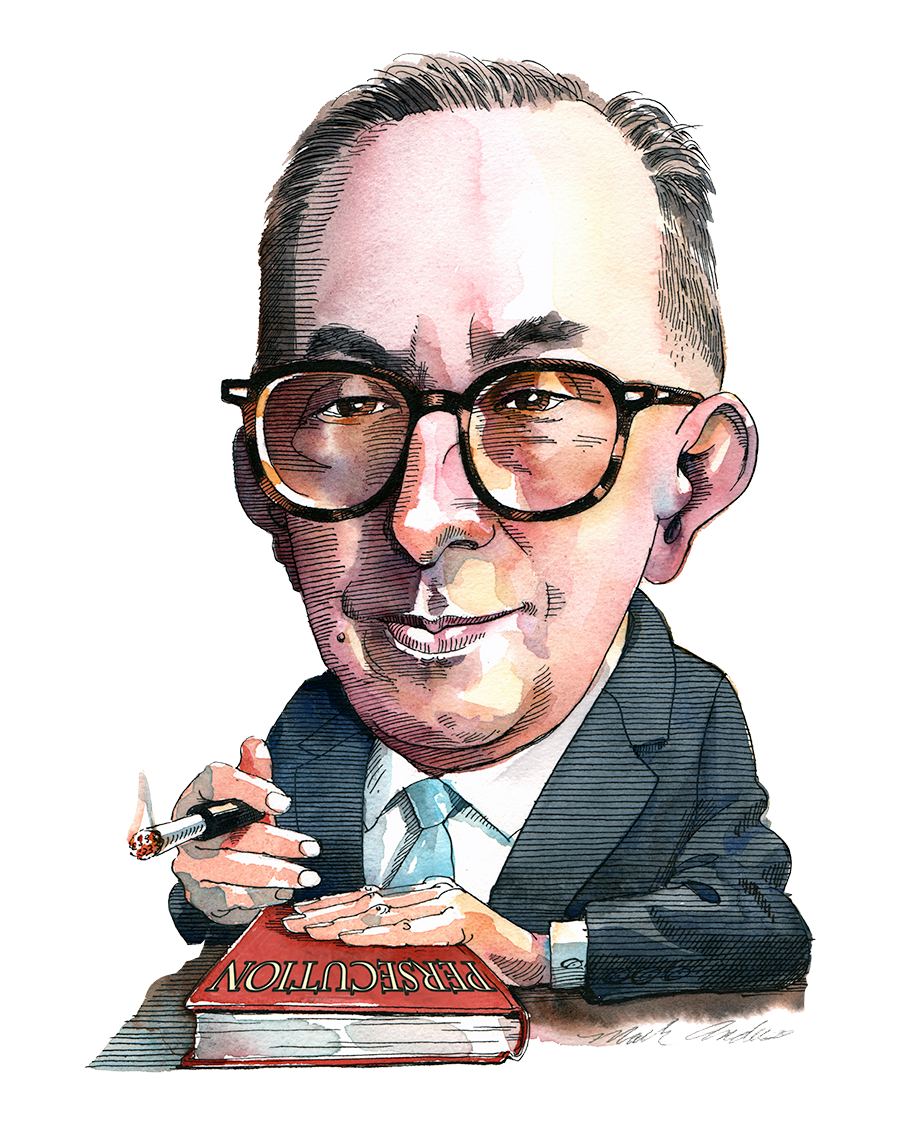
In his great memoir of his early years, From Berlin to Jerusalem, Gershom Scholem tells the story of how the twenty-seven-year-old Zalman Rubashov rescued him in 1917, after Scholem’s father threw him out of the house for “anti-German activities,” which was to say his Zionism. Rubashov invited the twenty-year-old Scholem to move in with him in a rooming house full of dislocated Russian Jewish intellectuals, found him work as a translator, and when he was drafted into the German army, accompanied him to the barracks in Berlin when he was inducted. “At the gate,” Scholem wrote, “he embraced me Russian style and kissed me on both cheeks.”
He pressed a little black object into my hand and gazed after me wistfully as I walked away. What he had given me was a miniature edition of the Hebrew text of the Psalms in which he had inscribed the verse “May God protect you from all evil, may He protect your soul.”
This would not seem to be a likely gift from a young leader of Poale Zion, but, as Scholem comments, “Rubashov was a Marxist Zionist, but he was on good terms with God even then.” Like most of his ideological peers, he had been raised in a traditional home but, unlike the great majority of them, he didn’t reject his upbringing. He only defected from it—in practice, but not in his heart. Throughout his life, Rubashov, who would change his name to Shazar, remained attached to his Chabad heritage, as Zvi Yekutiel shows in his excellent new Hebrew biography of the third president of Israel. Not long before his election to the presidency in 1963, Shazar had a private audience in Brooklyn with the Lubavitcher Rebbe, Menachem Schneerson, that started at ten in the evening and lasted until four in the morning and left him exhilarated. “After forty years,” Yekutiel observes, “Shazar returned to being a Chabad Hasid in his own special way, at one and the same time that he was a secular man and one of the leaders of Mapai.”

After sharing his recollections of Shazar in wartime Berlin, Scholem noted that fifty years afterwards the two men had become neighbors once again, living on the same street in Jerusalem and fulfilling what he said were “not so dissimilar public functions,” Shazar as president of the State of Israel and himself as the third president of the Israel Academy of Sciences. They might have played even more similar roles if Shazar had followed through with his original career plans. He had been in Germany in the first place to study for a PhD in history, and two decades later, he still hadn’t given up on the idea. While on duty in New York in 1935 as an emissary of the labor movement, he took courses at Columbia with Salo Baron, who was to direct his PhD thesis. Despite his political responsibilities, Shazar managed to accumulate lots of academic credits, but he had trouble writing papers in English. So, Yekutiel tells us, he asked “a fellow student, Gershom Levy, to translate his work from Yiddish to English. Levy later related that when he came to give his translation to Shazar he didn’t find him in his hotel,” on West 72nd Street. But he knew where to bring the paper—to the Mount Royal Hotel, twenty blocks away, where Shazar’s longtime lover Golda Myerson (Meir) was staying.
Shazar never finished his studies. When Moshe Beilinson, the editor of the labor daily Davar diedsuddenly in 1936, he received a summons to return to Palestine to come back and take over. Even without a PhD, Shazar continued his historical research and writing. Appreciating this work, more than a decade later on his sixtieth birthday, David Ben-Gurion admiringly wrote to him that “your existence is rooted in two worlds, the lower world of everyday activity and the higher world of thought and reflection,” perhaps deliberately echoing a kabbalistic distinction which was central to Lubavitcher theology.
The title of Yekutiel’s book translates to “in two worlds,”but he didn’t explicitly borrow the phrase from Ben-Gurion. In his eyes, what was in the end most noteworthy about Shazar is the same thing that Scholem commented on, the way he blended the secular and the religious. Yekutiel writes:
In his life he sought to integrate these two worlds, both in his public activities and in his scholarly and essayistic writing. He sought to weave together Orthodoxy and socialism, messianism and political realism, secularism and religion, Zionism and the diaspora mentality.
This combination left many people befuddled, and it takes Yekutiel hundreds of pages to describe and explain this “man of contradictions.” I’m not sure that he really gets to the bottom of the story (or that anyone could), but he does succeed in painting a full and memorable picture of a very formidable and complicated person.
Suggested Reading
The Man Who Thought in Pictures
S.Y. Agnon was a completely visual thinker. Now his stories have been turned into a comic book.
Letters, Summer 2019
Garden Betrayed, Mysterium Tremendum or Coping Mechanism?, Lucifer in the Details
Containing God’s Presence
The Torah reading cycle provides the structure not just for the Jewish year but also for countless volumes of commentary on the biblical text.

Irreconcilable Indifferences
Night Night Yawn
Comments
You must log in to comment Log In