Rabbi to the Stars
A little while ago, I got an email from a popular progressive LA synagogue celebrating a $25 million gift toward their building fund from an iconic television comedy producer. Somewhere in heaven, or perhaps elsewhere, Rabbi Marvin Burns must have been wondering, Where did I go wrong?
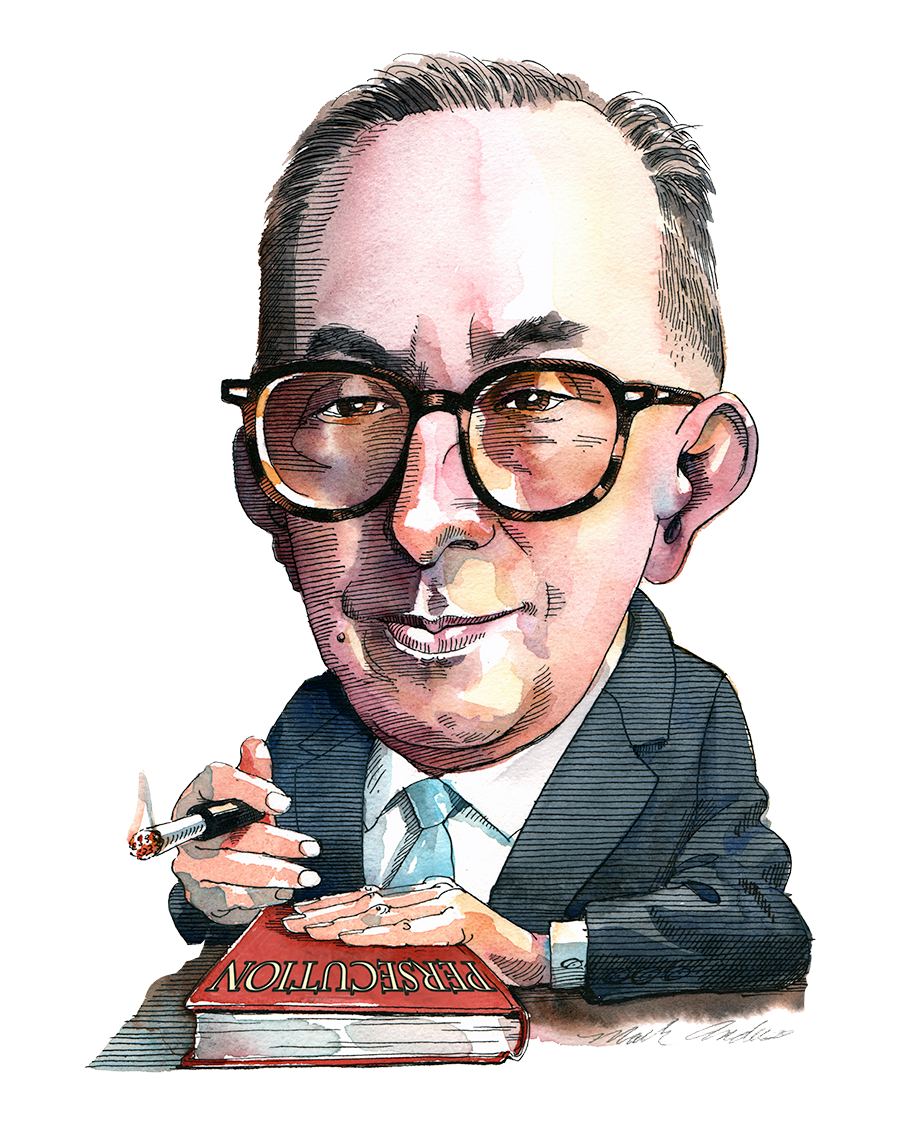
Burns is the eponymous hero of a newly reissued 1931 novel by the screenwriter Aben Kandel, a sardonic immigrant from Romania, who put out a comedy starring William Powell a year later in which a con man is described as someone who could “sell a second crop of whiskers to Moses.” Rabbi Burns is closer to the con man than to Moshe Rabbeinu, and Adam Krasoff, “the sour-faced Litvak” who covers the rabbi’s exploits for the local Jewish paper, is Kandel’s contemptuous, splenetic, but generally correct stand-in.
The novel begins on Yom Kippur:
Melancholy spectacle of fourteen million forlorn Jews world-wailing on the Day of Atonement, around the earth in tears, wailing more fervently in Jerusalem and Vilna and Brownsville than in Berlin or Cincinnati, or on Fifth Avenue, and not so melancholy in the benevolent creamed sunshine of Los Angeles with everything model-bright and modern cheerful and the Hebrew gloom dispelled even inside the synagogue.
We are at the temple of the well-fed and generally placid Rabbi Marvin Burns, where Yom Kippur is celebrated with a nice lunch, after which congregants return for the afternoon prayers with the “pleasurable anticipation of an audience at a successful musical comedy matinée.” And, of course, a fundraising pitch to build a million-dollar neo-Byzantine temple showcasing the American success of its congregants. And why not? The rabbi’s crass fundraising consultant remarks:
“What the hell—you’ve got moving picture houses in this town that cost more than a million to build. And owned by our people. They ought to be willing to spend that much on a temple for religion.”
Rabbi Burns paled . . . to preside over a house of worship as elaborate and magnificent and costly as Sid Grauman’s Chinese Theater.

When the novel first came out, its publishers tried to use the scandalized responses of the Jewish community to gin up sales. “Some rabbis have denounced Rabbi Burns as an untruthful, vulgar picture of the modern Jew and the Rabbinate. Other Rabbis have hailed it as the sort of reminder the modern Jew needs,” read the ad in the Los Angeles Times, which went on to coyly defend its “fleshly note[s]” and “Rabelaisian touches” as “but incidental to the principal thesis.”
Meanwhile, the distinguished film critic Kenneth Turan informs us in a short, witty introduction to this new edition that “a Chicago Sentinel columnist called the book ‘a desecration of a rabbi’ and mentioned that ‘five libel suits have been filed against Aben.’” As Turan makes clear, the unmistakable model for Rabbi Marvin Burns was Rabbi Edgar Magnin, the Reform rabbi who had completed the building of the massive Wilshire Boulevard Temple just two years earlier with contributions from Louis B. Mayer, Carl Laemmle, and the Warner brothers, among others. The book even includes photos of Magnin and appends the chummy, pretentious eulogy he gave for film mogul Adolph Zukor when he died in 1976 at age 103.
In the novel, Adam proposes to Rabbi Burns that he commission artwork for his new temple as a menschlich way of giving work to a Russian painter of great talent but few means, an idea Burns rebuffs as being heretical. Magnin himself had no such qualms. Director and scenic artist Hugo Ballin, magnanimously loaned for the task by the Warner brothers, was engaged to fill the walls of his new temple with a 320-foot-long mural of—as a movie poster of the time might have had it—“The sweep! The drama! The heartbreak of Jewish history!” (When I visited the recently restored and expanded Wilshire Boulevard Temple, I found Ballin’s style bold, striking, and deeply weird—a bit Gustave Doré, a bit Gustave Moreau, and a bit Dr. Moreau—as when a dog-faced flying dragon pursues the Jews leaving Spain after the Inquisition, a detail I have missed in other histories. The reminder that this was Los Angeles came from a depiction of the prophet Amos, whose frankly incredible arms veritably burst out of his flowing robes. It must be said that our forebears have never been better looking.)
Although there is no doubt that it is a roman à clef, Kandel’s novel is more Sunset Boulevard than Wilshire Boulevard, a biting satire of the hypocrisies of early Hollywood, not just its rabbis. Though the book is very much of its time, its characters will feel familiar to any reader who has spent time in Los Angeles more recently. When, for instance, we first meet Yasha, an earnest young Russian Jew, we learn that “he believed in vegetables.” This soon progresses to “trifling with mysticism, sun worship and Christianity.” Yasha eats only two meals a day “both from belief and economy” and tucks into a “protose steak,” which “tastes just like meat.” He sounds like someone I recently overheard talking loudly at a WeHo coffee shop—or just unfollowed on Instagram.In a more moving incident, a supposedly Mexican prostitute Krasoff visits after Yom Kippur turns out to be a nice Jewish girl from Romania, who is brokenhearted to discover that she has missed this year’s Day of Atonement.
Rabbi Burns, published one year after Queer People, the ur-Hollywood satirical novel, but eight years before Nathanael West’s Day of the Locust, is full of sharp, knowing portraits of Hollywood types. Although it has a plot, Kandel’s novel is, at its best, an ensemble piece around the array of dreamers who have come to LA thinking of it as a tabula rasa only to realize that the tablet’s rules (who shall prosper, and who shall carp from the sidelines) have already been written.

As for what actually transpires under LA’s benevolent creamed sun, our hero Adam Krasoff is interested in Rabbi Burns’s secretary, while she inexplicably pines for her oleaginous boss. The rabbi, in turn, is smitten with Bonnie, the glamorous daughter of the macher who is going to build his temple. Meanwhile, a decent girl named Olga loves Krasoff for his “lost mutt” self, but it won’t work. Nobody lives happily ever after, though the great and ridiculous temple will be built.
One thing that does distinguish Rabbi Burns from other classic Hollywood satires is that it really is concerned with Jews and Judaism as such, or rather the way in which slick operators like the rabbi and crass businessmen turn their religion into just another show—this one put on at Magnin’s Ancient Hebraic Theatre on Wilshire. Krasoff misses East Coast synagogues and shtiblach, with their authentic mustiness. For spectacle, can religion compete with Hollywood? The Wilshire Boulevard Temple murals suggest you can try, but Rabbi Burns gets his final comeuppance when he decides that the way to win Bonnie is to get out of the rabbi racket and get into showbiz, becoming a Hollywood flack who defends the spiritual uplift of its product to the press and religious critics. But the only thing Bonnie ever saw in him was his spirituality, so even if Marvin Burns (né Moshe Bernstein) wasn’t much of a rabbi, he’s now just another showbiz manqué to Bonnie, and as a come-on his career move flops.
The novel ends on a poignant note with Adam telling Olga that he is leaving town (and her, though he was never really with her in the first place). “Where are you going?” she asks:
“Filling my suit-case with samples. I’m going on the road.”
“You expect to peddle?”
“Why not? . . . It’s our oldest profession. I’m carrying a swell line of discarded Judaism.”
She asks him to wait, but he won’t. He is “a Jew and his satchel going on.”
As for Kandel, he went on to a long, successful Hollywood career, in which he cowrote director Mervyn LeRoy’s classic crime drama They Won’t Forget (1937) and was still working two decades later when he wrote I Was a Teenage Werewolf. Although Rabbi Burns was forgotten, another novel of his was made into a good James Cagney movie. In any case, in the absence of true Hollywood power, Kandel’s ornery skepticism kept him in better shape than his fictional creation; he died at age ninety-six, prospering in the City of Angels a little longer than Rabbi Magnin, if not quite as long as Adolph Zukor.
Comments
You must log in to comment Log In
Suggested Reading

Intrigues and Tzuris
Have you seen the one about the Hasidic jewelers and the Albanian goons?
Hollywood and the Nazis
In their dealings with Germany in the 1930s, were Hollywood’s moguls just watching the bottom line or aiding the Third Reich’s PR machine?
Kibitzing in God’s Country
It may come as a surprise that there is an entirely different Catskills, a Catskills that doesn't involve Grossinger's, bungalow colonies, or Jews, in the words of Billy Crystal, eating "like Vikings."
Forget Remembering
Rutu Modan’s graphic novel The Property explores the uneasy coexistence of love and death.
gershon hepner
COUNTERFACTUALITY
When God got mad with hosts of Hyksos
the Reed Sea made them all Deep-Sixos.
While Miriam danced and Moses sang
God drowned the hosts of Pharaoh’s gang.
United Nations in those days
did not object to Jews’ displays
of strength against the ones who swore
to drive them to the ocean shore,
and kick their butts like balls of soccer
straight into Davy Jones’ deep locker.
Had Bible tales today been written
they would have told, in France and Britain
and Germany and Italy,
how Pharaoh fought most bitterly
against the Zionist intruders
who kissed him first, and then like Judas
betrayed him. Moses and the Highest
Authority they’d say were biased,
adding: Bible stories pander
to Zionists as propaganda.
Remember, when you’re reading Ex-
odus Tyrannosaurus Rex,
though now esteemed as great straight arrow,
once got a bum rap just like Pharaoh.
Literature that’s counterfactual
might help us see how biases
make men regard as actual
false facts, by satiriaisis,
modality the Hebrew Bible
not infrequently employs,
and this poet, too, is liable
to use in reformations he enjoys,
rewriting facts the Masoretes impacted
reformed by Rabbi Burns, Eugene Magnin, whose
Wilshire Boulevard Temple truth redacted,
as I, while orthodox, do for frum Jews.