The Riddler
Amid the chaos and trauma of October 7, 2023, one of the innumerable cultural events deferred was the release of a unique documentary about the elusive Monsieur Shoshani. Shoshani’s mysterious persona, brilliance, and iconoclastic disposition have been the stuff of legend since he emerged from Europe after the Holocaust (he is depicted on the movie poster as a hunched-over figure carrying a suitcase). Shoshani was purportedly a master of Jewish tradition, Western philosophy, mathematics, science, and as many as thirty languages. He taught Torah everywhere he went—France, Morocco, Israel, and Uruguay—though what, exactly, he taught and where he came from remain a mystery. His students ranged from scholars and physicists to farmers and Holocaust orphans.
After he met Shoshani, the great French Jewish philosopher Emmanuel Levinas famously said, “I cannot tell what he knows; all I can say is that all that I know, he knows.” His gravestone in Montevideo, Uruguay, reportedly paid for by Elie Wiesel, reads, “His birth and life were sealed in a riddle.”
Although Shoshani’s life remains shrouded in mystery, the curtain seems to be drawing back, at least a bit. In 2021, the National Library of Israel announced Shoshani, whom Levinas once called “the Oral Torah in his entirety,” had left dozens of notebooks behind. Some of these cryptic notes, which Yoel Finkelman explored in these pages (“Think Over My Lesson and Try to Destroy It,” Fall 2022), had been preserved in a secretive trust by four of his students since 1969. Another trove was donated to the National Library by Professor Shalom Rosenberg, an Argentinian-born scholar of Jewish thought at Hebrew University who became close with Shoshani toward the end of his life. For the last fifteen years, French Israeli director Michael Grynszpan has toiled and puzzled over the notebooks and the life of their author. His result is The Shoshani Riddle, which chronicles Grynszpan’s hunt for Shoshani and his attempts to piece together the master’s life story.
Shortly after the war, Elie Wiesel was on his way to Taverny, France, to teach Bible to young Buchenwald survivors when he met Shoshani on the train. His subsequent remark, like Levinas’s, became part of the legend: “My encounter with this Master put an end to my career as a lecturer. I was once again a student.” Grynszpan’s film, which intersperses standard documentary footage with shadowy black-and-white animated scenes from Shoshani’s life as a wanderer, includes a re-creation of the scene on the train.

Grynszpan, seeking his own entry point, turns to Shoshani himself (as reported by Levinas) for insight. Shoshani taught that each verse of the Torah has 2.4 million interpretations: “This is because six hundred thousand Hebrews left Egypt and for each individual there are four ways of understanding divine words: peshat (the literal meaning), remez (the allusive meaning), derash (the interpretive meaning), and sod (the secret mystical meaning).” The four methods mark the four parts of the film.
Peshat, of course, is far from straightforward. None of Shoshani’s biographers has been able to piece together the basic facts of his life. One of them, an Italian psychoanalyst named Haim Baharier, maintains that Shoshani’s 1968 death in Uruguay was faked and he still walks the streets of Europe, or at least he did until recently (he would now be more than 120 years old). When he began working on the film, Grynszpan believed that Elie Wiesel (who died in 2016) would be able to clear up many of the questions about Shoshani’s life and became obsessed with meeting him. But Wiesel at this time was a very old and very busy man and seems to have stonewalled Grynszpan for two years, as he interviewed dozens of Shoshani’s other former students, many of whom studied with him during his visits to religious kibbutzim. All of these interviewees paint a vivid, fascinating, and even consistent picture of a brilliant, irascible, impoverished, and unmatchable teacher who did not care for externalities. Indeed, the externalities are where the accounts differ: Was he Sephardi or Ashkenazi; born in Poland, Jerusalem, or Morocco?
In a hilarious interlude, Grynszpan finally tracks down Wiesel when he crashes a 2013 gala thrown by Rabbi Shmuley Boteach’s World Values Network. Once they meet, Wiesel seems happy to share his warm memories of Shoshani with Grynszpan, and he does so with eloquence and charm, even alluding to a vast cache of notes he possesses from the years they spent together. He even reveals that he tricked Shoshani into revealing his Hebrew name—Mordechai—by giving him an aliyah one Shabbat, and he laughs gently when he remembers that Shoshani stole books and whiskey from him.
Yet Wiesel can’t, or won’t, quite answer Grynszpan’s questions. He quotes something Shoshani supposedly said to him, though it certainly sounds like something Wiesel could have said too: “It’s not what I am called; it’s what I am doing that matters.” An overzealous secretary forces their fifteen-minute meeting to end.

Since peshat doesn’t help Grynszpan understand Shoshani, he turns to derash to uncover not who Shoshani was but the nature of the spell he cast upon those who met him. Here Grynszpan explores the darker side of Shoshani’s legacy. “He was not a mensch,” one interviewee tells him. Many call Shoshani slovenly and mean. Others mention his fondness for beautiful women—a male student laughs when he says that if a young woman walked into the room, “I no longer existed.” Another older French Moroccan woman who knew Shoshani in her youth gives the camera a dark knowing look and says, “He was a devil.”
Shoshani left a powerful impression on everyone he met, but, Grynszpan is disturbed to realize, hardly anyone can quote verbatim even a sentence he actually said. Could Shoshani have been a hypnotist rather than a genius, who entranced even some of the greatest Jewish luminaries?
Yet this suspicion is punctured by Professor Shalom Rosenberg, the erstwhile keeper of Shoshani’s notebooks. When Grynzpan visits Rosenberg in his Jerusalem apartment, Grynzpan wants to discuss Shoshani’s appearance and his antinomianism, as he does in all of his interviews. Rosenberg’s wife gesticulates from the kitchen that he should stop. Rosenberg answers with a warm smile, “At one point in my development as a child I decided, I am not going to judge my parents.” He goes on, “All the things that people said about him don’t interest me. If I stand before a spring of wisdom, I wish to immerse in this spring.” Someone who knew both Shoshani and Rosenberg comments that Rosenberg “was on a high enough level to ask the right questions.”
Rosenberg does not dwell on Shoshani’s unnatural genius or the mysteries of his biography. Rather he’s primarily interested in his philosophical insights: “I believe he was the Jewish Socrates. . . . He said the ticket into the palace of knowledge is the query” (the kushia). In a 1995 tribute in the Israeli journal Amudim, Rosenberg wrote of Shoshani:
My teacher used to say that we must learn to stay with a difficult question for forty years. Not to let up, and not to despair. Then there is a chance that we will reach the truth.
Rosenberg convinces Grynszpan to move away from the sensationalist impressions of Shoshani toward his actual teachings. This leads Grynszpan to the remez portion of the film, which he subtitles, perhaps not quite literally, as “deeper and deeper.”
A foundational teaching of Shoshani, as taught by Rosenberg, is:
A wise man is preferable to a prophet-scribe. . . . One does not learn practical law even from the interpretation of a traditional Mishnah, even though a law is stated there, much less from the Bible, much less from knowledge expressed in a Talmudic argument. The decision is made by the Holy Spirit in the heart of a wise man.
Trying to retrace Shoshani’s steps, Grynszpan travels to Uruguay, where he finds a community of slightly younger students who still conduct a memorial service at Shoshani’s gravesite each year. These former students, members of a small and depleted Jewish community in Montevideo, remember Shoshani warmly, not as a cipher but as their rebbe. When Grynszpan dons a yarmulke to attend his yahrtzeit ceremony in the pouring rain, one senses that the real discovery the film has led him to is not whether Shoshani was Ashkenazi or Sephardi, a genius or a madman, but rather to how his memory continues to inspire the lives of ordinary Jews whom he taught.

With this realization, and with the help of a newly discovered trove of writings, Grynszpan enters the sod level of the film. Shoshani’s diaries are written in a mysterious script that is virtually unreadable. Grynszpan turns to a series of well-known experts on Jewish mysticism: Rabbi Adin Steinsaltz, Rabbi Oury Cherki, and Kabbalah scholar Moshe Idel for help. They all marvel at the code but cannot decipher it. Once again, it is Rosenberg who bails out Grynszpan by suggesting that he turn to a computer program to crack it.
Once deciphered, Shoshani’s texts yield valuable biographical information. Grynszpan discovers that before Shoshani became known for his fixation on pretty women, there was one woman, Sara Abitbul, a Moroccan Jewish woman to whom he was engaged in 1939 Paris. There had always been a rumor that a woman Shoshani loved had been murdered by the Nazis in occupied Paris; now she may have been identified. Grynszpan uses the notebooks to piece together more of Shoshani’s experience in the Holocaust, and what emerges is a deeply human, and also classically Jewish, portrait of a man who suffers great loss and takes sanctuary in the sea of Torah.
When The Shoshani Riddle finally arrived in Israeli theaters in May 2024, it was something of a hit. Since then, the Hebrew version on YouTube racked up more than five hundred thousand views while it was available—an extraordinary number for a documentary about an itinerant, perhaps unknowable Jewish intellectual, released in the middle of a war. In the words of the filmmaker, everyone seemed to have seen it, “even secular Israelis, haredim, young children, old people, left, right.” I tried to attend a screening in my not terribly intellectual hometown of Ra’anana, which is also home to a large community of French speakers, only to find all the seats sold out. I finally saw it at the Tel Aviv Cinematheque, where the applause lingered long after the end of the movie.
In an interview last summer with Haaretz, in anticipation of the film’s international release—it’s playing at the New Jersey Film Festival this February—Grynszpan suggests that Shoshani’s intellectual approach is relevant to the terrible intelligence failures of October 7. Grynszpan points to the existence of the Devil’s Advocate Unit in the Israeli army, also known as Ipkha Mistabra, which is Aramaic for “it appears to be the opposite.” Ipkha Mistabra was established after the Yom Kippur War to critically evaluate intelligence assumptions and prevent future catastrophes: “Ipkha mistabra, the mindset of questioning everything, that’s what’s vanished,” Grynszpan said. “And that’s exactly what Shoshani stood for.”
Comments
You must log in to comment Log In
Suggested Reading
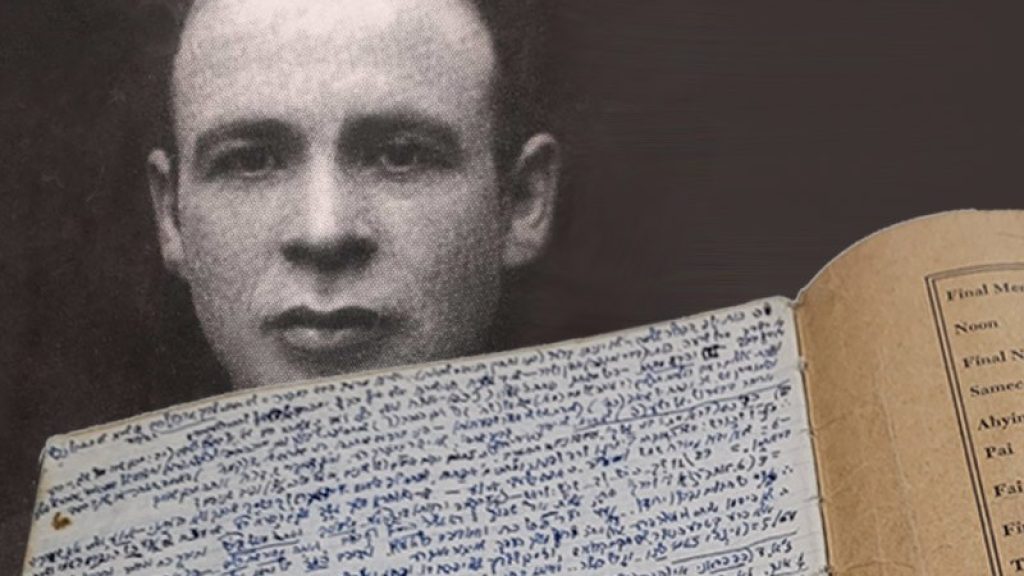
Think Over My Lesson and Try to Destroy It
When Levinas met a vagabond called Chouchani, he told a friend, “I cannot tell what he knows, all I can say is that all that I know, he knows.” Now that we have dozens of Chouchani’s notebooks, can we finally know what he knew?
Jewish Destiny in a Cheek Swab
Possible Jewish ancestry has fascinated both Jews and non-Jews when it comes to American historical figures, reaching as far back as Alexander Hamilton.
Fatal Attraction
Although Martin Heidegger joined the Nazi Party in 1933 and never forthrightly repented of the episode “no other philosopher had more impact on twentieth-century European Jewish thought.”
Strange, I’ve Seen that Face Before
Just as I was about to close the window and move on to the next Geniza fragment, two words winked at me as if I were a friend.
gershon hepner
ART IS INCOMPLETE CONFESSION
Art is confession, and because of this it is the secret told,
Thornton Wilder once explained, but he’s not quite correct.
It’s a confession, as he said but also is a riddle rolled
in an enigma. We can’t tell what’s told, and only can suspect,
since at the same time that it’s told, as Thornton added, it keeps hidden
the very secrets that allegedly it will expose
but doesn’t, so whatever’s painted by the artist or is written
is a rose that has a name, but isn’t what you might suppose.
Regarding the relationship between the earth and heaven is
a riddle that Shoshani told Elie Wiesel and Emmanuel Levinas.
David Nimmer
I very much wish to see the movie! As it is not currently available on YouTube, how can I proceed?