Shtetl Revenant
The new translation of Sons and Daughters, Chaim Grade’s richly textured family saga, is not exactly the novel any reader of the Yiddish version ever encountered. It began life as a serial in the pages of the Tog-Morgn Zhurnal in August 1965, less than a year after Fiddler on the Roof—a considerably more nostalgic depiction of shtetl life—premiered on Broadway.
The original title of Grade’s work was Dos alte hoyz (The Old House). Over the next eight years, he changed its name to Zin un tekhter (Sons and Daughters) and suspended publication twice due to illness and other disruptions. In 1971, the Lubavitcher Rebbe wrote to wish him a full recovery, playfully telling him that “the sons and daughters” were anxiously awaiting further chapters.Finally, a few years after the Tog-Morgn Zhurnal folded, the serial moved to the Forverts, where it restarted from the beginning under yet another title, Beis harav (The Rabbi’s House). Installments were published there from November 11, 1973, to May 30, 1976, at which point editors promised further chapters, which had still not materialized when Grade died in 1982.
In an afterword, translator Rose Waldman describes how she pieced together the novel from published and unpublished materials. To complete her task, she sifted through the newly accessible Grade papers—a vast archive long withheld from researchers by Grade’s widow, Inna Hecker Grade, whose fierce protectiveness of his literary estate was legendary. Using Grade’s letters as a guide, Waldman discovered a few pages in the archive that appear to be the conclusion Grade envisioned. Sons and Daughters is in many ways a joint effort between a resourceful, innovative translator and a masterful Yiddish novelist who ran out of time.

At the center of the novel is a many-branched rabbinical family rapidly losing coherence. The rabbi Sholem Shachne Katzenellenbogen and his wife, Henna’le, spend much of their time wringing their hands over their children’s incomprehensible life choices. One son has moved to Switzerland to study philosophy (and has secretly married a gentile); another has moved to Białystok, lured by the promise of wealth; a third, the father’s favorite, is drawn to Zionism and eventually moves to the Land of Israel. The elder daughter has reluctantly married a dour traditionalist while continuing to yearn for passion (and threatening to abort her second child); the younger daughter rejects her conventional match, moves to Vilna for an education, and falls in love with a poet. We also meet a colorful cast of secondary characters: an erratic buffoon who sells his wife’s luxury dinnerware and moves to America only to discover a fear of skyscrapers; a headstrong youth who gets caught up in a roundup of Communist agitators and refuses to abandon his comrades in prison; and an aging rabbi’s third wife who confronts Jewish owners of local cinema houses that are luring customers in defiance of the laws of Shabbos.
With the exception of a few scenes in the Swiss Alps, the entire novel takes place in towns near Białystok and Grodno. The one concrete date we get is the year 1930. At some of the novel’s most bracing moments, Grade leaves the outside world altogether, inviting us into the dark corridors of his characters’ unconscious, where identity dissolves into diffuse desires, fantasies, fears, and hopes. Elaborate dream sequences and internal monologues reveal contradictory inner lives. The rising antisemitism that would soon destroy this shtetl-based world is palpable throughout. But the novel never loses its focus on powerful, complex psychological forces within the Jewish family. The seeds of dissolution are also internal. A great virtue of Sons and Daughters is that, although some of the children seem motivated by all-purpose rebelliousness, the ultimate motivations for their actions remain obscure. At one point the patriarch, Sholem Shachne, receives diametrically opposed explanations from different onlookers for his children’s waywardness: He was too permissive; he wasn’t permissive enough. This is a comical sequence that removes any shred of moralism from the narrative. Nobody really holds the key to the good life or understands why things turn out as they do.
Sons and Daughters chronicles a tumultuous period in Eastern European Jewish history not by surveying major events but by describing the landscape at different seasons of the year and the feeling of dimly lit interiors where parents and children meet to hash out their differences. The reader comes away with a visceral sense of a world on the verge of annihilation. But although anguished parents often quote from the book of Job, the novel’s dominant tone comes closer to the somber resignation of Ecclesiastes. Grade is a master of the anticlimax. Characters restrain themselves on the verge of baring their souls; they head off with ambition to political meetings that devolve into useless shouting matches. All things, or a good many, are wearisome, more than one can express.
As with Grade’s renowned short story “My Quarrel With Hersh Rasseyner,” Sons and Daughters stages a number of debates. At one point the saintly Torah scholar Zalia Ziskind insists on the necessity of preserving memory: “A person who doesn’t want to remember his past is even lonelier than someone without relatives, without kin.” Ziskind is addressing a tormented, wayward Jew who has rejected traditional Judaism. In a novel that is itself a prodigious act of remembrance, Ziskind’s words would appear to be an endorsement of Grade’s own efforts. Nevertheless, a few pages later, we are given a fiery speech by Ziskind’s son, Marcus, on the value of freeing oneself from the burdens of the past. Marcus, a recent convert to the philosophy of Friedrich Nietzsche, bemoans the fate of those of his fellow Jews who have condemned themselves to carrying “the tombstones of all the past generations” on their shoulders.
Although Grade seems to support Ziskind’s emphasis on memory, he is also sympathetic to the rebellious son and his desire to forget. This is not a nostalgic novel. Marriages are haunted by bitterness and regret. Aging parents gain little comfort from their children. At one point, a group of villagers finds the body of a mysterious man who has drowned in a lake; his identity is never discovered, nor is his motive for what appears to be a suicide. The past is not a place of comfort or joy but of tension and stifled energy. And yet, Grade seems to be reminding his readers: These are our relatives.
One of the most distinguished writers of Yiddish prose of his generation, Grade began his literary career as a poet. Born in Vilna and educated at the legendary Novaredok Yeshiva, Grade abandoned the yeshiva at twenty-two, joining the avant-garde writers of Yung-Vilne (Young Vilna). When the Nazis invaded Vilna in 1941, Grade fled to the Soviet interior, leaving behind his wife and daughter, whom he mistakenly believed would be spared the worst.
After the Holocaust, Grade remarried and lived briefly in Paris and Łódź before relocating to New York City, where he would remain in a kind of limbo, never fully habituating himself to the rhythms of American life. Like other Yiddish writers who wrote mainly poetry before World War II, such as Chava Rosenfarb and Isaiah Spiegel, Grade turned to narrative only after the Holocaust. He evidently felt himself pressed into the service of cultural commemoration. Nevertheless, the spirit of poetry never departed from his work. Objects come to life in his prose, such as a samovar surveying a dining room or white and rose-colored trees bursting into full bloom near the marketplace. Grade’s lyrical style is one among many things that distinguish him from his better-known peer Isaac Bashevis Singer.
Waldman captures the charm of Grade’s descriptions (Her “lips puckered with resentment, shoulders high like a porcupine raising its quills in defense”) as well as the pith of his wit (“Not only had he never learned to accept a universal God, he hadn’t even learned to like his neighbors”). At the same time, her translation reflects the spirit of cultural revival. Whereas earlier translators from Yiddish sought to smooth over anything that might have sounded jarring or unfamiliar to English readers, Waldman weaves into her prose terms and phrases from Hebrew, Yiddish, and Aramaic. People don’t pray in a synagogue; they daven in a beis medresh. They recite not Sabbath Psalms but Shabbos Tehillim. She refuses to domesticate the text. Yiddish translations from a generation ago would never have included lines like these:

Shabbos Hagadol morning rose upon Morehdalye with a high blue sky and temperate weather. . . . The man who’d been given an aliya just before him, and who was still standing at the bimah, had peyes curled like a Havdalah candle. . . . Singing the tropen at the weekly sedrah each Shabbos had left his back stiff as a stick.
Waldman’s Yiddishized English argues implicitly that each untranslated term represents an irreducible, culturally specific concept. It allows Grade’s remembered culture to breathe without apologies or emendations. For instance, when a debate arises about degrees of transgression for various sins, one character asserts that selling nonkosher meat is among the worst:
In fact, if a shochet is accused of bedding a prostitute, there’s one rabbinical opinion that says his slaughter is still kosher. It falls under the yutzru tukfu exemption, for when a sinful inclination is too strong to withstand. And at least he didn’t cause others to eat treyf.
A less daring translator—and one less familiar with rabbinic culture—might have glossed the talmudic phrase and spoiled the moment.

Family sagas were popular in midcentury Yiddish literature. Examples include Israel Joshua Singer’s The Brothers Ashkenazi and The Family Carnovsky, Der Nister’s The Family Mashber, and Isaac Bashevis Singer’s The Family Moskat. Taking their cues from Dostoevsky’s The Brothers Karamazov and Mann’s Buddenbrooks, these novels traced narratives of cultural decline and decadence as well as quests for personal salvation. What distinguishes Sons and Daughters from its predecessors is its emphasis on the flexibility and variousness of traditional Orthodoxy. Grade’s rabbis and rebbetzins do not speak in one voice. Some of them come to recognize that what looks like apostacy in the younger generations may be evolution. The hopeful notes come from passages in which a rapprochement between generations is achieved or at least hinted at. Suddenly it seems that however much things fall apart, the center—call it Yiddishkeit, call it family loyalty, call it memory—seems to hold.

In his introduction, Adam Kirsch calls Sons and Daughters “the last great Yiddish novel.” But, leaving aside the marvel of its recovery and its inspired translation, how great is it really? Written as a weekly serial and never fully revised, Grade’s narrative suffers from some unevenness. Unlike the heartrending memoir My Mother’s Sabbath Days, in which Grade is at his finest, this work lacks a sustained emotional center. A few characters never emerge from their shadowy outlines, such as the capitalist brother Bentzion and the discerning aunt Chavtche. Too much time is spent on the agonized reappraisals of the apostate elder brother, Naftali Hertz, rather than on his original rebellion. In general, readers may feel that too many of the pivotal decisions occur offstage or have already been made before the story begins. The dynamism we associate with the classic nineteenth-century novel is largely missing. Perhaps this is because so many decisions made on the eve of the Holocaust will come to nothing, as Grade and his readers know all too well.
Sons and Daughters is more portrait, then, than story. However, some of the novel’s heated exchanges about the meaning of Judaism and Jewish peoplehood will sound familiar to readers who live in a fractured and seemingly irreconcilable Jewish world. It is somewhat reassuring to read about past generations struggling with similarly divisive issues. The portal this novel opens into the past gives us a world of such vividness, it may help us find our way.
Suggested Reading
The Family Heretic
Mark Mazower’s What You Did Not Tell: A Russian Past and the Journey Home belongs to a newish genre: the Jewish family memoir that is an act of filiopiety but also illuminates broad historical themes.
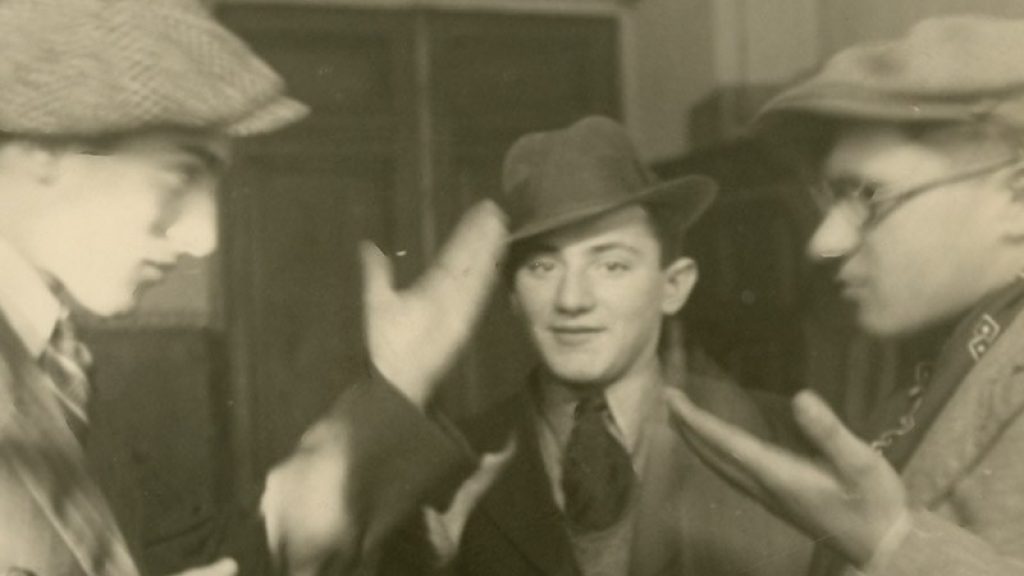
Chaim Grade: Portrait of the Artist as a Bareheaded Rosh Yeshiva
Grade attempted to perform the impossible: to undo in literature what had occurred in history and revive the dead of Jewish Vilna.
Story Evades Cogitation: An Interview with Cynthia Ozick
"I can’t and won’t reread: What’s done is done. Print is writing’s final fate."

In the Beginning, There Was Angst
Where a committed secularist would raise up the literary in place of the sacred, Adam Kirsch’s discussions in The Blessing and the Curse read more like a coda to the sacred scriptures.


Comments
You must log in to comment Log In