Story Evades Cogitation: An Interview with Cynthia Ozick
On my way to Cynthia Ozick’s house in New Rochelle in the back of an Uber, I began to worry about whether I knew how to properly dip a madeleine in tea. Had I ever even eaten a madeleine? Did those cellophaned three-packs of tasteless shell-shaped sponges at the Starbucks register count? In preparation for our meeting, I’d read Giles Harvey’s 2016 profile in The New York Times Magazine, in which Ozick complimented him on his cookie-dipping technique: “‘You’re doing exactly the right thing!’ she said. ‘Just what Proust did!’” But how had Proust done it when he evoked those childhood memories? And which end of the cookie had Harvey broken off so impeccably?

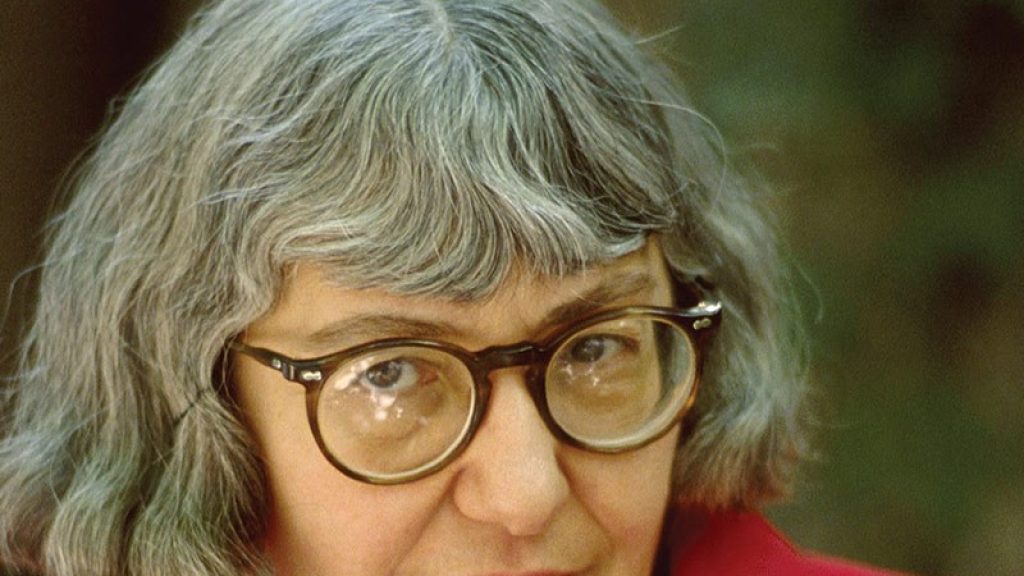
Cynthia Ozick. (Courtesy of Fred R. Conrad/The New York Times/Redux.)
I was going to interview Ozick because I’d been knocked out by her introduction to the new Everyman volume of her selected stories and essays. I’d known, of course, that she hadn’t slowed down over the last decade. Around the same time Harvey was visiting her for the Times, Dara Horn had reviewed Ozick’s Critics, Monsters, Fanatics, and Other Literary Essays in these pages. A few years later, I sent Ozick’s latest novel Antiquities to Allegra Goodman (“a book as richly layered as an archaeological site”), and new stories, poems, and essays have continued to appear with startling frequency for a writer whose first novel, Trust, appeared in 1966. So what surprised me about Ozick’s introduction was not the familiar polysyllabic snap of her prose, or that she was still thinking through her key themes aslant and anew, but that she was confronting head-on the common critical wisdom that her essays were better than her stories. “I have been given a verdict,” she writes, “in the hierarchy of prose, the essays . . . are deemed better . . . than the fiction.”
In a Yellow Wood, the title Ozick has given her new collection, is Frostily ambivalent about the relationship between her fiction and her criticism. The famous lines she takes as her epigraph read:
Two roads diverged in a yellow wood,
And sorry I could not travel both
And be one traveler, long I stood . . .
I took the one less traveled by,
And that has made all the difference
Why, Ozick asks herself, “in a lifetime’s progression from yearning youth to skeptical old age,” has she found herself “zigzagging from fiction to essays and back again,” despite the fact that “like the forlornly impassioned character in Lionel Trilling’s abandoned midcentury novel, I cling to the cry novel or nothing.” And yet Ozick has not chosen between these two “prose-ridden roads,” and the fact that she hasn’t makes her wonder, at least rhetorically, whether this indecision has made all the difference. Will she be “stuck forever in that autumnally yellow wood?”
When I wrote to Ozick and requested an interview, she responded: “Would you be interested in an email Q&A? . . . Unlike the raggedness of (my) talk, it may have the advantage of written clarity.” I was disappointed, but I shouldn’t have been surprised. Forty years ago, when The Paris Review interviewer turned on his tape recorder, Ozick had turned on her electric typewriter: “I asked a question, she typed out an answer and then read it to me.” Still, they had at least been in the same room in those pre-Cambrian times, so I persisted and Ozick demurred:
Spoken language is inevitably looser than written language, and when it ends up in print, even after the removal of tangles and falterings, will still, because it is in print, look like a (badly) written voice. A visit when you are in New York . . . would surely be a delight. But I hesitate to face transcription and cleaning up, even in part, and I hope you can forgive a reluctant spirit.
Responding to Ozick’s reluctant spirit and effortless eloquence over the next couple of weeks, I felt like a weekend swimmer flailing next to an Olympian in the JCC lap pool. Eventually we hit on a solution: I would visit for an off-the-record tea, and then, having established a rapport, we would correspond by email.
When we sat down together in Ozick’s living room next to a coffee table covered in neat stacks of books—Is that Kafka?, a volume of Matt’s translation of the Zohar, Harold Bloom’s Strong Light of the Canonical, and The Porcelain of Brother Thomas—it was the week before Pesach. I gave her a copy of our new Spring issue. She was charmed by Chad Gadya’s alien abduction on the cover and excited to see Balint’s essay on Norman Manea, but flinched when I took out my phone. I reassured her that we weren’t speaking for publication, and we began to chat. “Have we established a rapport yet?” she asked wryly after a few minutes. “Then it’s time for tea,” and I resumed worrying over my dunking form.
Ozick’s dining room is presided over by Bruno Schulz’s disconcerting self-portrait, given to her by Philip Roth. As I took my seat, I was instantly relieved to see that the cookies on the platter were not Proustian madeleines but rugelach, redolent of a thousand shul kiddushes. The interview that follows is a lightly edited record of our email exchanges over the three months that followed.

SOCHER: I asked to interview you about the stories and essays collected in your new volume In a Yellow Wood. But in the interim, you published a poem in The New Yorker and an essay in Harper’s. Can we begin with them?
OZICK: I’m ready to follow whither you go.
SOCHER: Thank you!—but instead of responding like Naomi in the book of Ruth, let’s turn to your poem “Refusal.” It’s dedicated to the short story writer Lore Segal, who passed away last fall. It begins “Acclaim/Nature’s hues,” and ends:
Refuse
to seed
in shame
what Nature sows
and choose
what leaf and petal and wayward weed
all know:
grow.
At first, I thought these lines were dedicated to Segal’s memory without being somehow about her. But now, rereading them, I wonder . . . Is this the continuation of a conversation—an argument—with your friend about what to acclaim and what to refuse?
OZICK: You are right on both counts. Lore Segal and I have known each other for half a lifetime, and we have been arguing ever since. I met her through David Segal, her husband, the editor who published Trust. Once on a bus to Jerusalem we were in such heated contention that she stopped speaking to me for a time—an incident atypical of her willingness always to engage. Three summers ago we were in feverishly indefatigable correspondence on the same subject. On my side, what it came to was this: that there are two ways of looking at any circumstance—either to see (and to claim the priority of) what is similar, or to see (and to claim the priority of) what is different. Or to put it otherwise: to favor fusion over distinction-making, and vice-versa. I was on the side of the significance of distinctions. Lore insisted on recognizing resemblances. You will ask, but what was the argument about? In brief: Call it the road to Jerusalem.
Still, “Refusal” concerns another argument altogether. You say that Lore “passed away.” This phrase, and others like it, she condemned as unneeded euphemism: people don’t “pass,” they die. And again you will ask what this last argument was about. And again in brief: I pleaded with her to choose life.—Yet despite all these fundamental disagreements, in recent years our joyous literary friendship only deepened.
SOCHER: In your Harper’s essay, “Voices from the Dead Letters Office,” you ask, “Who can deny that the letter—pen, paper, envelope, stamp—is dead?” But then the essay ends with a furious exchange between you and a friend over email . . . What is lost when our letters become emails?
OZICK: Virtually nothing when emails go back and forth from writer to writer, where words retain their intent and their force. Most emails skirt conversation—ideas, opinions, observations, feelings—and are substitutes for time-bound phone calls meant to give or acquire information. But at the same time, because fresh technology is constantly replacing prior technology, everything on email is likely to be lost. Parchment and paper outlast pixels.
SOCHER: I think of your essay as a little commonplace book of some of your favorite correspondence: Madame de Sévigné’s extravagant letters to her daughter, the Bintel Brief advice column in the old Forverts, Lionel Trilling’s worries over being a mere critic rather than a novelist, and so on. But, then, right in the middle of it all, you shock the reader—or at least me—by mentioning that you once wrote anonymous love letters to the Columbia philosopher Sidney Morgenbesser and signed them with the name of Byron’s crazed lover, Lady Caroline Lamb. Although you’ve told the story before, you never said who the philosopher was. . . . How did you become (briefly, distantly) infatuated with him?
OZICK: There’s no accounting for infatuation!—though I can recall the very moment the arrow struck. I saw Morgenbesser on the sidewalk, I no longer remember where, swinging a little boy between his legs. The child was the son of Isaac Levi, a fellow philosopher at Columbia. And somehow this scene, the formidable Intellect at play with a laughing toddler, threw me into an indefinable rapture. Not long before, I had picked up from a table of remainders at the 8th Street Bookshop a biography of Byron and learned of Caroline Lamb’s frenzied pursuit of the poet. From then on it was imitatio maniae, mimicking madness.
SOCHER: Morgenbesser is now mainly remembered for his wit—for instance, he said that “pragmatism is all very well in theory but it doesn’t work in practice.” But I take it from your essay that you never actually talked to him?
OZICK: Never.
SOCHER: So, your new collection is called In a Yellow Wood, after the famous Frost poem (“Two roads diverged in a yellow wood, / And sorry I could not travel both / And be one traveler, long I stood . . .”), because it includes both stories and essays—the two “prose ridden roads” you’ve traveled. But it seems like a tricky title, since by the second page of the introduction you are wondering whether fiction and essays are really “less the divergence of separate genres than a unitary mode of metaphysical merging.” What did you mean by that?
OZICK: From a more sober perspective, it seems far too grandiose a statement. After all, what is “metaphysical merging” if not what we more simply name temperament? Or overall disposition, for which “a predominant tendency of one’s spirit” is one definition. One may be drawn to both Scrabble and chess, different in design and difficulty, and yet the underlying approach to each will derive, inevitably, from similar habits of mind.
SOCHER: I’m still a little confused. What is merging with what? And in whom? And doesn’t the chess/Scrabble analogy understate the difference between what you call “Intellect and Imagination”? As you write later in the introduction, “Like the forlornly impassioned character in Lionel Trilling’s abandoned midcentury novel, I cling to the cry of novel or nothing.”
OZICK: In chess in particular, intellect (logic) and imagination (swoops of wild daring) are intertwined. Or merged. The same in Scrabble, though probably with less of a stepping-off-a-precipice sensation. And isn’t fiction subject to fizzle and failure more frequently than non-fiction?
SOCHER: Maybe that’s why fiction writers don’t really consider the rest of us real writers: less risk of fizzle and failure. We’re not tightrope walkers; we work too close to the ground. How many of your essays and stories did you reread while you were working on this book?
OZICK: I can’t and won’t reread: What’s done is done. Print is writing’s final fate; but it’s also true that nothing written counts as done—fully consummated—until it lands in print. In having been asked to choose the contents of this volume, I was mainly concerned by length, the briefer the better: an almost impossible charge, since the word count of both stories and essays is substantial. “Dictation,” for instance, is incontrovertibly a novella; nevertheless, I dared to include it.
SOCHER: Some of your most-discussed essays and stories from the 1970s—say “America: Toward Yavneh,” “The Pagan Rabbi,” or “Literature as Idol: Harold Bloom”—aren’t in this book. Was that deliberate?
OZICK: Yes, deliberate, and with regard to those two essays, unavoidable. For the Common Reader, toward whom Everyman’s, even by virtue of its name, is directed, Bloom’s long row of esoteric Greek terms is beyond off-putting. As for the main proposition of the Yavneh piece—that no literature not in a Jewish language can be properly Jewish—it is so mistaken as to be thoroughly shocking (Kafka, Babel, Heine, et al.), and I saw no reason to reproduce it. “The Pagan Rabbi” and also “Envy” were omitted to make room for more recent stories, including “The Conversion of the Jews.”
SOCHER: Yes, all those crazy terms Bloom had for the way a “strong poet” misreads and overcomes her predecessors: misprision, kenosis, kabbalistic emptying out of vessels. . . . And yet when I visited you, I noticed that Bloom’s The Strong Light of the Canonical, his CUNY lectures from sometime in the mid-1980s, was on your coffee table. It seems to me that your confrontation with Bloom got to something central in both your work and his. How do you think about your exchanges with him over literature and idolatry now?
OZICK: Mainly with laughter. In another time and in another country and in different garb Bloom would have been a Hasid attached to some wonder-working rebbe. I, of course, would have been wearing my sheytl and reading the Tsena Urena, but would nevertheless have been a staunch mitnaged.
SOCHER: Let me press this question of literature and idolatry from a different direction. Take the story you just mentioned, “The Conversion of the Jews.” A young scholar goes to a Dominican monastery in the Judaean desert looking for a manuscript that will help him understand Pablo Christiani. Christiani is the Jew who became a Dominican and debated Ramban in front of King James in 1263. Our young scholar doesn’t find the manuscript, but he does bring back a tourist trinket: a portrait of a saint on a platter. Back in New York, he ends up praying to her, trying to magically invoke her presence.
And there are idols, quasi-idols, metaphorical idols, idolatrous attitudes, and fetishes in several other stories collected here. When did you first begin to think seriously about idolatry? Were you influenced by any particular writer (after, that is, Moshe Rabbeinu)?
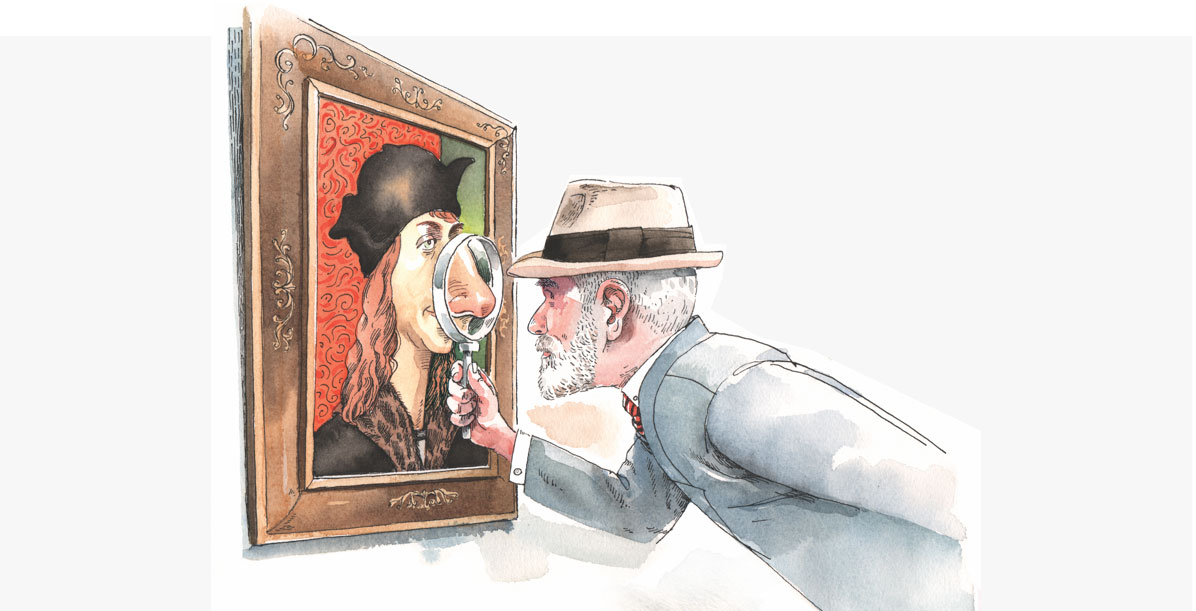
OZICK: When did I first begin to think seriously about idolatry? When in childhood I heard the tale of Abraham and his father Terach, the maker of idols. Abraham, tending the shop in his father’s absence, chides a man who comes to purchase an idol: “You, a man of fifty years, will worship a thing that was made only yesterday?” But idolatry—magic, mysticism, make-believe—as a subject for fiction is germinated from fairy and folk tales, mythology, all the plural gods and goddesses in religion all over the world. I am a rationalist mitnaged in life, a besotted Bloomian in stories.

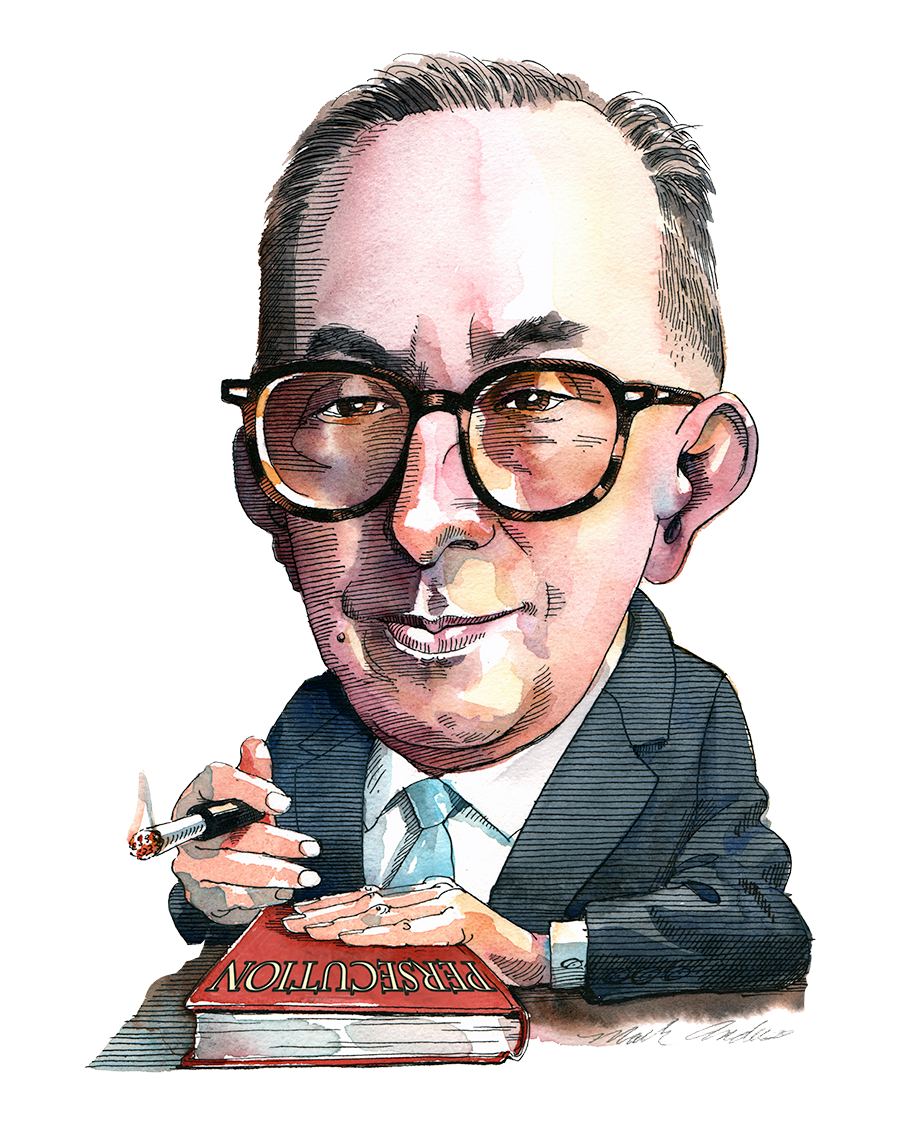
Illustration by Mark Anderson.
SOCHER: Are you? I wonder, but let’s come back to that. Meanwhile, to which of your contemporaries do you still find yourself returning?
OZICK: Malamud and Bellow. Malamud as an antidote to ubiquitous cynicism, Bellow as a bracing reminder of ideas in fiction as vessels of emotion.
But my actual contemporaries (counting for the moment only Jewish writers) are not in the past, but writing vigorously right now, whether in fiction or non-fiction or both. There are backward-looking intervals, though, when I am tempted to wonder if time will bring counterparts to the extraordinary critical and creative fertility of the twentieth midcentury. Do Irving Howe, Alfred Kazin, Lionel Trilling, Harold Rosenberg, Clement Greenberg, Leslie Fiedler, and others of similar repute have their equals now, fifty years on? Are there biographers to rival Richard Ellmann on Joyce? The literary, cultural, and political thinker Adam Kirsch brings the versatile Howe to mind. And James Marcus, Richard Kopley, and Benjamin Balint, biographers of Emerson, Poe, and Bruno Schulz, respectively, may one day be seen to claim Ellmann’s mantle.
Yet what of the legacy of that unique (and reluctant) midcentury triumvirate, Bellow/Malamud/Roth? Together they stood as a promontory of literary inventiveness, a circumstance that may never come into being again—not merely because of the distinctiveness of each writer’s voice (and voice is the passion that assures lastingness). Still, it may be that Philip Roth especially is likely to leave little or nothing heritable, since he was the product and the purveyor of a sociological outlook; and his sociology is dead.
What marks the lastingness of a work of fiction—apart from the judgment of posterity—isn’t prominence in the present, or brilliance or ingenuity . . . but this is a sentence that can’t be completed.
What we can be sure of is that it will not be Bellovian or Malamudian or Rothian, or Alice Munrovian or Updikesque, but something different in kind at the marrow. A very few are already different in kind: Nabokov, for one, Percival Everett for another, Norman Manea for yet another (and him we have only in translation). Also Lara Vapnyar and André Aciman. Can it be because all but one are foreign-born and all carry history in their bones?
SOCHER: Of that midcentury triumvirate, Bellow probably had the most distinctive voice, and certainly the widest vocal range. And despite what you call Roth’s sociology, I think that we probably agree that it was also Bellow who wrote most perceptively about American Jewry, from The Victim to The Adventures of Augie March (“first to knock, first admitted . . .”) to, well, To Jerusalem and Back. But we seem to have entered a new moment, anxiously watching Jerusalem (and Gaza, and, now, Tehran), but also worried about our place here in America, at least on campus. What would it take, do you think, to capture this moment in fiction, to dramatize the way we live now?
OZICK: “Worried about our place here in America.” This is something new. Or is it? I remember as a child sitting before the radio in the early ’30s with my parents, listening to Father Coughlin’s rants. They were savage and unrestrained, direct and unmistakable, with no veneer of dissemblance, à la Tucker Carlson. And later there was Lindbergh’s charge that Jews who “for reasons which are not American wish to involve us in the war,” a cry we hear repeated at this very instant, even as Israel battles the bloodthirsty tyrants of Iran. So hostile voices like these haven’t been unfamiliar. But what is different now are outright public assaults—in the streets, in synagogue invasions, in increasing vandalism, in arson, in flagrantly open murder—many of them incited by swastika daubings, by kaffiyeh-clad marchers and their chants, by university classrooms and curricula, by K-12 ethnic studies indoctrination.
We can speculate, then, that to capture this moment in fiction would perhaps, given the urgency, be irrelevant, and that the way to dramatize how we live now ought to be pursued not in moralizing fable but in action. In opposition; in deterrence; in all the uses of American democracy’s vital capacity for the positive assertion of good against evil.
Still, can The Victim be characterized as a moralizing fable, or does it count as the model of a transcendent work of art? Or both? And if both, what ingenious writer at work now is capable, or desirous, of pulling it off? What is the likelihood that Michael Chabon, say, who in The Yiddish Policemen’s Union posited a defeated and destroyed counterfactual Jewish state, might be such a one?
SOCHER: In your introduction, you discuss two actual contemporaries who aren’t Jewish: Rachel Cusk and Karl Ove Knausgaard. Does autofiction like theirs solve your “two roads” problem or evade it?
OZICK: Autofiction, or so it seems to me, whatever its relation to its icy ancestral nouveau roman may be, is antithetical to Story, whether in its traditional, modern, or postmodern formations. No two roads here. The ultra-conscious sensibility that pares away everything beyond self—eschewing narrative, character, worldly emotion not one’s own—will never touch even the hem of the garment of the Brothers Grimm.
SOCHER: Back In A Yellow Wood: Your first story is “The Coast of New Zealand,” in which a charismatic, vaguely demonic librarian named George teaches four female fellow librarians to live by Walter Pater’s famous art-for-art’s-sake dictum: “to burn always with this hard gemlike flame.” At first, I expected something more sinister to happen than George’s being a phony—but I now think that you find Pater’s aestheticism quite wicked enough.
OZICK: In my freshman composition class at NYU the instructor, George E. Mutch, twenty-seven years old (as I later learned), and with whom I long afterward corresponded for many years, wrote on the blackboard several exquisite phrases. Andrew Marvell’s “a green thought in a green shade” was one, and Walter Pater’s “To burn always with this hard gemlike flame, to maintain this ecstasy, is success in life” was another. I fell headlong into the Paterian syrup, a blissful drowning, a believing baptism. George in the story isn’t a phony. Nor is his dictum wicked. He’s only, like his namesake George E. Mutch, too poetically intoxicated too far into his future. (Evangeline and I swallowed it all until we couldn’t.)
SOCHER: Critics—Adam Kirsch, for instance—often describe your stories as fables, parables, or allegories. Do you think of your stories in this way?
OZICK: No, but since they more often tend to begin with an idea rather than a circumstance—and then I’m committed to inventing the circumstance—he may have caught hold of the tail of a truth.
SOCHER: That’s interesting. Can we go back, for a moment, to Madame de Sévigné and her obsessive letters to her daughter Françoise-Marguerite? Here’s what I’m thinking: Their correspondence is in your Harper’s essay, but it also plays a role in your novel The Cannibal Galaxy, where it foreshadows the relationship between Hester Lilt and her daughter Beulah. And then, in The Puttermesser Papers, Ruth Puttermesser conjures up a golem daughter. If your stories tend to begin with an idea rather than a circumstance, is there a common idea that animates these mother-daughter relationships?
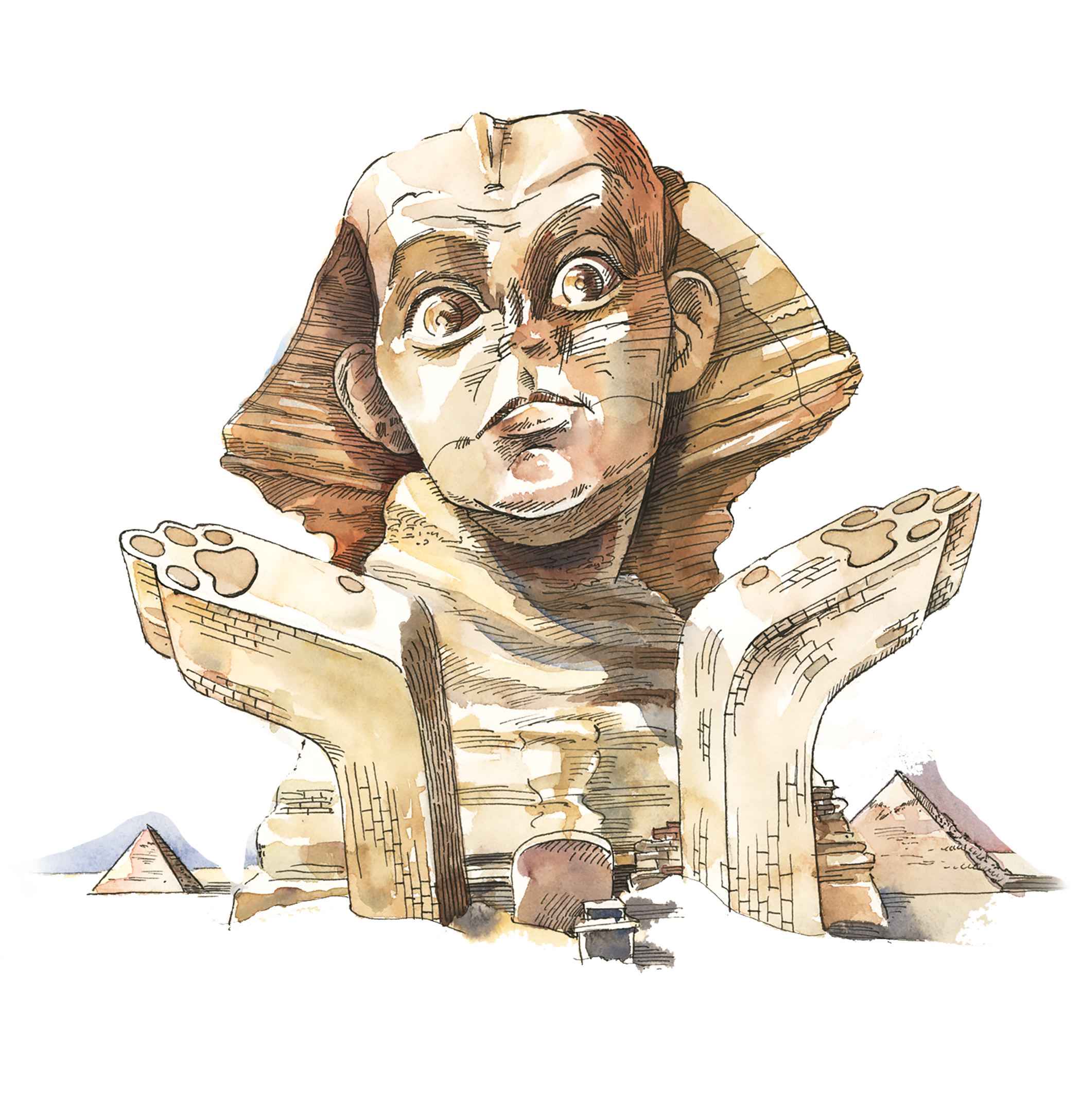
OZICK: How surprising, unsettling, befuddling! I never saw or suspected these connections, and they are, now that you raise them, incontrovertibly there: proof, perhaps, of the reality of the Unconscious. What I had in mind, though, were entirely separate streams of conduct. Hester Lilt carries an emphasis on not judging too early. Madame de Sévigné mistakes love for possession. Puttermesser inhabits mythology, a dangerous endeavor. It may be, then, that what links all three is the folly of a wrong turning: but this is after the fact. In the act of writing, Story evades cogitation and is—by definition?—berserk.
SOCHER: You’ve talked about always writing at night (and you are probably answering this email at night). Do you think night writing has any impact on your style?
OZICK: Morning is an enemy. It demands, it urges, it enslaves, it commands: Get up! Get up! Get up NOW! Night is a secret friend. It offers authentic freedom, no interruptions, no constraints, no appointments, no hours, read on and on if you please, sit at the computer until the morning Sh’ma if you like . . . so it’s night itself that possesses an independent style.
SOCHER: Two stories, “Bloodshed” and “Usurpation,” both very Jewish and both of which seem to me to have that nighttime style, were originally published in the 1970s with Gordon Lish at Esquire. This is doubly surprising, since Lish is remembered as the guru of what one might call goyish minimalism (Raymond Carver, Richard Ford, Amy Hempel). What was it like working with Lish?
OZICK: Well, to begin with, it appeared to be altogether anomalous because it was so fully unprecedented for stories bearing a Jewish texture (and also including some particles of Jewish text) to turn up in a popular magazine once regarded as appealing mainly to a readership of men. Lish, at the height of his renown as Captain Fiction, had also accepted a third story, “Levitation,” in a similar vein, which the presiding editor rejected. When Lish refused to back down, he was fired. He had already published, in 1974, an article recording my visit to Israel directly in the wake of Egypt’s 1973 surprise attack on Israel on Yom Kippur. The declaration he chose for its title was “All the world wants the Jews dead.” At the time some thought it too extremist; in the current circumstances of 2025, it has, unfortunately, only become less rhetorical and more dismayingly apt.
SOCHER: Often in your stories there is a moment of delirium on the part of the protagonist, or a dreamlike sequence. This happens, for instance, in “Conversion of the Jews” and “Usurpation,” and I can think of comparable moments in several of your novels. Why do you think this is?
OZICK: I’m not certain about the presence of any “dreamlike sequence,” but I am excited by your suggestion of delirium. I can think of one moment when I might have experienced something close to that. It was the middle of the night, when I had just brought the rabbi of “The Pagan Rabbi” to his confrontation with the tree nymph, and was firmly stymied: how would they communicate? What language might a dryad have? And then it came to me that she, being botanical, would speak through the olfactory nerve. Her lover would comprehend her fragrances. It seemed so natural, so given, so sublimely and nearly divinely revelatory, that I was carried away into . . . was it a kind of delirium? Both in the tale and in the teller?
SOCHER: You’ve written often that Judaism is about difference and the making of distinctions. When did you first come to this thought?
OZICK: On first reading Genesis. But with that as a start, and with this powerful idea in one’s pocket, it’s possible to see how elsewhere an opposite tenet rules. Gods become men, men become gods, dualities and trinities and whole pantheons prevail. It’s as if the human mind resists singularity—the conviction that one thing is not another thing—and that the gnostic allure of magical transfiguration claims all peoples, with only the Jewish perspective in millennial dissent.
SOCHER: Earlier you said that the famous midrash you learned as a child about Abraham smashing Terach’s idols first got you thinking seriously about idolatry. But at some point, you seem to have developed a sophisticated adult theory about all of this, and I’m still wondering what books and writers influenced you.
Take, for instance, your famous 1971 exchange with Norman Mailer. What everyone remembers is you asking him what color ink he dipped his balls in before writing. But in the lead-up to that you called him “a sacerdotal priest of the primal erotic religion” and talked about phallic lingam stones in India. So, what were you reading and thinking then that led you to the theological (or anthropological) thought behind remarks like this?

Ozick’s notes for a review essay. (Courtesy of Fred R. Conrad/The New York Times/Redux.)
OZICK: The Abraham-and-Terach tale is certainly attractive to children, but Genesis feeds into the highest reaches and most foundational elements of the idea of distinction-making. By means of Creation, light is divided from darkness, day from night, the sky from earth, and land from the seas. And it’s these primordial separations that serve as the template for understanding that man is not God, and that God is not man, and that divinity cannot be incarnate in anything visible or tactile or otherwise humanly imagined.
As for the lingam stones: my interest in such phenomena began in college, when I was drawn to a philosophy course in comparative religion, which included Hindu and Buddhist texts, touching also on Judaism, Christianity, and Islam. Much earlier, there was the school encounter with Greek and Roman mythology, and somewhat later William James’s The Varieties of Religious Expression, the Durants’ The Story of Civilization series, and Joseph Campbell’s The Hero with a Thousand Faces. And then, later still, in 2013, I read David Nirenberg’s Anti-Judaism. All of this led me to think that notions of mystical rapture may be the essence of Story and Poem, but living in the world summons us to what springs from the Genesis idea.
SOCHER: So, which, if any, writers of stories and poems manage to live in the world rather than rapture?
OZICK: If living in the world can be defined by conduct and deed—concrete acts, both in the everyday sense and in hours of crisis—then words in print must be excluded. But you suggest an argument: what of stories and poems that are teacherly, that demonstrate conduct and deed? If a novel, say, resembles a sermon, then throw it against the wall. Yet there are novels (Middlemarch, Anna Karenina, The Portrait of a Lady, Mr. Sammler’s Planet) that so intuitively palpate human proclivities that they carry us away—not into rapture, but into reflections of moral profundity. And Paradise Lost, the greatest of poems, is also the fiercest spur to introspection.
SOCHER: What did you learn from reading Leo Baeck in this regard?
OZICK: His essay, “Romantic Religion,” which addressed the nature of the departure of Christianity from Judaism, was a clarifying confirmation of my own departure from ideational rapture. (My undergraduate English thesis on the Romantic poets had “monism” in its title.)
SOCHER: I saw Heinrich Graetz’s History of the Jews on the bookshelf in your living room. What did you learn from him?
OZICK: I discovered the six-volume red-covered Jewish Publication Society Graetz, translated from the German, dated but distinctly not out of date, on a bookshelf in Newark, New Jersey—the Weequahic neighborhood, made famous by Philip Roth—where I was visiting, at age seventeen, with my parents. It’s no exaggeration to say that it was a turning point in life, the hinge that set me on the scent of history as a means of decoding human obsessions. That couldn’t have been my understanding then; but it thrust me into the long view, the dor v’dor of the centuries of Jewish thought and Jewish grief, and many years later, when I learned that Kafka too had been immersed in Graetz, it refuted much of how Kafka is read and received.
SOCHER: You once called the New Critics and Harold Bloom Karaites in their obsessive focus on the text of a poem, as opposed to its context or maker. Professor Mitwisser in Heir to the Glimmering World is a scholar of Karaism, and his assistant, Rose, imagines Karaites as “inked letters sweeping through the backs of the pages of old chronicles.” What is there about Karaites that interests—or horrifies—you?
OZICK: Have I ever mistaken the gnostic Bloom for a Karaite? Unlike the Karaites, for Bloom context and maker are, by contrast, elemental. His anxiety of influence is all too aware of the past as context and of prior poets as rival makers to be displaced. And it’s on several counts that the Karaites ignite curiosity. Mitwisser, not unlike Gershom Scholem, is attracted to an aspect of Jewish thought that is out of the mainstream. Karaites, like Protestants, follow sola scriptura, by Scripture alone. But like Jews immemorially, they initiated or augmented intellectual innovation. For example: through concentration on Biblical text, they became masterly lexicographers. Yet in abstaining from the tradition of commentary, and by renouncing Talmud, the Oral Law, they separated themselves from the main body of Judaism—and in the cruelest period of twentieth-century Jewish suffering, when the Nazis were determining whether they were vulnerable to annihilation, Karaites denied being Jews at all. And lived to witness the destruction of other Jews.
Still, historians seem to differ on the origins of East European Karaites: were they Jewish dissidents from authentic Rabbanite Jews, or were they actually derived from indigenous Turkic groups? Or is this yet another argument to add to the contentious roster of Jewish discourse?
SOCHER: What do you think is important about the rabbis’ insistence—against the Karaites and others—on there being Oral Torah (Torah she-ba’al peh) in addition to the Written Torah, or scripture?
OZICK: It may be difficult for a rational mind to accept as historical the concept of overtly time-bound human documents regarded as equal to the timeless revelation at Sinai, but for doubters as well as believers it must be enduringly significant that the Oral Torah—on the very ground of reasoning—minutely examines, questions, debates, parses, interprets, comments on the Written Law. Also, this long ingrained heritage of study has markedly influenced the secular pursuits of Jews both in the physical and social sciences.
SOCHER: Your uncle was the Hebrew poet Abraham Regelson. I think he made aliyah in the 1930s when you were still very young. Did he—or his example—influence you at all?
OZICK: In the essay “Nobility Eclipsed,” I spoke of my uncle Abraham in the context of that remarkable cohort, the American Hebraists. All but one, Gabriel Preil, immigrated to British Mandatory Palestine, my uncle and his family among them (in 1933). And like all, he was fully trilingual, steeped in the culture and literature of Yiddish, Hebrew, and English. (Sometimes I think that if he had continued in English, his work would have resembled that of Robinson Jeffers. Or, contrariwise, William Blake! Dan Miron, the eminent Israeli critic, has compared him to Shelley.)
In 1936, because of the violence of Arab rioting at the time, and the loss of a newborn son to malaria, he returned to New York until 1948, when he settled permanently in Israel. I knew him then, well into my late teens and long beyond. It was through him that I was led to William James, and much else. He was always a Literary Presence.
SOCHER: The other day, I read that Regelson was a partial model for Edelshtein in your famous story “Envy; or, Yiddish in America.” Is that true? Of course, Edelshtein is generally identified with Chaim Grade, and the writer of whom he is envious is taken to be a version of Isaac Bashevis Singer.
OZICK: Regelson as model for Edelshtein? Hardly possible, since Edelshtein is desperate for a translator, and Regelson was himself a translator, from Hebrew into English, sometimes of his own poetry (e.g., “Two Swans and a River,” on an episode in the life of William Butler Yeats), and also of Herrick, Blake, Wordsworth, Whitman, Dickinson, Francis Thompson, and more). But the confusion is understandable, since he was among the founders of the Hebrew Poetry Society of America. This small group, which met in New York, was far less grand than its title. I once went to a meeting, and it’s that occasion which, many years afterward, supplied the impetus for “Envy.” Much later still, having been given in the interval the opportunity to translate Yiddish poetry, I changed the story’s language, but not the original atmosphere.
I’m aware that Chaim Grade has been identified as Edelshtein, a rumor so widespread (and mistaken) that when I first had the privilege of meeting Gershom Scholem in Jerusalem, he startled me by asking “Is Grade Edelshtein?” (There’s no denying that Singer, in life as in fiction, is Singer. Once when he was pressed on this, he answered that he hadn’t read the story, but next time he was in the library he’d look it up.)
SOCHER: I don’t know if this is a “metaphysical merging” of the two “prose-driven roads,” but the plot of your 1983 novel The Cannibal Galaxy (my favorite) seems to have begun in your nonfiction.
In an essay from the early 1970s about living as a Jew in two worlds, you have an anecdote about running into the principal on the grounds of your daughter’s school. He is a survivor who studied math at Cambridge, and he illustrates a point to you with a famous story about Rabbi Akiva. Later, in a long story in The New Yorker called “The Laughter of Akiva,” that same character and anecdote show up (though now he was at Oxford). In The Cannibal Galaxy, the principal becomes Joseph Brill, a Sorbonne-educated astronomer from Paris. Did moving him to (and from) Paris reshape the story?
OZICK: Following the publication of the story, I was threatened with a lawsuit. Hence the transformations, which did, as it happened, thicken the texture and the chronological background of the novel: a Jew living in Paris is prey.
SOCHER: In Heir to the Glimmering World, one of the key characters is heir to the fortune created by his father’s Winnie-the-Pooh–like stories. Did you read Christopher Robin Milne’s angry memoir about growing up in the shadow of his father’s stories and being regarded as a kind of doll rather than a person?
OZICK: A name I proposed for this novel (and how I recoil from its ultimate name!) was The Bear Boy, leaving no doubt that the Winnie-the-Pooh phenomenon was the source. But it was long after the book was published that I discovered that the actual living adult Christopher Milne had written of his estrangement from his father.
This is the second instance of an invented circumstance turning out to be a fact in the real world. Most recently, in a story called “The Story of My Family,” the fictional narrator is the great-niece of Edgardo Mortara, a Jewish child kidnapped by the Roman Inquisition on the claim that he was secretly baptized. And then came an astonishing letter from Elèna Mortara, a professor of American literature at the University of Rome, and a descendant of Edgardo’s sister. Make-believe’s boundaries broken?
SOCHER: I think the British edition of that novel is actually called The Bear Boy. What do you hate about the title Heir to a Glimmering World, and how did you end up with it?
OZICK: Yes, and I hope it [the British version] wasn’t mistaken for a children’s book! As for the American title, it was the consequence of an editorial group consensus. I’ve been repeatedly asked its meaning and had to concoct something or other. What does it mean?
SOCHER: Let’s end back In a Yellow Wood. What pleases you most about this book (which you won’t reread)?
OZICK: I never imagined that I’d ever come under the aegis of the historic Everyman’s Library, and my delight and gratitude are augmented by this beautiful book with its gold ribbon as place marker: bookbinding apotheosis!
SOCHER: What is your next project?
OZICK: Another short story? But better than the last one. (I await the rejection.)
Comments
You must log in to comment Log In
Suggested Reading

Cynthia Ozick: Or, Immortality
Ozick is as marvelously demanding, harrumphing, and uncompromising as she has always been.
Cynthia Ozick’s Art and Ardor
Reading is a blessing and a curse in Ozick’s world, a gateway to heightened emotion and new experience and also a maze of cruel tricks and dead ends. Allegra Goodman reviews her latest novel.
Another Round with Norman Mailer
Norman Mailer had the gift of enlivening everything he touched. And he touched almost everything, from politics to Hollywood to Sports. But his Jewish novel stayed in the drawer.
Brave New Golems
As monsters go, golems are pretty boring. Mute, crudely fashioned household servants and protectors, in essence they’re not much different from the brooms in the “Sorcerer’s Apprentice” story.
ronnie perelis
this was magical- provocative, surprising, delightful
thank you