American Pharaohs
About ten years ago, my wife and I spent a memorable couple of days in New Orleans. We stayed at an elegant bed and breakfast run by an aging local civil rights and business leader who saw it as his role to challenge his guests at least as much as to tend to their needs, which is how our leisurely Sunday morning breakfast turned into a seminar on race relations. Inevitably, we ended up talking about Black and Jewish people. At one point, our host hit me over the head with the name of the Rhode Island merchant Aaron Lopez, who was one of the most prominent Jews of the colonial period and a leading slave trader. Yes, I said, but Lopez has to be seen in perspective. There was a lot of nonsense in circulation about Jews dominating the eighteenth-century slave trade, but in truth their involvement in it was relatively small and no more significant than that of others. “But you should have been better than the others,” he thundered in response.
There was some flattery submerged in that rebuke, but it was still a rebuke. You, a people who knew slavery from an ancient experience of which you ceaselessly remind yourselves, he was saying, were supposed to have learned a lesson about how to treat other people—and you clearly didn’t!
If our host reads Richard Kreitner’s comprehensively researched and vividly written new book, Fear No Pharoah, he’ll have more than Aaron Lopez to throw at future Jewish guests he may wish to shame—and uplift. Lopez, Kreitner shows, was the first of many prominent American Jews who were slave traders, slave owners, or ideological defenders of slavery in the ensuing century. Kreitner’s aim, however, is not to skewer them but to understand and display them, warts and all, alongside other contemporary Jews whose aims and actions were far nobler.
Kreitner doesn’t rail against Aaron Lopez so much as mock him:
Every spring, Lopez commemorated the Hebrews’ emancipation from Egyptian slavery—his account books list several large orders of matzoh and haroset for Passover—even as he financed and oversaw the abduction of hundreds of men, women, and children from the African coast and their shipment in horrific conditions to a distant continent.
And he, as well as others, did so remorselessly. “Neither Aaron Lopez nor any other Jewish slave trader in eighteenth-century Newport left a word of regret or discomfort about slavery.” True, “Jews were responsible for perhaps 2 percent” of the Atlantic slave trade, Kreitner observes, relying on the same scholarship as I had in New Orleans, but that, he judges, is “not quite negligible” or truly exculpatory.
The most famous nineteenth-century American Jew, Judah P. Benjamin, was not just a participant in the slave economy but an exceptionally eloquent defender of it. That the Confederacy’s secretary of state from 1862 until its ruination would take such a position is not surprising, but it is startling to learn from Kreitner that two decades earlier, he had criticized slavery just as eloquently. “What is a slave?” Benjamin asked in 1842, while trying a case before the Louisiana Supreme Court. He continued:

He is a human being. He has feeling and passion and intellect. His heart, like the heart of the white man, swells with love, burns with jealousy, aches with sorrow, pines under restraint and discomfort, boils with revenge and ever cherishes the desire for liberty.
But Benjamin uttered these words to assist a client, and he never said anything of the sort again.
Benjamin wasn’t much of a Jew. He took no pride in his origins and never, as an adult, practiced his religion, nor did he pass it on to his children. In this respect, he was utterly unlike the next most famous American Jew of this era, Mordecai Manuel Noah, who, among other things, tried to found a colony for distressed Jews called Ararat on an island in the Niagara River near Buffalo as the first step to an eventual return to Palestine. Nonetheless, “as the editor and publisher of some of New York’s leading newspapers,” Noah followed a trajectory similar to that of Benjamin, evolving from a critic of the “peculiar institution” into an ally of the Southern Senator John C. Calhoun
Noah did not cite the Bible in support of slavery, as did many contemporary Southerners, but there was a rabbi who did. On January 4, 1861, outgoing President James Buchanan called for a national day of fasting, humiliation, and prayer, as the conflict over slavery was driving the nation to the brink of dissolution. Morris Raphall, the charismatic Orthodox rabbi of B’nai Jeshurun, the oldest Ashkenazi synagogue in New York, led a service in which he directly addressed the issue. “Raphall had no problem with the racial theories that supported American slavery,” but he maintained that it was the biblical Noah’s curse of his son Ham that determined the fate of his supposed descendants, that is, Black people. That slavery in general was no sin was evident, he insisted, from the fact that all of the biblical forefathers had owned slaves. To those who maintained otherwise, “like the famous Brooklyn minister Henry Ward Beecher . . . Raphall asked, ‘Does it not strike you that you are guilty of something very little short of blasphemy?’” Raphall did acknowledge, however, that slaves in ancient Israel were treated better than those under the brutal system of the American South.
Kreitner offers many explanations for Raphall’s stance, including his wish to reflect the sentiments of the majority of the people of his city. Heavily dependent on trade with the South, New York’s “merchants, Jews and gentiles alike, had put their principles up for sale along with their merchandise” and voted overwhelmingly against Lincoln in the recent election. “Above all,” however, “Raphall seems to have intended his sermon as a last-minute peace proposal, an audacious effort to patch up the differences between North and South, and to use Judaism as the glue.” Shortly thereafter, “a group of prominent pro-South citizens . . . invited Raphall to repeat his sermon at the New York Historical Society.” Samuel F. B. Morse, the artist and famous inventor, chaired the event, and funds were solicited to publish Raphall’s sermon.

Some Reform rabbis also spoke out in defense of slavery or effectively supported it. Kreitner singles out Rabbi Maurice Mayer of Charleston, a veteran of the 1848 revolution in Germany, who “saw no contradiction between his support for liberal revolution in Europe and his embrace of slavery in the United States” and felt that “the peculiar institution” was, in his own words, “not relevant to the core of Jewish interest.” Isaac Mayer Wise, who would become the leading figure in American Reform Judaism after the Civil War, was not so much proslavery as he was pro-Union. Even as he opposed the extension of slavery to the West, he maintained that “‘abolitionist agitation’ threatened the Constitution that had given Jews unparalleled liberty.”
Some nineteenth-century American Jews were stalwart in their opposition to slavery, including a prominent abolitionist whose very existence almost defies belief. Born in Poland, the daughter of an orthodox rabbi, Ernestine Rose ran away from home when she was fifteen after eluding a bad shidduch and made her way first to Berlin and then to London before coming to America, reading and arguing all the way. By the time she arrived, she held to “a form of socialism propagated by the utopian industrialist Robert Owen,” to which she was drawn by his embrace of “religious freedom, including the freedom to have no religion at all” and the idea “that marriage should be based only on mutual love.” Such a marriage became hers after she met a non-Jewish silversmith named William Rose.
William opened a silver shop in New York, and Ernestine campaigned against slavery alongside William Lloyd Garrison and Frederick Douglass. She condemned it as a “great incomprehensible inconsistency . . . in a country that calls itself a Republic.” In her opinion, “humanity’s children” were all equal, whatever their color or gender, “all one and the same family, inheriting the same earth.” A resolute atheist, she disavowed Judaism but didn’t hesitate to describe herself as “a daughter of poor, crushed Poland, and the down-trodden and persecuted people called the Jews, ‘a child of Israel.’” Nearly forgotten today, Rose, Kreitner writes, “was likely the best-known woman orator of the time.”
In contrast to Ernestine Rose, August Bondi’s abolitionism does seem to have flowed from his commitments as a Jew. As a youthful revolutionary in Vienna, he had, in his own later words, “fairly fanaticized with sympathy for the downtrodden of the globe.” After the failure of the Vienna Uprising in 1848, his family migrated to St. Louis. In 1855, when he was twenty-two, he moved to Kansas and participated for a time in John Brown’s “ragtag frontier army” in the fight against slavery (though he did not participate in its most brutal escapade at Harper’s Ferry). In 1861, reminded by his mother “that ‘as a Jehudi’ he was obligated ‘to defend the institutions which gave equal rights to all beliefs,’” he joined the Union Army. When Lincoln issued the Emancipation Proclamation on January 1, 1863, Bondi, according to his own widely quoted and posthumously published memoir, jotted down in his diary: “No more pharaohs and no more slaves.”

Bondi’s story would certainly have made more of an impression on the host of my bed and breakfast than my statistical arguments, though if he reads Kreitner’s book, he’ll be able to point out what Bondi actually wrote in his diary: “‘No more slaves returned to their masters,’” which is not quite the same thing. And his idealism was, Kreitner argues, perhaps not entirely pure. Bondi, he writes, “did not go to Kansas seeking to join the front lines of a civil war between freedom and slavery so much as he went looking for adventure.” He was, in short, somewhat less imposing than the Reform rabbi who supplied Kreitner with the title for his book.
That was David Einhorn, who declared, “We fear no Pharaoh on this sacred soil of religious liberty.” German-born, he was forty-six years old when he arrived in the United States to assume a pulpit in Baltimore. In his first sermon in his new country, he “professed his abiding belief ‘in one humanity, all of whose members, being of the same heavenly and earthly origin, possess a like nobility of birth and a claim to equal rights, equal laws, and an equal share of happiness.’” His subsequent denunciation of slavery as “the cancer of the Union” and an immoral institution that must be abolished provoked a decidedly mixed response in his border state synagogue.
Nevertheless, after the publication of Morris Raphall’s sermon in January 1861, he railed against the Orthodox rabbi. Kreitner writes:
Einhorn could not understand how someone who “praises the Lord daily for the deliverance out of the Egyptian yoke of slavery, undertook to defend slavery.” The first line of the Ten Commandments identifies God as the being “who brought thee out of the land of Egypt—out of the house of bondage.” To Einhorn, Raphall’s remarks were nothing less than “a profanation of God’s name.”
This attitude rankled a lot of people and resulted in threats against Einhorn’s safety. He wanted to tough it out, even in April when proslavery mobs were tearing through Baltimore and his name was high on their list of targets. But friends convinced him to take refuge in nearby Pennsylvania. When order was restored a few weeks later, he tried to come back. But when his congregation requested that he keep quiet about slavery, Einhorn resigned and never returned to the city.
“Einhorn was far from representative of most Jews in America,” Kreitner acknowledges, but he doesn’t use him as a cudgel with which to beat his less courageous contemporaries:

As with Jewish participation in the Atlantic slave trade, the extent of Jewish slave ownership in the early republic was roughly on par with that of the white population overall. Jews were neither uniquely guilty nor a morally enlightened exception. They went along with the practices of those among whom they lived.
With a few exceptions, Southern Jews “were part of the South. They shared the principles, practices, and prejudices of other whites.”
What about the Jews of the North? When Lincoln took office, most of the Jews in the US were new arrivals (their population had risen from 50,000 to 150,000 over the previous decade), and most of them lived in the North. They were shaped by memories of their difficult European past and aware of the animosity toward them that existed even in the New World. In a “sometimes hostile atmosphere,” they generally felt, “it was best to simply keep one’s head down and not draw attention.”
The relatively favorable status that the Jews enjoyed in antebellum America was in part because, Kreitner argues, there was another object of racial hostility on hand to deflect hatred that might otherwise have been directed against them. He suggests that “a gut-level awareness of this dynamic may have discouraged American Jews from speaking out against slavery.” Those who felt otherwise, like Bondi, Einhorn, and Rose, had to be bold. For, as Kreitner writes, “any Jews who decided to speak—or act—against slavery had to do so as individuals, without communal protection or encouragement of any kind.” Moreover, the abolitionist community was deeply Christian and unhospitable to Jews, so it was no “wonder that so few Jews opted to join the abolitionists’ often openly anti-Jewish crusade.”
Both in the South and in the North, in short, a variety of factors discouraged Jews from standing up for the human rights of Black people, and yet some did. Richard Kreitner’s excellent book displays both our predecessors’ weaknesses and their strengths; it provides more food for thought than ammunition for debate.
Suggested Reading
The Wages of Criticism
The great 18th-century talmudist Rabbi Aryeh Leib Ginsburg never whitewashed his disagreements with other scholars, claiming that most "ruined good paper and ink and embarrassed the Torah." According to a popular rabbinic legend, his downfall came when, in an act of cutting vengeance, the books he had criticized came toppling upon him.
Israel on the Hudson
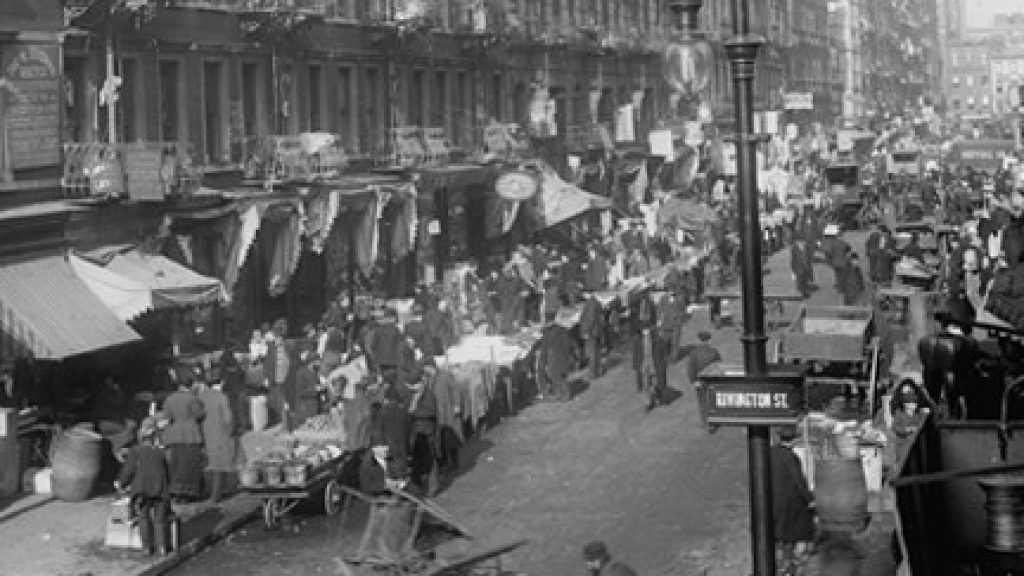
An ambitious, new three-volume work attempts to tell the story of New York's Jews from the days of Peter Stuyvesant to the present.

An Israelite with Egyptian Principles
Judah Benjamin was a brilliant New Orleans lawyer who became the most important cabinet member in Jefferson Davis’s Confederate government. He was, Senator Benjamin Wade correctly declared, one of the “Israelites with Egyptian principles.”

Open-Door Policy
The Jewish American Paradox expresses Mnookin’s conviction that only a Judaism of choice, open to all who publicly declare their belonging, has any prospect of flourishing in American society.
Comments
You must log in to comment Log In