It’s Complicated
The cover of Arie Dubnov’s book Isaiah Berlin: The Journey of a Jewish Liberal shows Steve Pyke’s familiar portrait of the philosopher and historian of ideas—the public face of the Anglo-Jewish sage in old age, his bald dome and shaggy eyebrows grave above owlish glasses, his mouth pursed as he gazes somberly sideways into the distance. The iconicity of the photograph is marred only by its exclusion of Berlin’s signature waistcoat.
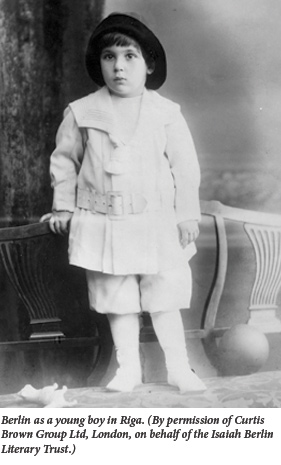
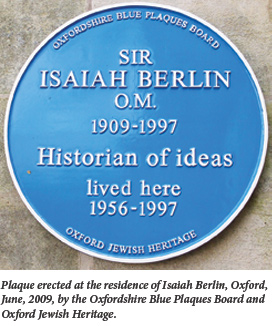
The image will be familiar to readers of Michael Ignatieff’s sensitive biography of Berlin. So will the story of Berlin’s journey from his upbringing as the son of a Jewish timber merchant in Riga to his late-life venerability as a British intellectual grandee. Born in 1909 to descendants of the first Lubavitcher Rebbe, Berlin (who passed away in 1997) came to Britain with his parents in 1921, following scrapes with the Bolsheviks and Latvian anti-Semitism. Within months of arriving, he was fast on his way to achieving the idiosyncratic mastery of the English language that would win him fame as perhaps the most dazzlingly erudite and vivid conversationalist of his time. Berlin seems to have gone everywhere, met everyone from Winston Churchill to Greta Garbo (often at crucial moments, as when he attended a dinner with John Kennedy on the first night of the Cuban Missile Crisis), and impressed them all—even when they could not follow his rapid-fire, Oxbridge-accented delivery. Harold Ross, founder of The New Yorker, is reported to have told the young Berlin, “Young man, I don’t understand a word you’ve said, but if you write anything, I’ll print it.”
Charm and affability had their dangers. It was cattily said that Berlin had been knighted for “services to conversation”; Berlin himself admitted that he had “always been prone to coloured descriptions of unimportant phenomena” and never stopped protesting that he had been “systematically over-estimated.” Yet his essay “Two Concepts of Liberty” has shaped liberal political theory and dominated theoretical discussions of political freedom for more than half a century; and in his account of moral conflict and loss he offered, in the opinion of one contemporary, “the truest and the most moving of all the interpretations of life that my own generation made.”
Berlin’s legacy is more considerable than either he or his critics predicted, but it is also ambiguous. His liberalism was complicated and enriched by his fascination with romantic, anti-rationalist critics of the temperate, humanitarian, rationalist ethos with which he was identified. Admirers and critics alike continue to debate whether Berlin remained a faithful liberal. Did his romantic sympathies lead him to adopt a relativistic or crypto-reactionary stance? And did his insistence on rationally irresolvable moral conflict support liberalism’s affirmation of toleration or reduce it to one contender among a multitude of equally valid value systems?
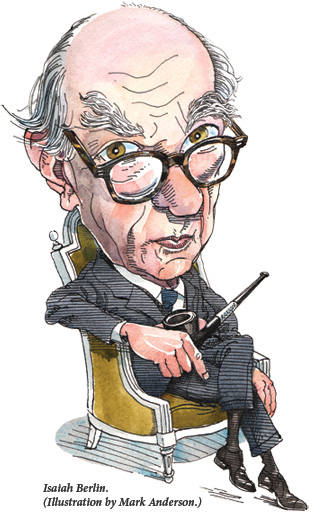
These questions have fueled a minor scholarly industry. Dubnov brings something new to this crowded field by going behind the familiar picture and concentrating on Berlin’s early years. In doing so, he shows how Berlin came to be who he was, and what it meant for him to make the choices that he did. The selection of jacket illustration aside, Dubnov digs beneath—and calls into question—the standard account of Berlin’s life as presented in Ignatieff’s biography.
Ignatieff, Dubnov charges, “made very limited and selective use of archival sources,” instead relying “heavily and not critically enough” on his own interviews with “the aged, celebrated” Berlin. This, combined with Ignatieff’s “highly apologetic interpretation of Berlin’s actions,” led him to produce a book that “avoid[s] uncomfortable reports of touchy or painful events.” Against what he regards as a too-smooth portrait, Dubnov stresses Berlin’s “ambivalence”—the “gaps, inconsistencies, and negotiation between contradictory forces that work simultaneously in one’s soul.” In tracing the emergence of Berlin’s mature thought and identity, Dubnov pays particular attention to the interaction between Berlin’s British affiliation and Jewish roots, and between his liberalism (seen as a reflection of British acculturation) and Zionism. He seeks to achieve a “dual perspective” that will come to terms “not only with the ‘British’ dimension of Berlin’s life and thought, but also with his Jewish upbringing and identity, and with his deep ambivalence toward Jewish nationalism.” While even a “dual perspective” may be too simple in dealing with so “complex, multilayered, and not necessarily consistent” a thinker as Berlin, it does represent an advance.
Dubnov is thoughtful, as well as searching, in his exploration of Berlin’s ambivalences. But his impulse to question received impressions of Berlin’s life sometimes leads him to give too little credence to Berlin’s own testimony. This is especially true in his treatment of the Russian dimension of Berlin’s consciousness, against which Dubnov stresses the specifically “Baltic” character of his upbringing in the Jewish community of Riga. This is fascinating, but its relevance is questionable. Multi-ethnic, mercantile Riga—which Berlin left at the age of 6 and for which he displayed little nostalgia—had less claim on his imagination than Petrograd, where he lived between the ages of 6 and 11 and witnessed both Russian revolutions. Until the end of his life he would remember seeing both the great bass Feodor Chaliapin’s performance as Boris Godunov and a tsarist policeman being dragged off to be lynched by a revolutionary mob.
Dubnov casts doubt on the significance of such memories, which were “shadows more than concrete experiences.” Yet, on the evidence of Berlin’s own writings—the only evidence available to us—it was Riga that was the “shadow” and the experiences of Petrograd that informed his consciousness.
Dubnov’s tendency to discount the importance of Berlin’s Russian connection is also reflected in his surprisingly skimpy treatment of his much-recounted night-long meeting with the poet Anna Akhmatova and other survivors of the Russian intelligentsia on his return to postwar Leningrad. Berlin identified these experiences as life altering and felt impelled to recount them again and again. There is a new note of seriousness that appears in Berlin’s postwar writing, which sets the mature thinker apart from the often frivolous young don, a shift in emotional tenor that seems impossible to account for without reference to his first-hand encounter with victims of Stalinism, as well as his guilty knowledge that his own recklessness had provoked further persecution for those he had met. Berlin’s absorption in Russian culture was genuinely deep—he felt “at home” in Russian thought and culture, with which he maintained ties throughout his life. Tellingly, while the library in Berlin’s house outside Oxford was filled with Western works of intellectual history and philosophy, his private study—his “inner sanctum”—was lined exclusively with works of (largely 19th-century) Russian scholarship.
Dubnov is inclined to treat this “Russian-Jewish” affiliation not as something deep and spontaneous but as a constructed identity that Berlin developed in order to navigate the elite world of British society—and, more specifically, Oxford, which combined its own sort of meritocracy with forbidding exclusivity. It was a social minefield—and, as with all minefields, the invisibility of the mines made them all the more frightening. Dubnov suggests that Berlin’s celebrated wit was a survival mechanism in this atmosphere. If so, Berlin—who always lamented his eagerness to be liked as his greatest failing—seems to have come to feel that he had overdone it, and to chafe at his public image:
“Wittiest man in Oxford”—I am not particularly witty—nobody can ever remember a single epigram I have ever made—and it annoys all the other really witty men. Anyway it is the last reputation I wish to have—I should like to be thought of as grave, deep, serious etc., and not as an agreeable talker. However one’s view of oneself and the view taken by others are strangely dissimilar.
Dubnov analyzes “the unspoken, yet ever-present pressure to conform” that Berlin faced as a Jew in British society with great empathy. But he also sometimes gives in to a penchant for overstatement—as when he claims that Berlin was “probably” one of three Jewish students at St Paul’s School. In fact, St Paul’s was among the most accessible to Jews of the venerable British public (that is, private) schools; Berlin recalled that there were approximately seventy Jewish pupils (out of five hundred) when he entered. Even if this figure is overblown, there were certainly more than three (among them, the son of then Chief Rabbi Joseph Herman Hertz). Nor was Berlin closer to his fellow Jews than to his non-Jewish schoolmates as Dubnov implies. A tendency to exaggerate both Berlin’s unease as a Jew in British society and his attempts to compensate for this is also evident in Dubnov’s presentation of Berlin as reserved, and even confused, about Chamberlain’s appeasement at Munich. Berlin’s description of a statesman “selling the Czechs piecemeal and bit by bit while he prepared … to sell them wholesale” does not strike me, as it does Dubnov, as the remark of an impassive observer.
Dubnov is nevertheless right in perceiving Berlin’s Jewish identity as a problem with which he had to grapple. He locates these personal struggles within a larger account of the intersection of Zionist politics with diasporic Jewish culture, which is sure-footed, incisive, and as fair-minded as it is vivid. Dubnov carefully reconstructs Berlin’s own engagement with Zionism, charting its intensification in the late 1930s as a result of the philosopher’s growing emotional involvement with the fight against Fascism, and offers the fullest account yet of Berlin’s tortuous navigation between the demands of his Zionist commitments and his role as a diplomat in America during World War II.
One of the main scoops of Dubnov’s book is his revelation of just how significant a position Berlin occupied within the Zionist movement in wartime America. Berlin became a confidante and unofficial (indeed, often covert) aide to Chaim Weizmann. (After the war, Berlin would often find this intimacy burdensome—particularly when Weizmann’s widow later pressured him to write her husband’s biography.) But while he sometimes went against his own government in working for the Zionist cause, Berlin, as Dubnov reveals, also fell prey to the morally distorting “frosted-glass view of events” (as Berlin described it) fostered by his diplomatic role. Most chillingly, this led him to hold back from joining in efforts to alert the public or pressure the Allied powers regarding the Nazi extermination of European Jewry.
Even before the testing experiences of the war, Berlin had to decide how to live as a Jew within English society and what his Jewishness meant to him. The problem went beyond social pressure from Gentiles. Thoroughly secular and largely unsentimental—he hated his days in a Riga cheder and was repulsed by his “bigoted religious ancestors”—Berlin’s attitude toward his Jewish roots reflected the mix of irreverence and dispassion with imagination and sympathy that marked his outlook as a whole. Berlin saw the Jews as a family, with all the diversity and conflict that this suggests; while he loved his family, he felt no need to stifle his skepticism or, on occasion, aversion towards its members. However sensitive he was to social pressures, Berlin remained “granite hard” in resisting “full-blown assimilation.” But he was also unwilling to let himself be ruled by others’ conceptions of what his duties as a Jew were—as when he declined repeated calls from the founders of the state of Israel to make aliyah and aid them in establishing the Jewish state.
Berlin’s chosen Jewish identity—diasporic, and neither religiously observant, ethnically chauvinistic, nor assimilationist—can hardly be called exceptional, either in his own time or ours. But his attitude toward Jewish identity has raised both eyebrows and hackles. The main source of offense was an ill-judged analogy that Berlin deployed in explicating the position of Jews in modern European society in his 1951 essay “Jewish Slavery and Emancipation,” Diasporic Jews, Berlin wrote, were like people with an obvious physical disability—”let us say hunchbacks.” Berlin went on to offer a typology of different reactions of the hunchbacks—the Jews—to the presence of their “humps,” that is, their anomalous position in Gentile society.
Dubnov persuasively defends Berlin against charges of Jewish self-hatred, arguing that Berlin was responding to contemporary debates and tropes concerning the psychological effects of diaspora, exclusion, and stereotyping. His reconstruction of this broader Zionist discourse of Jewish “normalization” as it was developed by Berlin’s friend, the formidable British historian and Zionist activist Sir Lewis Namier, is sharp and illuminating. So is his depiction of the influence on the young Berlin of both Namier’s pessimistic, aggressive, political Zionism, and the “cultural Zionism” of Ahad Ha’am, with its emphasis on ethical “Jewish values” that supplemented and harmonized with universal values.
In Dubnov’s account, Berlin synthesized and went beyond these positions to articulate a distinctive “diasporic Zionism.” The most powerful expression of this position is offered in “Jewish Slavery and Emancipation” in the course of a polemic against the novelist and anti-Communist intellectual Arthur Koestler. Following the founding of Israel, Koestler had taken to arguing that there were now two—and only two—viable options available to Jews: immigration to Israel or total assimilation. To continue on as a distinct ethnic entity in the diaspora was muddled and irresponsible.
Koestler’s was, Berlin wrote, a “clear-cut thesis” and as such was attractive to those who craved simplicity and intellectual tidiness. The problem with clear-cut theses was that they generally involve slicing into human sentiments and relationships (if not into actual human bodies). To “quite gratuitously” impose on ambivalent, divided individuals “a rigid ‘either-or’, just because we like ‘radical’ solutions” was “an intolerable form of bullying,” a “kind of petty tyranny” that “derives ultimately from the conviction that human beings have no right to behave foolishly or inconsistently or vulgarly.” Against this Berlin asserted “the rights of human beings to a certain elasticity . . . the right to realize themselves as they wish within the widest possible limits compatible with the existence of a minimum of justice and liberty and well-being.”
The true gift of Israel to the Jews, from Berlin’s perspective, was not simplicity, but greater freedom to define their own lives, and, thus, greater dignity. The creation of a Jewish state had “rendered the greatest service that any human institution can perform for individuals”: to make it possible for them “to choose as individuals how they shall live—the basic freedom of choice, the right to live or perish, to go to the good or to the bad in one’s own way, without which life is a form of slavery.” This was a distinctively, fundamentally liberal version of Zionism, in which there seems to be little room for a notion of the individual as subordinate to the Volk—an impression confirmed by Berlin’s declaration elsewhere that “all that is ultimately valuable are the particular purposes of particular persons.”
Dubnov’s “dual perspective” requires him to bring the rich, sometimes troubling story of Berlin’s evolving Jewish identity and Zionism together with accounts of his debt to British philosophy. One surprising link that Dubnov uncovers is between Berlin’s Jewishness and foreignness, and his early involvement in academic philosophy at Oxford in the 1930s.
The story of philosophy at Oxford in Berlin’s time is an intricate one, and Dubnov’s detailing of influence and affiliation is not always convincing. His depiction of Berlin joining the “crusade” of his radically empiricist contemporary A. J. Ayer, only to become “suddenly appalled” by its crudity, is exaggerated. Berlin had from early on questioned attempts—including Ayer’s—to establish some single, simple, “infallible criterion” of knowledge or meaning. Dubnov also overstates Berlin’s debt to the Oxford Idealist R. G. Collingwood, omitting to mention (in an otherwise painstaking reconstruction of their relations) Berlin’s 1932 confession that he knew little about Collingwood, but found the old philosopher “frequently deceitful and unsound.” Nor does he mention his later judgment that Collingwood’s Idealism “broke to pieces.”
Dubnov’s account is nevertheless astute in identifying a significant link between Berlin’s early philosophical background, his identity as a Jewish émigré, and his later political thought. In joining his contemporaries’ rejection of British Idealism (which had dominated Oxford in the late 19th century and the beginning of the 20th) Berlin was reacting against not only a philosophical doctrine, but also a social outlook. Idealist political thought was bound up with a commitment to a morally unified, cohesive—and Christian—communal culture. For Berlin, Idealism represented a tendency toward religious exclusion, cultural uniformity, and an intolerantly moralizing view of character. In rejecting Idealism, Berlin’s philosophical views, cultural position, and political liberalism converged. An echo of this early reaction against Idealism is apparent in Berlin’s criticism of T. S. Eliot in “Jewish Slavery and Emancipation.” Eliot (who wrote a doctoral dissertation on the Oxford Idealist F. H. Bradley) had, in the 1930s, warned that the cultural and moral unity of “Christian civilization” was being undermined by the influx of “foreign populations” and the presence in society of “any large number of freethinking Jews.” In response, Berlin, the foreign-born freethinking Jew, declared both Eliot and Koestler to be “souls filled with terror” at the unruliness that resulted from human variety.
In the 1930s, Berlin’s objections to Idealism were primarily philosophical. The political threats with which he was concerned were far more urgent and malignant: the effects of the Depression and the unhealed wounds of World War I, the stagnation of liberal democracy, and the rise and allure of totalitarian movements of the right and left. While most of his peers regarded liberalism as a dead option in a world dominated by fascism and Nazism, Berlin remained, in Dubnov’s term, a “pink liberal”—sympathetic to the left, but unwilling to fully embrace its more radical tendencies. Berlin described his own position as occupying “the extreme right wing edge of the left-wing movement, both philosophically and politically.” However, when faced with those “conspicuously outside” the left-wing movement, “who wish to attack it as such, there is nothing to do but man the walls.”
The complexity of Berlin’s politics is reflected in his political theory. Berlin remains best known to political theorists for his distinction between “negative” and “positive” liberty—a distinction more complicated than it first appears. “Negative liberty” is relatively simple: it involves, first, “opportunity for action” (in Berlin’s metaphor, the existence of open doors); and second, “non-interference,” from others. Berlin defined “positive liberty” both as being ruled or determined by one’s own decisions, and as a capacity to act (or to act successfully) based on those decisions.
Both of these conceptions of positive liberty were prone to what Berlin regarded as dangerous perversions. The idea of liberty as self-rule had, over the course of history, come to be equated with having one’s actions determined by what one would will if one were freed of irrationality and illusion, while the idea of liberty as capacity for action came to be equated, in a similar “sleight of hand,” with acting well. Once these moves had been made, rulers were, Berlin wrote, “in a position to ignore the actual wishes of men or societies, to bully, oppress, torture them in the name, and on behalf, of their ‘real’ selves, in the secure knowledge that whatever is the true goal of man (happiness, performance of duty, wisdom, a just society, self fulfillment) must be identical with his freedom.”
This argument has led some to view Berlin as a champion of freedom understood as non-interference and an opponent of all government intervention—a sort of libertarian. In fact, the “pink liberal” Berlin did not regard all “positive” theories of liberty as equally mistaken or dangerous nor all “negative” theories of liberty as morally defensible. The “positive” idea of freedom as self-determination was a genuine value, and the idea of liberty as non-interference had been “used to support politically and socially destructive policies that armed the strong, the brutal and the unscrupulous, against the humane and the weak, the able and ruthless against the less gifted and the less fortunate.” What, then, was Berlin actually arguing against?
Dubnov says that his critique of positive liberty was aimed at philosophical Idealism (with its moralizing identification of freedom with living a virtuous, public-spirited life) and totalitarianism (with its identification of freedom with obedience to the commands of a visionary ruler). But that Berlin was writing against attempts to co-opt the idea of liberty for illiberal ideologies has always been clear, and the benevolent, long-dead worthies of British Idealism hardly constituted a live intellectual or political target by the 1950s.
Dubnov’s most promising contribution to our understanding of Berlin’s mature writings on liberty is in his suggestion that Berlin’s defense of “a loose texture and toleration of a minimum of inefficiency” against the imposition of neat patterns grew from his personal struggles against the imposition of confining conceptions of Jewish identity. These came from conservative Christians like Eliot, as well as Jews—whether right-wing Zionists, dogmatic champions of Orthodoxy, or “non-Jewish Jews” like Berlin’s bête noir Isaac Deutscher—who sought to dictate the terms of Jewish identity.
As “Jewish Slavery and Emancipation” shows, there was a deep affinity between Berlin’s political position and his personal predicament as a Jew. But it is also possible that Berlin’s opposition to confining visions of Jewis h life reflected a larger temperamental aversion to all attempts to deprive individuals of meaningful freedom in deciding the course of their own lives. From his undergraduate days onward, Berlin’s writings echo with the image of Procrustes, the mythological bandit who sought to fit hapless travelers into his stone bed, even if it meant stretching their limbs or lopping them off. It is not clear, from the evidence at hand, whether Berlin’s distinctive brand of liberalism represented a response to his Zionist commitments, as Dubnov claims, or whether his particular version of Zionism reflected antecedent sentiments and commitments that made him a liberal.
Despite occasional overstatements and factual slips, Dubnov’s linking of Berlin’s intellectual positions to the development of his identity as a British liberal and Russian Jew is illuminating, as well as original. His book makes a compelling case that Berlin’s thought cannot be grasped fully if his social standing as a Jew and engagement with Zionism are bracketed or omitted. To do so (as I, among others, have done) is surely a mistake—and one that will be extremely difficult to defend in the wake of Dubnov’s often revelatory study.
Berlin emerges from Dubnov’s account a flawed but humane figure, whose own ambivalences led him not to seek salvation in a constricting pattern of order, but to appreciate variety and untidiness. He defended a conception of freedom—”the ability to choose as you wish to choose, because you wish so to choose, uncoerced, unbullied, not swallowed up in some vast system . . . to resist, to be unpopular, to stand up for your convictions because they are your convictions”—which was at once very British, very liberal, and marked by the experiences of a Jew in the 20th century.
Suggested Reading
In Brief, Spring 2012
Baseball, Beats, and Scandals in Satmar.
Inventing American Judaism
Unlike the Jews of Venice, whose charter was anxiously renegotiated every decade or so, American Jews participated in civic life, confidently building themselves a future.
Brief Kvetches: Notes to a 19th-Century Miracle Worker
One day in the 1860s, a father burst into Rabbi Elijah Guttmacher's study house begging for help. His son's stomach was distended, and he was barking like a dog.

Repentance and Desire
Mizrachi identifies the heightened energy she senses in the streets of Israel during the days between Rosh Hashanah and Yom Kippur. She renames the period between Rosh Hashanah and Yom Kippur known as the Ten Days of Repentance, “Aseret Yemei Teshuva,” as the “Aseret Yemei Teshuka,” or “Ten Days of Desire,” a time when the yearning for a return to God and Torah reaches a primal, visceral level.


Comments
You must log in to comment Log In