Diaspora Scrapbook
One of my favorite Jewish jokes is about Chaim and Mendel, who meet in a displaced persons camp after World War II. They become best friends, but when Chaim receives permission to immigrate to the United States and Mendel gets papers for Britain, they have to part. After two years, Chaim decides to go to England to visit his friend. As he steps off the ocean liner, he sees Mendel waiting for him in the crowd, now clean-shaven and wearing a beautiful Savile Row suit, weeping loudly. “Mendel,” Chaim says, “I thought you’d be happy to see me. What’s the matter?” “Haven’t you heard?” Mendel replies. “We lost India!”
Like all the best Jewish jokes, this one has a bitter aftertaste. Its target isn’t British Jews in particular; it’s about the Jewish desperation to belong and the self-deception it breeds. About 150 years ago, almost all the world’s Ashkenazi Jews lived in central and Eastern Europe. Today, their descendants are patriotic Americans or Israelis or Britons or French or Mexicans or Australians. But if we’re honest, we know that with the slightest twist of fate, any of us could have ended up anywhere—or nowhere, if our ancestors hadn’t managed to emigrate in time.

“To Jerusalem by Way of American Farms,” an article by C. H. Abbott in The San Francisco Call on August 25, 1907. (Courtesy of Texas State Historical Association.)
Melting Point, an innovative family history by the British writer Rachel Cockerell, tells a number of different stories—about politics and literature; Greenwich Village and Galveston, Texas; big messy households and lonely orphans. But the metanarrative, as it were, is about the randomness of Jewish fate in the twentieth century and how it severed our connections to the past and to one another. When she began the book, Cockerell says in the introduction, she intended to simply write about her grandmother; she had never even heard of most of the people and events that ended up filling it. “Above all,” she writes, “this book is an attempt to transport myself back in time, to see things as they really were.”
The unusual construction of her book reinforces this sense of witnessing. Not a word of it was written by the author; rather, she curates hundreds of quotations from newspapers, memoirs, letters, and interviews, ranging in length from a sentence to several pages. Each source is identified in the margin, giving the book the appearance of an oral history or a textual commentary. This is not quite the unfiltered voice of the past: Cockerell skillfully shapes the material into a coherent narrative, complete with artfully chosen character descriptions and scene setting. But the result is something more like time travel, or at least a documentary film, than a standard work of history.
Despite all this testimony, ironically, the central character in Melting Point remains a blank. Growing up, Cockerell knew almost nothing about her maternal great-grandfather, David Jochelmann, except for the “huge, sombre portrait” that hung in a relative’s house. At the end of the book, the reader doesn’t know much more. Jochelmann wrote nothing Cockerell can quote, and he died in 1941, so there’s no one left to ask about him. But the choices he made determined the shape of his family’s future.
The first and longest section of Melting Point is dedicated to the early Zionist movement and its offshoot, Territorialism. Cockerell begins at the beginning with a description of Theodor Herzl, taken from a 1901 article by a journalist who met him:
This man’s self was so bizarre, so disturbing, so strange, that I caught myself wondering at its persistence in my mind. Why should I keep in my memory so clear a picture of Herzl when so many other men and women fade out of it like shadows of shadows?
A chorus of other voices testify to Herzl’s good manners and good looks, but it seems clear that the real source of his charisma was the idea he embodied. European Jews reacted to Herzl in much the same way that African Americans did to Malcolm X, and for the same reason. People described Herzl with words like “royal,” “king,” “colossal,” and “monumental” because Zionism promised to restore dignity to a people accustomed to contempt.
After Herzl’s opening speech to the First Zionist Congress in Basel, Switzerland, in 1897, one delegate was “seized by an overpowering desire . . . to cry out, loudly, for all to hear: ‘Yechi Ha-melech! Long live the King!’” But the key event for Cockerell’s family history was the Seventh Congress in 1905, the first to be held after Herzl’s death. Following a fierce debate, the delegates rejected Britain’s standing offer to open part of Uganda for Jewish settlement, insisting that the goal of Zionism could only be a Jewish state in the biblical land of Israel.
In doing so, the Congress rejected the arguments of Israel Zangwill, who emerges as one of the main characters in Cockerell’s narrative. Like Herzl, Zangwill was in his time a famous writer, the author of the novel Children of the Ghetto and the play The Melting Pot. Physically and temperamentally, however, he was Herzl’s opposite: homely, badly dressed, and messy, his “pockets overflowing with manuscripts, proof-sheets, newspaper clippings—in fact, every scrap he had thought worth saving for days past.”

The Cockerell family. (Courtesy of Rachel Cockerell/Farrar, Straus and Giroux.)
Zangwill was an early champion of Zionism, but he split with the movement over Uganda, feeling that the situation of Jews in Eastern Europe was so desperate that they should accept any refuge. After the Seventh Congress, he founded a new group, the Jewish Territorial Organization, or ITO, dedicated to securing a home for the Jews outside Palestine. “There must exist somewhere in the world a healthy, empty or thinly-populated territory, large and fertile enough to hold a population of many millions,” Zangwill declared. In fact, Cockerell shows with a series of tragicomic news reports, the locations scouted by ITO kept turning out to be barren and uninhabitable.
Finally, at the end of 1906, Zangwill announced a different strategy. Instead of building a new country, Russian Jews should continue the mass migration to the US that had begun in 1881—but not to New York, where they had been arriving in large numbers for twenty-five years. Instead, ITO would help them move to the southern and western states through the port of Galveston, Texas, a small coastal city best known for having been completely destroyed by a hurricane six years earlier. The impetus and funding for the Galveston Plan would come from the Wall Street millionaire Jacob Schiff, who, like other well-established German Jews in New York, preferred to see penniless Russian Jews dispersed across the US rather than piled up on the Lower East Side.
As for the organizational work, Zangwill announced that it would be entrusted to “our friend Dr. Jochelmann.” This aside on page 122 is how Cockerell’s great-grandfather makes his entrance onto the stage of Melting Point. He never becomes much more prominent: There are no sources to tell us exactly what he did in Russia or how he convinced some ten thousand Jews to head for Galveston over the next eight years (or how he failed to convince more). Instead, we see the Texas city through the eyes of other observers, Jewish and non-Jewish, and get to know the local rabbi, Henry Cohen, who met every group of new arrivals and helped them find homes in the American South and West.

Israel Zangwill. (Courtesy of Lebrecht Music & Arts/ Alamy Stock Photo.)
Zangwill relates Jochelmann’s report that “emigrants of ours, whom he had known in Russia as crushed, worn-out, hopeless and prospectless pariahs, he found again in America, holding up their heads, decently dressed, living in bright, clean flats.” But this was not the Jewish dream of Zionism or even Territorialism. It was the old American Dream. There is little difference between this description of thriving Jewish immigrants and the way Hector St. John de Crèvecœur described thriving Scottish immigrants in the 1760s.
But then, Cockerell shows, Zangwill himself was never sure what he wanted for the Jews. Was it a state of their own, a temporary asylum, or simple assimilation of the kind he praised in The Melting Pot? The play tells the story of David Quixano, a young Jewish musician who flees Russia for America after his family is killed in a pogrom. Rather than Zionism or Territorialism, Quixano finds salvation in American patriotism, celebrating his new country by writing an American symphony, The Crucible. He falls in love with another Russian émigré, a Christian girl, and when it turns out that her father is the tsarist officer responsible for killing his own parents, David is stricken by guilt. But in the play’s last scene, he decides that the truly American thing is to forget the collective identities of the past, with all their bloody history, and be forged anew in the crucible of the United States. “What is the glory of Rome and Jerusalem where all nations and races come to worship and look back, compared with the glory of America, where all races and nations come to labour and look forward!” David cries.
That message pleased President Theodore Roosevelt, who, per The New York Times, attended a performance of the play in Washington and was seen to “lean forward in his box and say in a perfectly audible tone: ‘That’s all right!’” But the idea of America as a melting pot has long gone out of fashion, as new ideals of pluralism and multiculturalism have made “assimilation” sound like a dirty word. Cockerell’s own title, Melting Point, reads like a skeptical response to Zangwill’s. How high do you have to turn up the temperature to reforge a Jew into an American or an Englishman? Can it ever really happen?
Her own family’s story provides good reason to doubt it. David Jochelmann, who convinced thousands of Jews to go to Texas, did not follow them there. Rather, when the Galveston program ended in 1914, just before the outbreak of World War I, he moved to England to be near Zangwill and stayed there for the rest of his life.
The second part of the book focuses on Jochelmann’s son Emmanuel, who came to America on one of his father’s trips and decided to stay. Emanuel graduated from Columbia in 1919 and enjoyed a brief celebrity as an avant-garde playwright in Greenwich Village in the 1920s under the improbable pseudonym Emjo Basshe. As Cockerell shows, Emjo was friendly with better-known writers like John Dos Passos and Mike Gold and impressed the financier Otto Kahn, who became his patron. However, reviews of his first play, Adam Solitaire, mocked it as trendily incomprehensible, with one critic noting that the main character “suffered almost as much as his audience.” In truth, Emjo, who died in 1939, was to avant-garde literature what his father had been to Jewish politics: a tertiary figure, less interesting himself than as a point of entry into a milieu rich in philanthropy, idealism, competitiveness, and a certain amount of absurdity.
The final section of Melting Point is closest to the book Cockerell originally envisioned: a family memoir focused on her grandmother, David Jochelmann’s daughter Fanny. Instead of articles and books, the most important sources here are Cockerell’s interviews with family members, who conjure up the household at 22 Mapesbury Road, London, in the cold and hungry years after World War II. Fanny and her sister, Sonia, lived there together with their husbands and children in a state of chaos that was sometimes jolly. “There were always people up and down the stairs, and in the garden, and playing ping-pong,” recalls the author’s father, Michael.
Yet the memories of burnt, inedible dinners and near-fatal car accidents, the result of Fanny’s perpetual distraction, are less than idyllic. The stories give the impression of a group of people who aren’t quite sure why they are living where and as they are. During the war, for instance, the family acquired a Morrison shelter, “like a huge table tennis table, with very thick legs, made of iron. Supposedly, if a bomb fell, it wouldn’t crush you under this table.” After the war ended, it continued to serve as their kitchen table for years. It’s the kind of careless improvisation you’d expect from people who don’t feel they are at home. What’s the point of building a comfortable life when it could all get swept away in an instant?
And, in a way, it did. In 1950, Sonia’s husband, Yehuda, an ardent Zionist, took his wife and children to Israel, never to return. Fanny, who had married an Englishman named Hugh Cockerell, stayed behind with her family. More than seventy years later, both the English cousins and the Israeli ones seem bewildered by the course their lives took. “It was all so new,” says Judy, Sonia’s daughter, about that abrupt move to Israel, where she has spent her entire life and now has eight grandchildren. “It wasn’t until later on that I realised what we’d lost, really.”
It’s the next-to-last quotation in the book—a melancholy ending to a family epic in which home always seems to be somewhere else.
Suggested Reading

Days of Redemption
Did early Zionists abandon Messianism or inherit it? Or, as Arieh Saposnik argues, did they do something more subtle and interesting?

Saladin, a Knight, and a Jew Walk Onto a Stage
Outside of Germany, Nathan the Wise is one of those works more often read than performed, and more often read about than actually read.
Shabbtai at Seventy
Stuart Schoffman traded Malibu for Jerusalem, "smack in the middle of the First Intifada."
One Nation, Two Disraelis
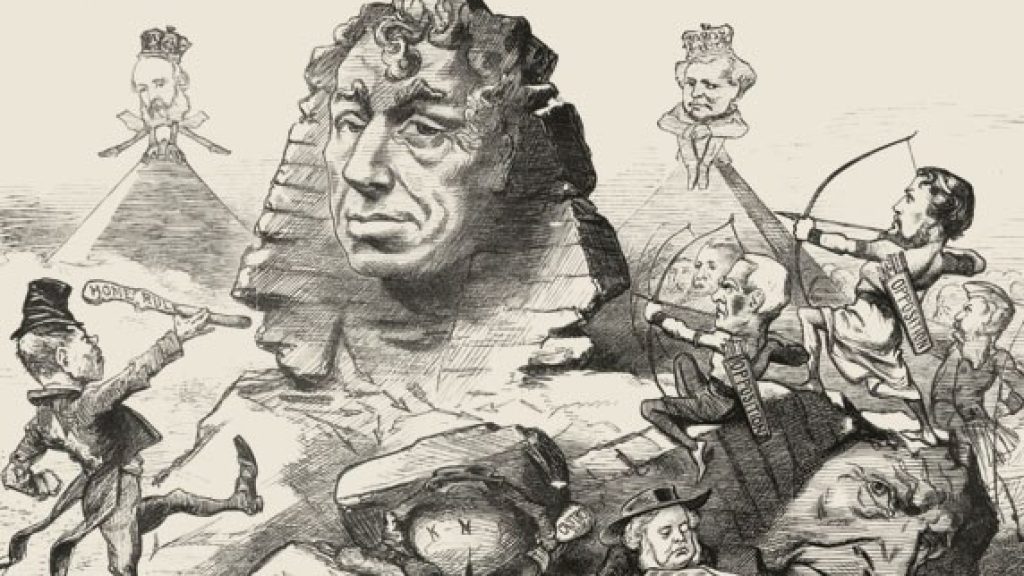
In locating Disraeli within modern Jewish history, the late David Cesarani engages with a tradition that he traces back to Hannah Arendt and Isaiah Berlin, who placed Disraeli’s Jewishness at the heart of his private life, his novels, his political thought, and his career as a politician.


Comments
You must log in to comment Log In