Angels, Chickens, and the Debris of History
“I’m cured of Walter Benjamin,” I said to a friend, standing in front of Paul Klee’s Angelus Novus at the Bode-Museum in Berlin last June. It was my third day watching people come and go, observing, discussing, contemplating the mythologized “Angel of History” that Walter Benjamin bought at a Munich street fair in 1920 or 1921 for the equivalent of $14. I had tried to see Klee’s angel for years, traveling to Jerusalem three times, asking for it to be brought out from the storerooms below, but unlike my conversion rabbi who acquiesced after three tries, the museum did not. The timing never worked. So I waited, patiently, for years.
When my friend told me it was going to be displayed, I booked a plane ticket and reserved a room three blocks away, not stopping to think about my relationship to Germany, or Berlin. The first time I visited Berlin, my ex-partner’s family had summoned us to the kitchen table to discuss the ethical implications of traveling to Europe. A detailed itinerary was drawn up for us to follow: the Memorial to the Murdered Jews of Europe, the Topography of Terror museum, the Jewish Museum Berlin, Platform 17 Memorial at Grunewald Station, Vienna’s Judenplatz Holocaust Memorial, and Prague’s Holocaust Memorial in the Pinkas Synagogue, followed by a day trip to the Theresienstadt concentration camp before flying home. This time I was on a different sort of trip, traveling throughout Europe to give talks and see friends. At least that is how I thought about it, all while knowing that I was also going to Warsaw and the Jewish Festival in Krakow before attending a conference at Auschwitz to mark the eightieth anniversary of the liberation of the camps.

At each stop along the way Auschwitz became the inevitable topic of conversation. Sitting at a café in Oxford a friend asked: “Who’s funding it?” Another: “There’s no way to prepare.” Another: “I don’t think anyone should go.” I wrote to a friend and asked which books I should take with me: a siddur and Yerushalmi’s Zakhor: Jewish History and Jewish Memory, he wrote. I packed both.
When I arrived in Berlin the three-winged museum rising up out of the banks of the Spree was dramatically draped with a print of Benjamin’s angel, making it look as though the city itself were being put on trial. Inside the museum, Klee’s little monoprint, only slightly larger than an ordinary sheet of paper, was suspended between two portraits hung on opposing walls: one of Benjamin taken by Gisèle Freund at the National Library of France in 1938, and a print of Albrecht Dürer’s woodcut Melencolia I from the sixteenth century, making it look as though the angel were rendering a judgment on Benjamin. For Benjamin, melancholia reflected a certain acedia of the heart; a failure of self-sovereignty, an inability to see one’s own desire through to completion. It was the proud badge of worn-out left-wing revolutionaries who refused to give up their losses, clinging to defeat at all costs, triumphing in being the losers of history.

It is fair to say people visit Klee’s angel not because of the work itself but because of Benjamin. To feel some proximity to the man, the patron tzaddik of overlooked academics who want to take refuge in the idea that, like Benjamin, their failure is only testimony to the fact that their hidden genius might not receive recognition or fame in this lifetime. Accordingly, the show presented Klee’s Angelus Novus not as a work of art—we’re never told its materials, “oil-transfer drawing and watercolor on paper on engraving on cardboard” over a copper engraving of Martin Luther—but as an artifact of history. After Benjamin bought the work it traveled with him from apartment to apartment for most of the next twenty years, while also spending some time with his friend Gershom Scholem in Jerusalem, a place Benjamin himself refused to visit. When he fled Paris in 1940, he left it in the hands of George Bataille to hide in the National Library of France with his Arcades Project. In 1921, Scholem wrote a little birthday poem for Benjamin inspired by the artwork:
My wing is ready for flight
I would like to turn back. If I stayed
timeless time,
I would have little luck.
This poem in turn inspired Benjamin’s famous ninth thesis in his “Theses on the Philosophy of History,” a collection of fragments he likened to a “bouquet of whispering flowers” written after he escaped a French internment camp:
A Klee painting named Angelus Novus shows an angel looking as though he is about to move away from something he is fixedly contemplating. His eyes are staring, his mouth is open, his wings are spread. This is how one pictures the angel of history. His face is turned toward the past. Where we perceive a chain of events, he sees one single catastrophe which keeps piling wreckage upon wreckage and hurls it in front of his feet. The angel would like to stay, awaken the dead, and make whole what has been smashed. But a storm is blowing from Paradise; it has got caught in his wings with such violence that the angel can no longer close them. The storm irresistibly propels him into the future to which his back is turned, while the pile of debris before him grows skyward. This storm is what we call progress.
After the war, which Benjamin didn’t survive, Bataille gave the painting to Theodor Adorno, and when Adorno died in 1969, it returned to Scholem in Jerusalem. When Scholem died in 1982, his widow bequeathed the angel to the Israel Museum in Jerusalem.
Caught in the storm of progress, blown back into the future, the angel stares out at the rubble of history mounting at its feet. Or at least he does on Benjamin’s entirely idiosyncratic but now canonical reading.

Inside the museum the angel is staring at the exit sign, perhaps like me, looking for a way out. Standing in the middle of the museum in Berlin, I was tempted to turn back, straight through the heavy wooden swinging doors that slammed a little every time someone walked in or out. But I stayed, looking, making little notes:
There are thirteen folds in the painting. It’s funny how he appears to be wearing a skirt. There are five finger tips. A string is wrapped between them extending from the middle of the pinky and ring finger to each hand, like he’s playing a game of Cat’s Cradle. There are darker bits of ink along the string. Is it a kind of rosary?
In the middle, a pale patch of orange with something like a fishhook hanging down from the middle of the string, forming an X in the middle, almost looks like a church.
No care has been given to his feet. Four toe points on the right foot and only three on the left. He has chicken feet!
His upper lip touches his nose, his lower lip is split, rounded. His hair unfurls in ten scrolls. What are they? Reminds me of Simchat Torah, and rolling the scroll back to the beginning.
His left ear is bigger than his right ear. The colors are darker on the left. A pale November palette. He looks a bit like a lion with a beard, his head composed of cylinders, his almond shaped eyes, his nose a Fleur-de-lys column. He is jagged, uneven, pointy. Four little peaks fill out his arms and his legs can be seen beneath his skirt, which has a slit down the middle.
Klee laid the water color over the black portrait of Martin Luther.
I watch people tilt their heads to the right, reflecting the off-set balance of the angel’s torso. One man sets off the alarm by crossing the line to capture a photo. Another laments, “He is too small to be the angel of history.” A potbellied man twiddles his thumbs and sighs, “Ah da is da.” A middle-aged woman in a long black skirt scurries up to the painting, bows her head and makes the sign of the cross, turns around and scurries back out, offending, no doubt, both Walter Benjamin and Martin Luther. An elderly gentleman unfolds a portable chair, sits down, and then stands folding it back up: “It’s not much to look at,” he sighs. I feel a sense of solidarity with his disappointment and wonder why I haven’t brought a chair.
Behind the painting, a television screen plays Wings of Desire,Wim Wenders’s 1987 film about two angels who watch over a divided Berlin. To the left of the screen is a re-creation of Caravaggio’s 1602 masterpiece Saint Matthew and the Angel, which was destroyed in 1945 alongside 434 other artworks in a bunker fire in Friedrichshain. “From 1943 until the end of the war, Berlin was bombed with increasing intensity by the Allies. The German capitulation on 8 May 1945 did not put an end to the destruction,” the placard next to it read. A scene from Jean-Luc Godard’s Weekend flashed in my head: “My Hermes bag!” a woman shouts while climbing out of a flaming car crash, watching as her husband and purse burn in the wreckage. “Our Caravaggio!” the exhibition seemed to shout.

On my last day at the museum, I decided to retitle Klee’s painting “The Chicken of History.” Standing face-to-face with this truly terrible piece of art, I felt as though I could see Benjamin clearly for the first time, without the mask of a prophet or the halo of martyrdom.
The end of my journey hung over the trip the way the painting hung over Berlin. I had never wanted to go to Poland. It was never on my list of pilgrimages to make.
On my first day at the Krakow Jewish festival, I signed up for a tour of the old Jewish quarter, which is different from the newly fabricated old Jewish quarter, where Hebrew and Yiddish are painted on street signs, and every five minutes a golf cart with tourists on their way to Schindler’s factory whizzes by, leaving alarming sound bites: “the liquidation of the ghetto,” “arbeitslager,” “resistance.” When the tour was finished, I asked the guide if I could buy him lunch to ask a few questions, and he kindly agreed, inviting me to attend the klezmer concert that evening in the old shul.
I had assumed that because his name was Adam, he was wearing a kippa, and he had invited me to shul to listen to klezmer music that he was Jewish, but when I got there he told me that he wasn’t. He told me his grandfather had been in the Wehrmacht, that he had been forced to join and wasn’t a Nazi. He told me that there was a difference between the Nazis and Wehrmacht. I started to argue that it was more complicated than that but quickly gave up.
The next afternoon my friend arrived from the United States, and we called a cab to take us to Auschwitz, which is about an hour away from Krakow. We told the driver we were going to a conference at Auschwitz, and he corrected us quickly: “Auschwitz is its German name; in Poland, it’s Oswiecim.” Later, as we neared Auschwitz, the driver drew our attention to the amusement park Energylandia, which is located twenty minutes outside the camp. “It’s the number one roller coaster park in Europe!”
When we arrived, it was already dark. The newly built hotel sat next to the entrance, the back of it overlooking Auschwitz. After checking in we made our way upstairs to our room, which looked and smelled like a well-appointed dormitory. The next morning we had to be up early for our guided tour of the camp before the conference began.
Passing beneath the small, narrow, arched sign, Arbeit Macht Frei, we were not confronted with the debris of history. No, instead, imagine a neatly manicured New England college campus, with red brick buildings and courtyards surrounded by gardens and woods. And in front of each building there is a placard, but instead of reading “English Department,” it says something like, “This is where Dr. Mengele performed his experiments.” I’d never thought of the camp as a campus, but now I saw why Primo Levi had called Auschwitz a perverse social laboratory, why Tadeusz Borowski presented it as a world of routine tasks where people learned procedures the way students learn their class schedule. And I finally understood what Hannah Arendt had meant by the banality of evil. The horror comes from how ordinary it appears. Banal was meant to amplify evil, not diminish it. To liken Auschwitz to a New England college campus is an obscenity, and yet, to the eye, that is what it resembles. It was not how I imagined it.
As we approached the end of our tour, the guide stopped one final time and pointed out the house from The Zone of Interest. Looking more than listening, I caught the end of her sentence, “. . . no Polish SS” My head snapped around. “Excuse me. I’m sorry,” I said. “Did you just say there were no Polish Nazis?” “Of course not,” she said. “There was no Poland!”
I felt foolish. I had spent most of my adult life studying German Jewish intellectual history, but nothing could have prepared me for the abyss between imagination and reality.

I knew that Auschwitz and Birkenau were two separate places. Auschwitz was the administrative center and Birkenau was where the Nazis, Polish and otherwise, executed the Final Solution. But one says “Auschwitz-Birkenau,” so I was unable to hold them apart in my mind until we were boarded on buses and drove for ten minutes to the other side of town. As we climbed on board, the guide said, “We will drive, but the prisoners would have been forced to walk.” When we arrived and stepped off the bus, the guide pointed across the parking lot: “This is the arch from Schindler’s List . . . Though the train would have come from the other side . . . Inside you’ll find restrooms if you need them before we begin.” Once everyone was assembled, she led us down the gravel path that cut through the middle of the field. “This is where the trains stopped,” she said, “and this is where the passengers would have been taken off and sorted.”
Standing there, my friend and I spun around three hundred and sixty degrees, taking in the low field of chimney stacks left intact where the buildings had once been. Away, in the distance, was a tree hedge; there, we were told, the killing fields continued on. Only one sentence ran through my mind, over and over again. I looked at my friend and said it aloud: It is not the same. “No,” she said. “It is not the same.”
You cannot make the incomprehensible comprehensible, and “genocide” is a poor word to capture the magnitude of Birkenau, the impossible, inhuman scale. The sheer size of the camp leaves one feeling untethered to anything real.
The exhibition at the Bode-Museum had seemed to lament the lost and ruined angels of Berlin as victims of unnecessary bombings with a kind of unfocused animus. Here, it mirrored the animus I felt in Auschwitz. Two ways of forgetting.
At the conference that day, subjected to the inanity of academic lectures in which some professor sketched a matrix to solve two or three insoluble theological-political problems, I was reminded of why I’d left academia. Is it possible to perform moral mastery while sitting inside a concentration camp? The quality of the talks was so bad that I aged forty years into the future and became the heckling woman in the back row.

Between the panels we were invited to the lobby of the conference hall for coffee and cookies. Making my way around the high-top tables while listening to the careerist intellectual small talk, I almost forgot where I was—until I looked up. The room in which we had listened to the lectures was windowless with stadium-style seating, but this room looked out onto the camp, with its barbed wire and red brick terror. As we left the conference that day, my friend and I hesitated before boarding the buses that were taking us to dinner nearby and decided to walk the long way back to our hotel room in Auschwitz instead.
That night I took a lesson from Hannah Arendt, who never suffered academics gladly, and decided to leave the conference early. My friend and I sat on the floor of our hotel room and traded gossip like teenage girls at a slumber party, until we remembered where we were. “Maybe,” she said, “we’re talking about love because it is the only thing that can possibly keep away the darkness around us.” Maybe love is the minimum resistance to the surrounding forces of darkness, which is why it is so rare and hard. I packed my suitcase and put it by the door.
The next morning, I got dressed to leave and bent down to put on my black sneakers. They had turned white with the dust of Birkenau from the day before, and I couldn’t bring myself to put them on. I left the shoes inside the room and made my way downstairs to meet the taxi driver who would take me to the Krakow airport.
It was only a week later, when I returned to California, that I began having nightmares, which is one way of remembering.
As for the Angel, it is still caught in the storm of progress, now in New York City. Another place Benjamin never wanted to go.
Suggested Reading
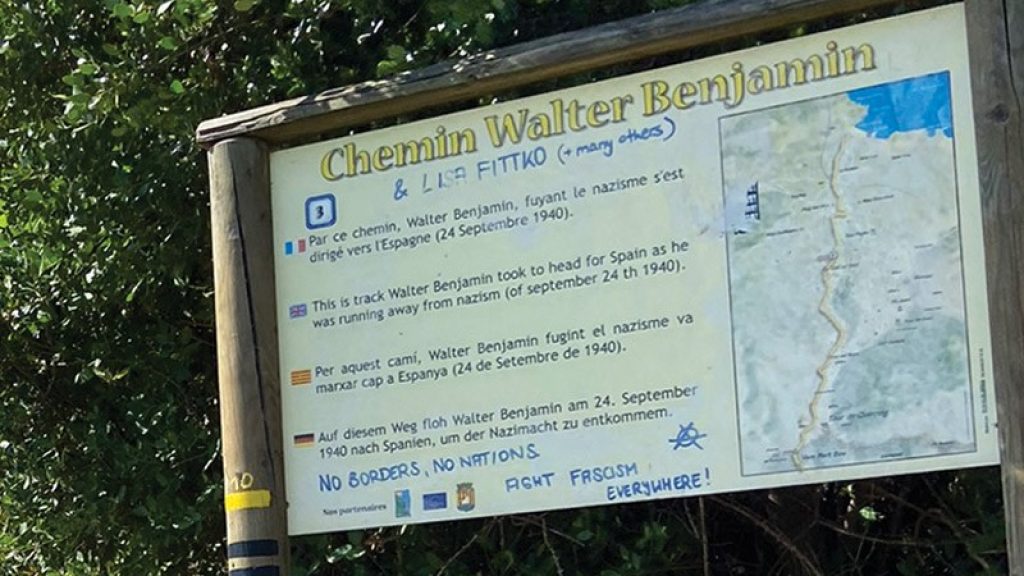
Walking with Walter Benjamin
On losing one’s self in Walter Benjamin’s final wanderings.
MAD Maus
A look inside the making of Art Spiegelman's classic graphic novel about the Holocaust.
Red Rosa
A newly published collection of letters shows a new, softer side of Rosa Luxemburg.
The Founder of Jewish Studies
In 1818, a 23-year-old university student named Leopold Zunz published a 30-page essay with the modest title “On Rabbinic Literature.” He could scarcely have imagined his impact.
Comments
You must log in to comment Log In