Davening with Tevye
Like every Jewish male, Tevye the Dairyman—the real Tevye, not the star of stage and screen—is obliged to pray three times a day: morning, afternoon, and evening. The latter two services, especially when davening alone, are brief and bare bones. Tevye knows both by heart, because even before he began delivering his dairy goods by horse and buggy, he eked out a living hauling logs through the forest. The forest is his second home, and he feels comfortable praying there. As for the choreography, only at three identical points in the service must one stand still and recite the Shemoneh Esreh, the eighteen blessings, in silence. Saying these prayers comes as naturally as breathing to a Jew like Tevye.

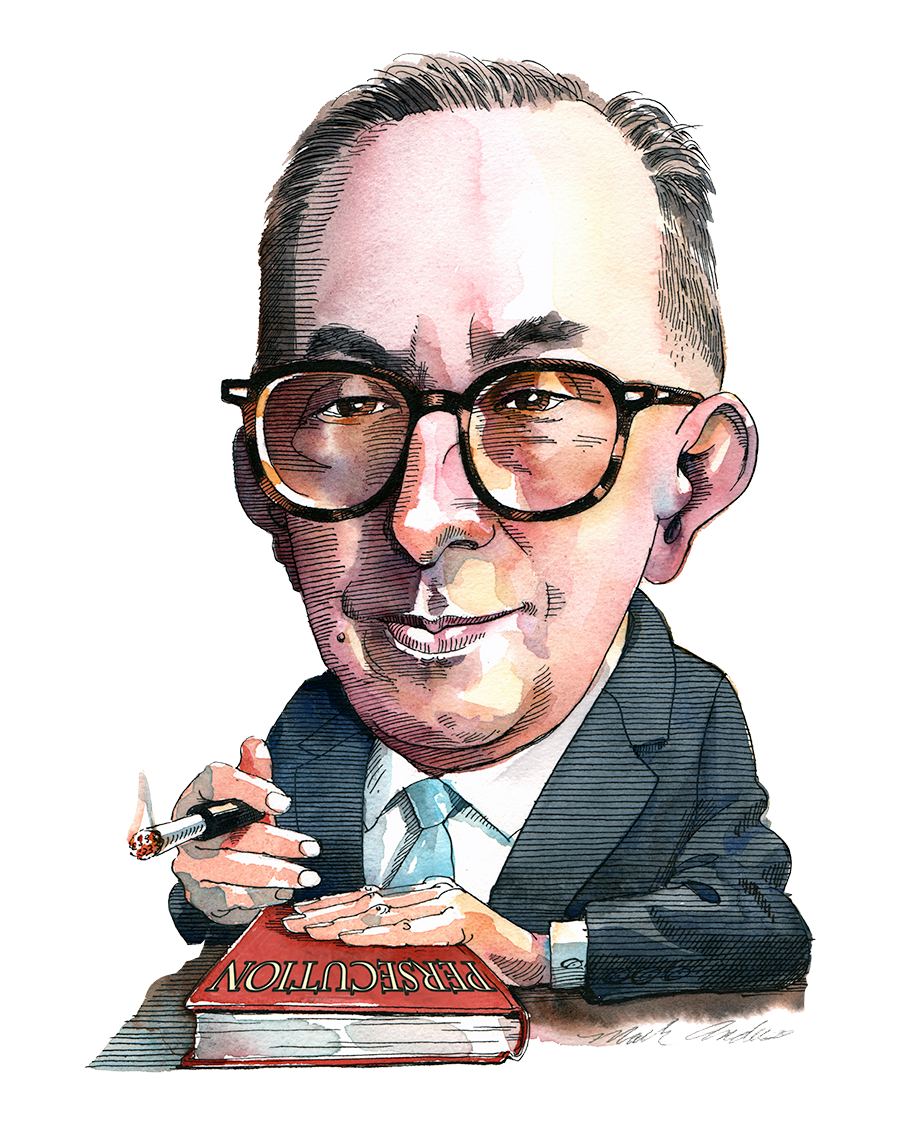
Illustration by Mark Anderson.
Tevye is what I would call a Homo Davenus, a person who loves to pray and doesn’t need a minyan or a fixed schedule to do so. His soul is always full to the bursting point. (Did I mention that he has seven daughters to marry off and a brief against the rich of this world who live off the fat of the land?)
Making his way home one late afternoon after a hard day’s work in the first of the Tevye monologues, he stops by the roadside for Mincha and feels a surge of pent-up emotion. But at the very point when he reaches the Shemoneh Esreh, which cannot be interrupted, his horse bolts, and instead of standing silently on the spot, Tevye is forced to continue—on the run! This somehow makes it easier for him to let it all out, to pray out loud as if he were repeating the Shemoneh Esreh in singsong in front of a congregation, but also to paraphrase, to amplify, to improvise, and to interpolate words of his own, some of which border on sacrilege:
Mekhalkeyl chayim bechesed—He who sustains the living with loving-kindness [he repeats the precise meaning in the word-for-word translation that he learned as a child], umekáyem emunásoy lisheney ofor—and keeps his faith, even with those who lie deep in the ground and bake bagels. Oy, I think to myself, do they ever lie underground! Oy, do they suffer. Not like those, for example, the rich folk from Yehupetz [Kiev], I mean, who sit the whole summer long in their dachas, eat and drink and bathe in luxury. Oy, God almighty, why do I deserve this? I am, think about it, a Jew like every other Jew. Help, dear God, Re’ey no ve’onyenu—Look, I say, take a good look at how hard we’ve gotta work, and stick up for the poor folk, alas, for who else will consider their lot, but You? Refo’eynu veneyrofey—send us the cure, the sickness we’ve got already.
I was fifteen years old when I first had this text in front of me, a school edition of the Yiddish original in one hand and my Shilo Siddur in the other, trying to make sense of Tevye’s prayers. At the Jewish People’s School in Montreal, the main exposure we had to religious life in the shtetl were I. L. Peretz’s neo-Hasidic tales and Sholem Aleichem’s bittersweet stories set on Jewish holidays. For all that Sholem Aleichem’s Motl was the son of Peysi the Cantor, the only prayer he knew by heart was the Kaddish. Motl, in fact, was our hands-down favorite, a child of nature who embraced freedom as his natural right. Here, with Tevye the Dairyman, both we (and Sholem Aleichem for that matter) were making a quantum leap, because Tevye’s rounds afforded him the mental space to interpret the prayers to fit his own life. What’s more, Tevye was a walking encyclopedia of Yiddish folk speech. We were expected to know, for instance, that lying in the ground and baking bagels was the Yiddish equivalent of dead as a doornail.
To understand how Tevye was pleading with God, arguing with God, talking back to God, I had to figure out where exactly he was crossing the line. Obviously, he understood the meaning of the liturgical Hebrew a whole lot better than I did. Each gloss, paraphrase, and personal commentary was exactly, if idiosyncratically, on point.
I did wonder, though, how Sholem Aleichem could have expected his readers to follow along if they were no longer davening every morning—if they, like me, were living in the secular world. How could they understand what was going on without a Shilo Siddur in their hands?
Tevye’s constant backing-and-forthing between liturgical Hebrew and earthy Yiddish speech was funny. The syncopated rhythm of his monologue was entertaining. And theologically, I eventually realized, this was Judaism Lite, since Tevye skipped all mention of resurrection, repentance, and forgiveness, of rebuilding Jerusalem or the messianic kingdom to come. He emphasized instead those words and formulaic phrases that could address the pressing needs of the present:
Ov horachamon—merciful, caring Father! Shma koleynu—hearken to our voices. Chus verocheym aleynu—take pity on us, on my wife and children, poor things, they’re hungry! Retsey—find favor, I say, in your beloved People Israel, as in days of yore, when the Holy Temple stood, with the Priests and the Levites.
Tevye moved seamlessly from “our” to “my” and from a care of his loved ones to the glories of the mythic past. He was Sholem Aleichem’s true ba’al tefillah, master of prayer, even though readers never saw him stand before a minyan of Jews.
Tevye quoted liberally from the ancient sources, even though he was no scholar, and was an incorrigible optimist, even though he graduated from the school of hard knocks. Rote repetition made it easier, even imperative, for Tevye to free associate, to insist on his right to dialogue. And it didn’t matter if sometimes he overstepped the limit, because God, like Mr. Sholem Aleichem, Tevye’s most valued customer, was a compassionate and careful listener who never talked back.
Suggested Reading
The Jewish Critic and the Devil’s Point of View
We have never met this Mendele before, but he expects us to trust him, appreciate his wit, catch his references, and share his attitudes. In a few deft lines, the author created a figure so democratic you don’t have to look up to him, so familiar you don’t have to fear him, and so appealing you won’t realize you’re being flogged.
Tradition! Tradition!
Wonder of wonders! One of the most beloved musicals ever created far outstripped its own creators' expectations for its success.
Live Wire
Bellow’s not so innocent knock in The Adventures of Augie March is generally taken as the moment when Jews barged into American literature without apology.

The Golem of Montreal
The famous golem of Prague was invented by a forger, faith healer, amulet salesman–and the most enterprising kosher chicken slaughterhouse supervisor of Montreal.
Comments
You must log in to comment Log In