“Alone Like Us, Perhaps”: Rereading an Ambivalent Masterpiece
A small group of Jewish students try to enter a lecture hall when they are met by a larger group of fellow students, who taunt them and block their entrance. Later, another group of Jewish students is yelled at and pelted with balls of paper until they leave the classroom. In other incidents around campus, fistfights break out between Jewish students and their non-Jewish peers—shirts and hats ripped, insults hurled, some blows exchanged.
These eerily resonant scenes are from Mihail Sebastian’s autobiographical novel For Two Thousand Years, which was published in Romania in 1934 and skillfully translated into English by Philip Ó Ceallaigh in 2016. Sebastian survived the Holocaust only to be killed in 1945 by a bus as he was crossing the street to teach a class. His novel tells the story of a young Jew like himself in 1930s Bucharest, struggling between tradition and modernity, between communal obligation and intellectual pursuits, and between assimilation and antisemitism.

Sebastian—born Iosif Mendel Hechter—was just twenty-seven when he published the novel, and he worked as a lawyer until he was forcibly moved to a ghetto during World War II. The contemporary Jewish Romanian writer Norman Manea has described Sebastian as a “Jew who had become entirely assimilated, an exceptionally literary man devoted to Romanian culture.” In these interwar years, Bucharest was called the “Little Paris of the East,” and Romanian literature and philosophy thrived. Throughout the 1930s, Sebastian was a member of a literary group called Criterion, to which he clung even as it grew violently antisemitic.
Perhaps because Romania became a global afterthought while under Soviet control, Sebastian’s novel was largely forgotten until its English translation in 2016. It is worth rereading not only for its portrait of an antisemitic culture but for its delicate modernist probing of the inner life of a Jewish artist in crisis.
Like Sebastian, the nameless author of the journal we are reading yearns to gain acceptance to modern European society. As a student at a university in Bucharest, this new path is obscured to him at every pass since he “stands at two removes from the active game of existence; firstly as an intellectual and secondly as a Jew.”
At university he faces brutal antisemitic beatings by fellow students and wishes he “could overcome two thousand years of Talmudism and melancholy, and recover—supposing one of my race has ever had it—the clear joy of life.” He is deeply troubled by his supposed obligations, believing that “there is too much devotion in the Jewish family.” And he detests his coreligionists: “I’m always on the brink of shouting out a coarse word, just to show that even though I’m in the midst of ten people who believe me their ‘brother in suffering,’ I am in fact absolutely, definitely alone.” In one of the most striking lines of the novel, he wonders: “Does not ‘God is one’ mean that God is alone? Alone like us, perhaps.” Of course, his contradictory view—invoking belief while renouncing communal obligations—is one of the many ironies of the book.

When he visits his hometown, the Jewish shopkeepers “salute me loudly, each from his own shop, with discreet knowing nods.” They’re excited to see someone who has been attacked for his Judaism, but the narrator rejects the solidarity of victimhood. The truth is he was recently attacked, but, as he wryly records in his diary, “I took eight pages of notes. Good value, for two punches.” And yet this humor is neither brave nor subtle; it’s delusional.
At the Jewish dorms, the narrator watches as his fellow students return from campus, “in dribs and drabs, or singly, worn out. And each one grimly enumerates the fights he’s got into, like a billiard score, so that a competitor won’t steal their points.” The inspiration for the narrator’s near-reckless denial of the situation on campus, even as he describes it, mirrors Sebastian’s own reluctance to acknowledge the changes going on around him. Throughout the 1930s, fellow members of the Criterion group joined the fascist and violently antisemitic Iron Guard, including Mircea Eliade, who would go on to become a leading scholar of religion. Still, as late as 1935, after he had published the novel, Sebastian was still trying to cling to the life he had tried to build for himself in Bucharest.
For most of his adult life, Sebastian kept a journal whose early entries were apparently the source material for the novel. When the journal, which had been smuggled out of Romania to Israel by his brother in 1961, was finally published in 1996, it caused an intense backlash in Romania for its unsparing documentation of Romanian antisemitism. In one passage, Sebastian writes about an argument he had with his fellow playwright Camil Petrescu, one of the “finest minds in Romania,” about an antisemitic attack that had just taken place in June 1936: “It’s regrettable, old man,” Petrescu says. “But all Jews have a responsibility for it.” “How’s that, Camil?” Sebastian asks. “Because there are too many of them.” But the diary, like the novel, is also filled with entries about concerts he attended and his travels and infatuations, romantic and intellectual.
In one scene in the novel, the narrator and his Jewish friends decide that they must change tactics and agree to walk into their lecture hall as a group to minimize the risk of harassment. Later, the narrator asks to have himself removed from a list of Jewish students who were beaten: “I don’t think I received more than two blows and, more to the point, Mama doesn’t need to find out.” His people make him cringe, yet he stands in solidarity with them; he finds Jewish families suffocating but doesn’t want to worry his mother. He muses, “One day—who knows—we may make peace with the anti-Semites. But when will we make peace with ourselves?” This ambivalence is never resolved. One might almost say that the subject of this novel is the story of his ambivalence.

While studying law, the narrator becomes entranced by a charismatic existentialist professor he calls Ghita Blidaru, despite, or perhaps because of, his antisemitism. The notes he takes from the lecture read: “Haven’t they always told us we’re a dirty people? Maybe it’s true. Perhaps our mysticism, our asceticism, our piety is just that—dirtiness. A way of getting . . . ever further from the white star of purity.” Ultimately, he follows Blidaru’s advice to abandon law for architecture, a less esoteric field, which is closer to the physicality of life. Less Jewish, one might say. “You resemble a stonemason,” Blidaru admiringly tells him. Sebastian’s model for Blidaru was the philosopher-journalist Nae Ionescu, who became the intellectual guru of the Romanian nationalist right.
Sebastian asked Ionescu to write the preface to For Two Thousand Years. Ionescu seized the opportunity. Addressing him by his given Jewish name, he wrote:
Iosef Hechter, the Messiah has already come and you did not know him . . . because pride put scales in your eyes. . . . Iosef Hechter, do not you feel how the cold and the darkness overwhelm you? . . . Judah suffers because it must suffer.
Whatever anguish this caused him, Sebastian published the screed with his novel.
Sebastian’s alter ego is also characteristically agnostic about the Zionist cause, neither a fanatic about Jewish self-determination like some of his friends nor openly hostile like many of the elders of the community. One such is Abraham Sulitzer, an old bookseller who carries his tomes “in the service of their eternal lives.” Sulitzer becomes the voice of defense for Jewish diaspora in the novel:
Two thousand years? Do you think Zionism has something of those two thousand years in it? Do you think that these boys of Jabotinski’s who wear boots and salute each other like soldiers, who ride bicycles on Saturday and can say “Give me a cigarette” or “Let’s go to a football match” in Hebrew—do you think these boys have anything in common with those two thousand years of our blood? Two thousand years through flames, through disasters, through wandering come to us through the history of the ghetto. It’s a history lived under lamplight. “We want sunshine,” they shout. Good luck to them—and let them become footballers. They’ll get plenty of sunshine then. But this lamp by which I’ve read so many hundreds of years, this lamp is Judaism—not their sunlight.
The narrator’s Zionist friend responds to the bookseller’s angry eloquent soliloquy on booted soldiers versus bookish scholars with the easy contempt of the young: “You’re old, Mr. Sulitzer. That’s why you talk like that.” To which he replies, “I’m not old! I’m a Jew—that’s what I am.” Sebastian himself couldn’t decide what a Jew was, or whether he wanted to be one, though he eventually knew that he did not have a choice.
Suggested Reading

Manea’s Shadows
Norman Manea's Judaism turned out to be the hinge to his career, if not the whole door.
Romania!
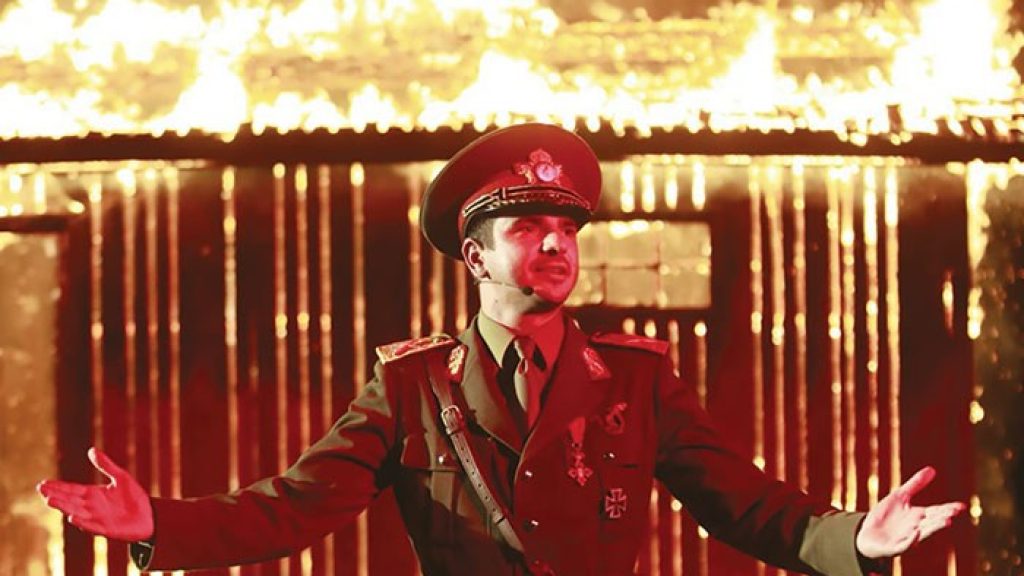
“I Do Not Care if We Go Down in History as Barbarians” is a reenactment; the quotation marks are part of its title, suggesting just how meta this film becomes. It steps back one more level into the minds of the people doing the reenacting.

Remembering Harold Bloom
As Harold Bloom's student, I wanted to be transported to the heights of the literary sublime where he always seemed to reside, whatever the cost (it seemed considerable).

Blocked Desire
The Tunnel, A. B. Yehoshua’s most recent novel, written as he moved into his eighties, does not exhibit any traits of what some literary critics have called “the style of old age,” but its unusual subject, incipient dementia, is patently a concern of old age.


Comments
You must log in to comment Log In