When Juliet Became Jael
In the closing years of the twentieth century, the cognitive scientist Douglas Hofstadter circulated a sixteenth-century French love poem to friends, students, colleagues, and translators around the world, asking them to render it in English. The result was Le Ton beau de Marot: In Praise of the Music of Language, a brilliant musing on the creative possibilities of language. Each chapter begins with one of the many translations he solicited for this playful twenty-eight-line love poem, exploring how it conveys—or falls short of conveying—the sweet tone, tight form, and romantic meaning of Clément Marot’s original.
Now Daniel Hahn has written his own homage to the joys and challenges of literary translation, focusing on a far better-known sixteenth-century poet whose work has been rendered in countless languages around the world. In preparation for If This Be Magic, he tells us that he ordered every affordable edition of a Shakespeare translation he could get his hands on: “Then one day, through the letterbox, came a Hebrew translation of . . . what? I don’t know any Hebrew.”
Undaunted by his lack of familiarity with most of the many languages into which Shakespeare has been translated, Hahn befriended more than a dozen of the leading translators of the Bard around the world, working with them to understand the choices they made in rendering Shakespeare in their own languages. In a book filled with quotations from Shakespeare in Japanese, Hungarian, Swahili, and Turkish—to name just a few—Hahn demonstrates just how much can be gleaned from a text even if one doesn’t know the language. When quoting from non-Roman alphabets, he highlights repeated phrases and rhymes so that we can appreciate how, for instance, a Greek translator uses synonyms and lengthens lines to preserve the Bard’s rhymes. Even those of us (including Hahn himself) who can’t read Japanese can nonetheless see how a Japanese translator reworks Shakespeare’s pun in Merchant of Venice on “light” as signifying both “bright” and “not heavy” by deploying words pronounced karui (bright) and akarui (not heavy). “How many translators does it take to change a light bulb?” Hahn asks with his characteristic dad-joke playfulness.

One irony of reading Shakespeare in translation, as Hahn demonstrates, is that it is often easier to understand than the original. After all, “it is only those of us who live in English who are stuck with 400-year-old Shakespeare.” Although English has evolved since the sixteenth century, most modern translators try to re-create the accessibility of Shakespeare’s verse to his original audience rather than his now antiquated English. This is a choice with which Hahn emphatically agrees, even when it means chastising his own great-grandfather, who translated Shakespeare into an archaic sixteenth-century Brazilian in the 1930s. “There are ways of opening the door to the sixteenth century without having to commit wholesale to a funny olde voice,” he writes. In fact, he dedicates an entire chapter to translations of Shakespeare into contemporary English—not the “made easy” versions, which he scorns, but those that take advantage of the possibilities that contemporary idioms afford, including a hip-hop Romeo and Juliet (“I’m getting capped by a Capulet”).
Throughout, Hahn’s tone is one of a bold adventurer taking us along with him for the literary ride as he tours Elsinore Castle with Hamlet’s Danish translator, celebrates Shakespeare’s birthday at Stratford-upon-Avon, and sits in a café in Istanbul musing on Shakespeare’s depiction of a Turkey that he never visited. Hahn clearly enjoys the journey. At one point, he remarks that translation combines total reverence for the author—whose every word is deserving of one’s utmost attention—with near-blasphemous irreverence, since every word is replaced with another. In his book, too, Hahn combines reverence for his subject with an irreverent sense of the fun of his craft (and the craftiness of his fun).
The author’s awe at Shakespeare’s literary boldness occasionally inspires his own, as when he informs us:
For my own silly amusement, I might decide, for instance, to make the first letter of each paragraph at the start of chapter 9 spell out the word Shakespeare.
In addition to leaving his readers to flip through the pages excitedly to discover the treasures he has buried, he also peppers his text with witty wordplay while nodding to possible future translators about the difficulty they might present.

No matter what obstacles he or she might face, and no matter what linguistic compromises are made, no one, Hahn argues, knows a text as well as its translator. Although an ordinary reader might spend, say, ten hours with a novel, Hahn and his fellow translators spend months “living deep in the book’s guts.” He shows how translators read both closely and deeply to understand all the roles a particular word plays, only one of which is semantic. A word also has sonic and associative properties: It may be short or long; it may have Latin or Anglo-Saxon roots; it may or may not have “polysyllabic poetic grandiosity.” Sometimes the goal “is not exactitude of meaning, but equivalence of effect.” Thus, a translator may render the same Shakespearean word that appears in two different contexts in two different ways, depending on how it must sound and rhyme and what it must connote.
In a chapter on gender, Hahn notes that one of the many challenges of translating Shakespeare is that English is not a very gendered language. He recounts the familiar experience of being several pages into a novel without yet knowing the gender of the speaker. A Spanish translator would have had to give up this information in the first few lines. Sometimes the ambiguity is maintained indefinitely in English; Shakespeare’s sonnets are addressed to a lover who at times could be either male or female. Who is being compared to a summer’s day? Scholars now generally believe that the majority of the sonnets were addressed to a young man, but even the reader aware of the scholarly consensus reads the English poems as ambiguous, mysterious. That mystery cannot be retained in gendered languages. Indeed, while reading Avi Hasner and Gail Hareven’s 2011 Hebrew translation of the sonnets, I was disconcerted to find it immediately apparent that it was a man who was being compared to a summer’s day and that the “love remembered” that brings such wealth was actually the love of a man, not a woman.
As with most other languages, it took a while before Shakespeare appeared in Hebrew. Hahn notes in his introduction that even a full century after Shakespeare’s death in 1616, there were only a handful of translations of his plays into any language, most of them unpublished. In the eighteenth century, translations became more common, and in the nineteenth century, they proliferated, especially in French and German. Indeed, it is likely that the first partial Hebrew translations of Shakespeare were really “relay translations” from these German versions by members of the Haskalah (Jewish Enlightenment), who were inspired by the admiration of figures like Lessing, Goethe, and Schiller.
The first Hebrew translation of a full-length play from English was Isaac Edward Salkinson’s translation of Othello, Itiel ha-kushi mi-venezia (Ithiel the Cushite of Venice) in 1874. Salkinson’s Ithiel (an obscure biblical name he chose for its phonetic closeness to that of Shakespeare’s Moor), along with his later translation of Romeo and Juliet, Ram and Jael, were published in an excellent and informative bilingual edition by Lily Kahn, a professor of Hebrew and Jewish languages at University College London. As Kahn tells us in her introduction, Salkinson had a traditional Jewish education until his late teens, when he was “hiding at the house of an innkeeper . . . to avoid being conscripted into the czarist army” and was introduced to modern Hebraism by the enlightened innkeeper.
Having avoided the Russian army, Salkinson made his way to Vilna, where he studied Hebrew grammar and key texts of the Haskalah with an enlightened teacher. After he was spurned by his teacher’s daughter—he tried to win her over with a Hebrew translation of a Schiller play about a doomed love affair—he made his way to England in the 1840s. He was converted by the London Missionary Society, eventually becoming a Presbyterian minister and a missionary himself.
His new role led him to Vienna, where he met and befriended the Hebrew newspaper editor, novelist, and proto-Zionist Peretz Smolenskin. Learning that Salkinson had already translated Milton’s Paradise Lost into Hebrew (not to speak of Paul’s Epistle to the Romans), and despite his reservations about missionaries, Smolenskin saw a rare opportunity and commissioned a Hebrew translation of Othello and, a few years later, Romeo and Juliet. Neither play was translated for the stage, since there were no permanent Hebrew theaters until decades later; rather, Salkinson and Smolenskin (who wrote long, enthusiastic introductions to both plays) seem to have intended them for private reading in Hebraist circles.
This marks “a great victory for our holy tongue,” Salkinson wrote. Drawing on Othello’s themes, he described his first translation as a revenge on the British, who had plundered the Hebrew Bible and scattered it around the earth: “Today we repay them for their deed, for we are taking the books which are as precious to them as the Holy Scriptures, the plays of Shakespeare, and we are bringing them into the treasure-house of our holy tongue.” Apparently, despite the fact that he was a missionary, as translator, Salkinson saw himself as an agent of Jewish cultural renewal, expanding the Hebrew literary canon and celebrating the wide range of creative expression possible in a language that others insisted, so he wrote, was “bound for the grave.”
As Daniel Hahn demonstrates throughout If This Be Magic, there are inevitable trade-offs in translation; much is lost, but there are also gains. Salkinson’s translations are not exceptions. In Ithiel and Ram and Jael, he was focused more on plot and meaning than on poetry. Although he incorporated rhyme (which is relatively easy in Hebrew), Salkinson wrote in unmetered prose. But he enriched Shakespeare’s texts with biblical language and references.
In Salkinson’s version of the famous balcony scene in Romeo and Juliet, Ram invokes the Song of Songs in longing for Jael to say, “I am my beloved’s and my beloved is mine.” He wishes to be not just any glove upon her hand but the kid skins in which Rebecca dressed Jacob to trick Isaac. And when Jael sighs, Ram invokes the description of Hannah praying at Shiloh. Before dismissing such riffs and conceits as charming happenstance, it is worth remembering how much Shakespeare learned from the King James translation of the Hebrew Bible. Salkinson was, indeed, “repaying” the British and the Bard. Perhaps surprisingly for a Christian missionary, he further Judaized Shakespeare by using Hebrew terms for Christian concepts: Easter became hag ha-matzot and evening mass was rendered as bein ha-arbayim—the twilight hours when the second daily sacrifice was brought in the tabernacle.


Although Salkinson’s work as a translator of Shakespeare has long been surpassed, by, among many others, great Hebrew poets like Shaul Tchernichovsky, Leah Goldberg, and Nathan Alterman, his translations remain landmarks of Hebrew literary history. His achievement, not to speak of his literary revenge on the British, does not appear to have impressed his superiors at the British Society for the Propagation of the Gospel, who briefly suspended him before instructing him to return to the translation of the New Testament, which he did until his death in 1883.
It is hard to imagine, given the proliferation of Shakespeare translations in languages spoken around the globe, that his sun will ever fade. Take, for instance, the recent multilingual production of A Midsummer Night’s Dream in South Asia that Hahn describes. Each actor recited lines in his or her native tongue—giving each audience member a different experience of the performance, depending on their native language. “Retranslation of something as rich as Shakespeare isn’t just acceptable but necessary,” Hahn insists. Moreover, there is no such thing as definitive translation, and this is to be celebrated: “The fact that multiple translations exist, each processed through a different human brain . . . is a thrilling feature of translation, not a bug,” he writes.
As Kahn, Hahn, and the translators discussed in their pages all know, each translation breathes new life into the text. This, then, is the magic of Hahn’s title—that translations do not just broaden access to Shakespeare but also reanimate it, allowing us to appreciate Shakespeare’s work in its multifarious complexity. Waxing somewhat mystical, Hahn writes of the moment when we can “access the thing that’s beneath (or inside?) the language, and are not aware of the fact that we’re processing language at all.”
We can forget that we are reading a translation, just as we can forget, sometimes, that we are sitting in a theater watching a play, and suddenly, “all the world’s a stage.”
Suggested Reading
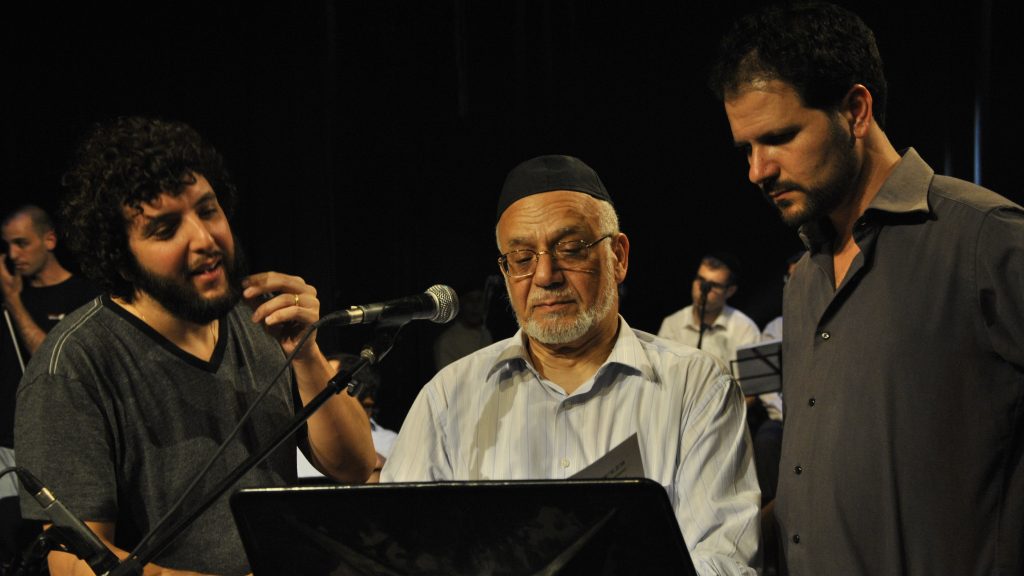
No Greater Love
The Israeli music scene is bringing together world-class Israeli jazz and classic Sephardic liturgical music. Voilà!: the jazz piyyut.

Setting the Table
“How will women’s proficiency in learning change family dynamics? . . . How will their sons view a woman’s capacity for rigorous study? Will women want a different sort of husband—one who is not threatened or intimated by an educated woman?”

Hidden Faces and Dark Corners: Megillat Esther and Measure for Measure
What happens when the hidden is revealed? Reading Megillat Esther alongside one of Shakespeare’s “problem plays” shows that question to be at the heart of Purim’s paradox.

Davening with Tevye
"Tevye moved seamlessly from “our” to “my” and from a care of his loved ones to the glories of the mythic past."




Comments
You must log in to comment Log In